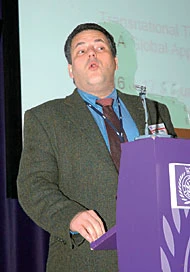
LONDON, 18 January 2006 — Prince Muhammad ibn Nawaf, the Saudi ambassador to the UK, pulled few punches in a speech to the Transnational Terrorism Conference here on Monday.
Setting the tone for the Kingdom’s stand on terrorism, he laid to rest any doubts about the linkage of terrorist acts and Islam saying that the corrupt and manipulative scholars who teach it “must be and are condemned.” He added, “We are determined to bring an end to this misuse of Islam.”
Prince Muhammad set out the long list of Saudi Arabia’s successes against local terror groups, the Kingdom’s moves against the transnational flow of finance and the clear assertions by Custodian of the Two Holy Mosques King Abdullah and the religious authorities on the moral and Islamic wrongness of terrorist activity.
“The battle against international terrorism is an international battle, not just a Saudi battle,” he said, “and we are doing all we can to play our part and encourage others to play theirs.”
Prince Muhammad identified the Internet as a major and actual source of potential recruits to terrorism. “At the press of a button we can communicate across our world to a dozen, a hundred, a million people. There are no Internet borders.”
He said that the government believed that any counterterrorism effort would not be effective unless it is part of a collective effort by the international community. To do this, the international community should promote international understanding and a better dialogue between civilizations, cultures, and religions.
Prince Muhammad believed that, as the Riyadh conference concluded, regional — referring to the Israeli/Palestinian conflict — and international conflicts which are exploited by terrorists and used for spreading their misguided ideology must be resolved adding that Iraq must not be allowed to become a breeding ground for terror.
Dr. Tarak Barkawi from the Center for International Studies at Cambridge University generated lively responses from the delegates in a challenging speech outlining the historical and philosophical elements of modern terrorist activity.
He suggested a link between on one hand colonialism and financial disempowerment and on the other, the seeds of terrorist activity in weak states. In particular, he pointed out the restrictions placed on Pakistan by the IMF in the 1980s. “This,” he said, “virtually eliminated access to the public education system for the poor. They subsequently sent their children to madrassas.”
Dr. Barkawi contended that at the core of North-South relations are histories of imperialism and colonialism which involved economic exploitation. “At the heart imperialism is political — it is about foreign control and influence over territories and populations.”
With the nominal independence of the Third World, he said that the mechanisms of informal control, indirect rule and such had been reinvented and adapted to the sovereign state system. The history of foreign control had generated another history, that of near continuous violent resistance, especially in the non-European world.
The West, he said, had to define itself in terms of itself against “the other” and as such, through the lens of “Orientalism,” imperialism for the West was not about domination and exploitation of others but a mirror reflecting its virtues, a civilizing mission or latterly spreading freedom and democracy.
As a result, said Dr. Barkawi, the West needed some humility if it was to begin to finding its way out of the serious and spiraling cycle of violence it was involved in.
“We need this humility not only to temper our righteousness but to realize just how vulnerable we and our societies are to terrorist attacks, and how fragile our liberal political systems are to the excesses of the war on terror.”