
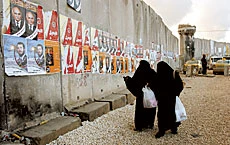
GAZA CITY, 19 January 2006 — Palestinian President Mahmoud Abbas said yesterday that he was open to fresh peace talks with Israel. He added that he might resign if the government formed after a Jan. 25 Parliament elections opposes his policies, including talks with Israel.
The Hamas group was expected to pose a strong challenge to Abbas’ ruling Fatah party in the election and earn a spot in the next government. A coalition government with Hamas would make it difficult for the two sides to restart long-frozen peace efforts.
“If I feel that I can’t fulfill this program...then the seat is not my ultimate ambition,” Abbas told reporters at his office in Ramallah, referring to his post as Palestinian president. However, he held out the hope that regardless of the election results, he would be able to pursue his peace plans.
“Who knows, Hamas may change its policy,” Abbas said. Abbas spoke a day after acting Israeli Prime Minister Ehud Olmert said that after the Palestinian poll and Israel’s March 28 election he hoped to begin negotiations that would lead to “a permanent peace agreement between us and the Palestinians.”
Olmert said he’d only resume negotiations if Abbas dismantles fighter groups after the vote. Abbas enthusiastically welcomed Olmert’s overture, but did not address a possible crackdown. “We will not hesitate to get into such a negotiation,” Abbas said. “The way to peace is to sit together at the negotiation table, not the path of killings and unilateral actions.”
However, the political situation on both sides is in flux.
Abbas’ Fatah party, plagued by corruption allegations, has been falling in the polls, while Hamas has gained support with its clean government campaign. Palestinian areas also have grown increasingly chaotic in recent months, calling into question Abbas’ control of his government and his ability to follow through on any commitments he might make in peace talks.
Local leaders of Hamas and Fatah in Gaza said yesterday they would cooperate to prevent violence on election day. They also said they would work together after the election.
Meanwhile, Israeli Prime Minister Ariel Sharon remained in a coma yesterday after suffering a massive stroke on Jan. 4, less than three months before elections that his new Kadima party was expected to win. With Sharon incapacitated, Olmert was seen as his likely heir. Olmert yesterday made a series of new Cabinet appointments to fill empty posts in a temporary government that will serve until the election. The positions were left vacant after the Labor Party pulled out of the government late last year and Likud ministers resigned Sunday.
In the new Cabinet, made up wholly of Kadima members, Justice Minister Tzipi Livni will also serve as foreign minister. Transport Minister Meir Sheetrit will also serve as education minister and lawmakers Roni Bar-On, Zeev Boim and Yaakov Edri will join the Cabinet as new ministers.
Several of the ministers said they did not expect Abbas to crack down on fighters after the vote. “He states explicitly that he will not do this. Thus it’s difficult to say when the negotiations on a final arrangement can start,” Cabinet Minister Tzachi Hanegbi told Israel Radio.
At the Cabinet meeting, Olmert also called for more concerted action by police and the military to restore law and order in the West Bank among unruly settlers, participants said. This followed violence by extremist Israelis against security forces in the West Bank city of Hebron. Olmert ordered up a comprehensive plan for removing all unauthorized outposts, a requirement of the road map plan that Israel has not fulfilled.
Meanwhile, 14 Palestinians were arrested across the West Bank yesterday morning including two who had been wounded before the arrest, witnesses and security sources said. Early yesterday morning, large numbers of Israeli troops stormed into Jenin under the cover of heavy and indiscriminate fire, forcing tens of families to leave their houses, witnesses said.
— With input from agencies

