NEW DELHI, 28 January 2006 — Custodian of the Two Holy Mosques King Abdullah yesterday concluded his four-day historic visit to India by signing a landmark declaration that committed the two countries to develop a strategic energy partnership.
The joint declaration, signed by the king and Prime Minister Manmohan Singh, said Abdullah’s visit, the first by a Saudi king in 50 years, “heralds a new era in India-Saudi Arabia relations and constitutes a landmark in the development of increased understanding and cooperation” between the two countries.
The declaration called for greater cooperation between the two countries to defeat terrorism. The declaration weaves together the new elements of an emerging strategic partnership reflecting India’s knowledge economy and its ravenous energy appetite and a changing Saudi Arabia looking eastward for fresh infusion of technology, skilled manpower and inspiration.
“Terrorism is a scourge of all mankind and there is need to intensify and coordinate bilateral, regional and global cooperation to combat and eradicate this menace,” said the declaration. “The signing of the memorandum of understanding between Saudi Arabia and India on combating crime will help in the fight against terrorism, extremism and criminal elements.”
Underlining the fact that it was not just rhetoric, the two sides backed a Comprehensive Convention on International Terrorism which is before the UN General Assembly, and agreed to set up an International Counter-Terrorism Center as suggested by the International Conference on Counter-Terrorism held in Riyadh in February 2005.
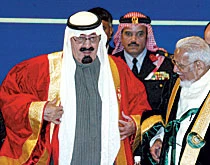
The radical transformation of Saudi-Indian ties was evident throughout the king’s visit, starting with Manmohan Singh going to the airport to personally receive the king, breaking protocol, the signing of three pacts on combating crime, investment protection, double taxation avoidance treaty, an agreement on promoting cooperation in youth and sports and the presentation of an honorary doctorate to the king by Jamia Millia Islamia.
The king was awarded the degree at a special convocation ceremony attended by over 10,000 invitees. The degree was given in appreciation of the king’s contributions to regional and international peace and development and for his efforts to promote Indo-Saudi ties.
King Abdullah thanked the university for conferring the degree on him. “Islam is a religion of mercy, love and benevolence. The criminal acts committed by a small extremist group have nothing to do with this great religion and its eternal principles,” Abdullah told the gathering.
Islamic universities should play a big role in explaining the true teachings of this religion, he said and urged Muslim youth to imbibe the spirit of Islamic faith, its tolerance and moderateness.
Since its inception in 1920, Jamia Millia Islamia has emerged as one of the leading institutions of higher learning in the country. Jamia, which has no minority character, was made a deemed university in 1963 and then declared a central university in 1988 by a special act of Parliament. It has currently on its rolls 12,000 students, including Saudis.
New Delhi made sure that the changing nature of the relationship was not lost on anyone, and accorded Abdullah, who arrived here Tuesday evening with a 250-strong entourage including senior ministers and royalty, the signal honor of being the chief guest at the Republic Day parade.
The development of a strategic energy partnership was another milestone during the king’s visit with Saudi Arabia, the world’s top oil producer that supplies nearly 30 percent of India’s crude oil, assuring India that it will continue to be “a trusted and reliable source of oil.”
Riyadh’s espousal of stability in the oil market and support for an Indian initiative to start a regional forum for dialogue among Asian oil and gas producers and consumers were significant pointers to this partnership.
The energy partnership will include reliable, stable and increased volume of crude oil supplies, through long-term contracts and cooperative and joint ventures, both in the public and private sectors, in the upstream and downstream oil and gas sectors in India and Saudi Arabia as well as in third countries.
Energy cooperation will also include Saudi investments in oil refining, marketing and storage in India and the setting up of Indo-Saudi ventures for gas-based fertilizer plants in Saudi Arabia.
India will assist in setting up an ICT Center of Excellence as well as institutes of higher learning in Saudi Arabia and encourage Saudi students to pursue postgraduate and doctorate level studies in technical institutions in India.
In a related development, Saudi Minister for Petroleum and Mineral Resources Ali Al-Naimi, who is accompanying the king, said oil prices were unlikely to fall in the near term because of factors beyond market control. “I have no control over prices. We accept that they’re high, and of course, we want them to come down,” Naimi told reporters. “But they’re not going to come down because there are many issues, (even though) supply and demand are balanced,” he said.
Saudi Arabia currently supplies nearly 175 million barrels of crude oil a year. “Oil companies of the two countries would decide a future increase in oil supplies from Saudi Arabia to India,” said Talmeez Ahmed of India’s Petroleum and Chemicals Ministry.
Analysts are bullish about growing Saudi-Indian ties. “The charm offensive before and during King Abdullah’s visit to India is part of a conscious decision to showcase a new political style that the House of Saud has now adopted,” said Indian Express columnist C. Rajamohan. “India must also recognize that King Abdullah is the first serious reformer the Saudi Kingdom has ever seen.”
“The joint declaration signed by the king and Manmohan Singh will open a new chapter in ties between Riyadh and New Delhi,” said Saleh Mohammed Al-Ghamdi, Saudi ambassador to India.
Before signing the declaration, King Abdullah was received by Congress party President Sonia Gandhi. The king also held wide-ranging talks with Sonia, Bhairon Singh Shekhawat, Indian vice president and Lal Krishna Advani, the leader of opposition.
“The talks focused on bilateral and regional issues with special reference to historical Saudi-Indian ties, which have once again been rediscovered,” Ghamdi told Arab News. “The meeting with Sonia Gandhi was very cordial and frank,” said Ghamdi, who expressed his happiness over the success of the royal visit.
E. Ahamed, Indian minister of state for external affairs, said the joint declaration reflected the “mutuality of interests as the two countries sought to forge alliance and find new ways and means to expand their relations in all sectors.”
Fawaz Al-Hokair, a Saudi businessman, said the visit had changed the Saudi perception about India and India’s perception about Saudi Arabia.