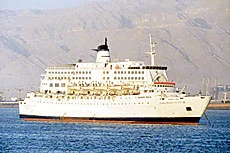
JEDDAH, 4 February 2006 — The Red Sea ferry Al-Salam Boccaccio 98 carrying over 1,300 people, mainly Egyptian workers returning home from Saudi Arabia, sank between midnight and 2 a.m. yesterday. The ship disappeared off radar screens 62 km from Hurghada while en route to Safaga on the Egyptian coast at the northern end of the Red Sea.
At least 295 survivors have been plucked out of the water and brought ashore at Safaga, where the 35-year-old ship was scheduled to arrive at 2 a.m. yesterday morning, official Egyptian sources said. One hundred and eighty-five bodies have also been recovered, they said.
A Saudi Interior Ministry spokesman said there were 1,318 passengers and 80 crew on board the ship. He said there were 1,200 Egyptians, 100 Saudis, six Syrians, four Palestinians, an Omani, a Yemeni, an Emarati, a Sudanese, a Jordanian, a Filipino, an Indonesian and a Canadian. He said people in Riyadh may contact Tel. No. 408-2558 to get more information on the accident.
“A massive air and sea rescue is under way,” involving the Egyptian and Saudi armed forces, Ayman Al-Kaffas, a spokesman for the Egyptian Embassy in London, told Sky News in a live interview. “This is a vast area of water that you can’t cover in a short period of time.”
He said no distress signal was received from the ferry, but at some point during the night it disappeared from radar screens.
Four Egyptian rescue ships reached the scene in the afternoon, around 10 hours after the most likely time of the ferry’s sinking.
Saudi Ambassador in Cairo Hisham Nazer said he had set up a working team to monitor the tragedy. “The team will identify the Saudis who died in the accident and those who have been rescued. It will also visit hospitals and provide necessary assistance to the victims’ families,” the Saudi Press Agency quoted him as saying. Relatives and friends have been asked to contact Tel. No. 749-0775 in Cairo to know about the whereabouts of their loved ones.
The ferry was on a trip between the Saudi port of Duba and Safaga, both at the northern end of the Red Sea. It was carrying both returning Egyptian workers and pilgrims who had performed Haj.
Capt. Mahmoud Al-Harbi, director general of Duba port, said the accident could have occurred as a result of the ferry carrying more than the permissible weight. “The weather was fine when the ship left Duba and was following the right international route,” he said, adding that the accident occurred while the ship was in Egyptian territorial waters. Egypt’s state news agency MENA said the Saint Catherine, another ferry on the reverse route, received a distress message in which the Al-Salam captain said his ship was in danger of sinking. The agency did not say how the Saint Catherine reacted.
Coastal stations received no SOS message from the crew, said Adel Shukri, head of administration at the Cairo headquarters of El-Salam Maritime Transport Company.
Farid Al-Douadi, the ship’s agent in Saudi Arabia, was quoted as saying there were around 220 vehicles on board and that the ship had the capacity for 2,500 passengers.
The ship sank while most of the passengers were asleep, plunging them into waters that average 19 Celsius (66 F) in February. Survival time in these waters can be as much as 40 hours, though unconsciousness can set in after seven. Flotation devices that keep unconscious victims afloat greatly increase the chance of rescue.
Britain diverted a warship, HMS Bulwark, to the scene. Alan West, first sea lord, said the assault ship would arrive in 36 hours. In Bahrain, the US 5th Fleet said Egyptian authorities had initially turned down an offer by the Americans to divert a US P3-Orion maritime naval patrol aircraft to the area where the boat went down. They later reversed their decision.
Egyptian political reaction to the disaster was rapid. President Hosni Mubarak suggested that the ship did not comply with safety regulations. “President Mubarak wants an immediate probe into the causes of the accident of the Al-Salam Boccaccio 98 ferry and guarantees that other similar ships comply with safety regulations,” his spokesman Suleiman Awad told public television.
“The speed at which the ship sank and the fact there were not enough life rafts on board confirm that there was a (safety) problem but we cannot anticipate on the results of the investigation,” he said.
However, Egyptian Transport Minister Mohammed Lutfy Mansour told MENA that the ship complied with all necessary safety measures: “The reasons (for sinking) remain unknown.”
“It’s a roll-on, roll-off ferry and there is big question mark over the stability of this kind of ship,” said David Osler of the London shipping paper Lloyds List. “It would only take a bit of water to get on board this ship and it would be all over... The percentage of this type of ferry involved in this type of disaster is huge.”
The head of the Egyptian Maritime Authority, Mahfouz Taha Marzouk, said the ship was built in 1971 and renovated in 1990 in an Egyptian shipyard. The Al-Salam 98 received a safety management certificate from an Italian organization in October 2005, covering safety drills and other on-board procedures. Osler of Lloyds List said that last June the ship passed a structural survey test conducted by the International Safety Management Code.
The Al-Salam Boccaccio 98 is owned by El-Salam Maritime Transport Company. The company’s owner, Mamdouh Ismail, said before the sinking was confirmed that the ship was registered in Panama.
A ship owned by the same company, also carrying pilgrims, collided with a cargo ship at the southern entrance to the Suez Canal in October, causing a stampede among passengers trying to escape the sinking ship. Two people were killed and 40 injured.
Steve Todd, national secretary of the Rail, Maritime and Transport Workers union in Britain, told the BBC that “you can never legislate for weather in any part of the world, unfortunately. One minute in the Red Sea can be quite flat, calm, and the next minute it can be really atrocious weather conditions.”
— Additional input from Hassan Adawi