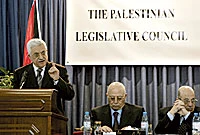
RAMALLAH, West Bank, 19 February 2006 — A new Palestinian Parliament dominated by Hamas was sworn in yesterday, with President Mahmoud Abbas asking the group to form the next government but also imploring them to honor existing peace deals and take the path of negotiations.
Hamas leaders rejected Abbas’ calls, but signaled a willingness to compromise.
Hooked up via video conferencing because Israel wouldn’t allow them to travel between the two territories, the new Palestinian lawmakers in the West Bank and Gaza Strip took their oath of office collectively, reciting a prayer with upturned palms.
At the back of a meeting hall in the West Bank city of Ramallah, Hamas lawmakers held up portraits of fellow legislators sitting in Israeli jails.
Abbas then urged the new legislature, 74 of whose 132 seats now belong to Hamas, not to endanger diplomatic gains worked out over years of painstaking talks with Israel and the international community.
“We, as a presidency and a government, will continue our commitment to the negotiation process as the sole political, pragmatic and strategic choice through which we reap the fruit of our struggle and sacrifices over the long decades,” Abbas said.
He reminded the new legislators “of the need to respect all signed agreements,” including the so-called Oslo Accords of the 1990s that set up the Palestinian Authority.
Amira Oron, a spokeswoman for the Israeli Foreign Ministry, called Abbas’ address a “very good and positive speech.” She said “there is always hope” that Hamas could change its violent ideology, and pointed to the ailing Israeli prime minister, Ariel Sharon, as someone who transformed from hawk to moderate.
“Even Sharon went through this ... He adapted his ideology,” she said.
Abbas’ words were likely to set up a political showdown with Hamas, which has up to five weeks to form a government. If that government refuses to heed Abbas’ demand to recognize past peace accords and accept negotiations, then Abbas, as president of the Palestinian Authority and head of the Palestine Liberation Organization, has the right to dismiss it.
That in turn would almost certainly trigger a parliamentary crisis, or possibly new elections, because any alternative government would need the support of the Hamas-led Parliament.
The backdrop to all this is an Israeli Cabinet decision expected today on whether to impose sanctions that would sever virtually all contact between Gaza and Israel, keeping out Palestinian goods and workers, and making it impossible to travel between Gaza and the West Bank.
In addition, some $50 million in monthly tax transfers to the Palestinian Authority would be halted. The proposed sanctions do not include humanitarian shipments into Gaza, but they’re likely to devastate the already frail Gazan economy.
The world will be watching to see if Hamas will recognize Israel and renounce violence. If it doesn’t, the Palestinians risk losing not just Israeli dispensations but also hundreds of millions of dollars from the US and Europe.
For now, Hamas remains committed to Israel’s destruction, and a leading Hamas legislator, Mushir Al-Masri, said after Abbas’ speech that negotiations with Israel are “not on our agenda.”
Nonetheless, after yesterday’s session, both Abbas and Ismail Haniyeh, Hamas’ choice for prime minister, said they would try to resolve their deep differences through dialogue.
“Why assume that there will be crisis? Let us resort to dialogue. Everything comes through dialogue,” Abbas told reporters after leaving Parliament.
— With input from agencies