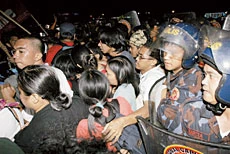
MANILA, 25 February 2006 — Philippine President Gloria Macapagal Arroyo yesterday declared a state of national emergency even as the military claimed to have successfully put down an uprising.
Arroyo made the announcement in a televised speech and said she had signed a presidential decree to quell a military uprising that sought to overthrow her administration.
The president’s declaration came after a lengthy meeting with Cabinet members and police and military officials in Malacañang, Press Secretary Ignacio Bunye said.
In the declaration, she invoked Section 18, Article 7 of the constitution that allowed the president to call on the armed forces to prevent or suppress rebellion.
“(Over the past months) elements in the political opposition had conspired with authoritarians of the extreme left represented by the National Democratic Front-Communist Party of the Philippines-New People’s Army and the extreme right, represented by military adventurists — the historic enemies of the democratic Philippine State — who are now in a tactical alliance and engaged in a concerted and systematic conspiracy, over a broad front, to bring down the duly constituted government elected in May 2004,” Arroyo said.
She also noted that “the claims of these elements have been recklessly magnified by certain segments of the national media.” The president said she would not hesitate to bring down the full force of the law on those plotting her downfall.
She said these series of actions were hurting the country “by obstructing governance, including hindering the growth of the economy and sabotaging the people’s confidence in government.”
The president added she would go after the financiers of any coup and promptly banned all scheduled rallies. Several had been scheduled for yesterday in commemoration of the 20th anniversary celebration of the EDSA people power revolution.
The lawyer of a sociology professor later arrested during one of the rallies said her declaration was tantamount to the declaration of martial law since he and his client were taken in for questioning without a warrant of arrest.
The president’s security advisers said they were investigating about 100 people, both within and outside the military, known to be critics of the Arroyo administration. The identities of the people, who the military said were arrested, were not revealed. Sources within the military said they had enough evidence against these people to prosecute them for involvement in the uprising.
In a related development, former Sen. Gregorio Honasan has been booked for his alleged involvement in an earlier uprising. A case of rebellion has again been filed against Honasan before the Makati City regional trial court. Cases have also been filed against Ernesto Macahiya, retired Capt. Felix Turingan, George Duldulao, Col. Virgilio Briones, retired Col. Romeo Lazo, Lina Reyes, and several other unidentified individuals.
The Department of Justice (DOJ) explained that the charges stemmed from their alleged involvement in a failed mutiny on July 2003 when junior military officers collectively known as Magdalo soldiers seized the fashionable Oakwood apartments in Makati to demand the ouster of President Arroyo.
DOJ Senior State Prosecutor Leo Dacera said the 43-page resolution opposed bail for Honasan.
The DOJ based its case on testimonies of 31 witnesses, led by former Criminal Investigation and Detection Group (CIDG) chief Eduardo Matillano.
Before he went into hiding, Honasan vehemently denied that he was behind coup plans together with the Magdalo and the Young Officers’ Union for the next generation (Young).
But Honasan admitted to the editors and reporters of a Manila newspaper that he respected the decision of the Magdalo and Young to destabilize the government because he understood and identified with their clamor for reforms.