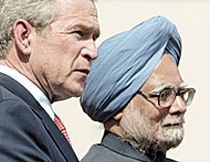
NEW DELHI, 3 March 2006 — On his maiden visit to India, US President George W. Bush yesterday secured a historic nuclear energy agreement between the two countries.
“It was not an easy job for the (Indian) prime minister to achieve this agreement, I understand. It is not easy for the American president to achieve the agreement,” Bush told a joint press conference with Prime Minister Manmohan Singh after their talks on the nuclear deal and other issues.
“But it is a necessary agreement as long as it helps both our peoples. I applaud your courage and your leadership and am looking forward to change decades of law that will enable the US to move forward on this important initiative,” the American president said.
Although an agreement has been signed on the United States helping India in developing the civilian use of nuclear energy, it will remain on paper until the US Congress gives its nod.
Manmohan Singh said Bush had assured India that he would do his best to sway opinion in Congress in favor of the deal. On India’s part, finalization of civilian facilities would begin and discussions would be held with the International Atomic Energy Agency (IAEA) on guidelines for bringing civilian nuclear reactors under its safeguards.
The UN nuclear watchdog welcomed the deal, saying it would end New Delhi’s nuclear isolation and spur global non-proliferation efforts.
Under the deal, Washington has offered India nuclear fuel and technology provided it separates its civil and military nuclear facilities and places the former under international inspections. Some US lawmakers and nuclear experts have criticized the pact, saying it weakens international safeguards, especially the nuclear Non-Proliferation Treaty, which India has refused to sign calling it discriminatory.
But the support of IAEA head Mohammed El-Baradei gives the deal an important seal of approval. El-Baradei said the deal would help satisfy India’s growing energy needs.
“It would also bring India closer as an important partner in the non-proliferation regime,” he said in a statement.
Tom Lantos, the ranking Democrat on the House International Relations Committee, gave it a cautious welcome. “A reliable and dependable strategic partnership is in the interest of both our great countries, and this agreement could herald an even closer relationship between the United States and India,” he said in a statement.
“Given the unprecedented nature of this agreement, Congress will have to carefully examine the details of the separation plan to assure ourselves and our international partners that this agreement will indeed support our shared political and security objectives.”
China was less positive, urging India to sign the NPT and also dismantle its nuclear weapons.
The US official who negotiated the pact said it was “unique” to India and would not be repeated with other countries such as neighbor and rival Pakistan. “What distinguishes India is that India has protected its nuclear technology over the 30 years of the Indian nuclear program — India has not proliferated,” Undersecretary of State Nicholas Burns told reporters.
Under the agreement, India will place 14 of 22 nuclear power reactors under international safeguards, an Indian official said. India currently has 15 nuclear power reactors that produce 3,310 megawatts of electricity and seven others under construction that would increase output to 6,730 megawatts.
Six of the 14 slated for civilian designation, including two under construction, are already under IAEA safeguards. The rest will be deemed civilian under a phased program to be completed by 2014.
The other power reactors will be classified as part of India’s military program.