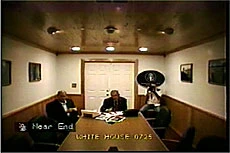
WASHINGTON, 3 March 2006 — A day before hurricane Katrina struck, President George W. Bush and Homeland Security Secretary Michael Chertoff were warned in a special video briefing that the New Orleans levees could be breached with devastating consequences.
Bush was still on holiday at his ranch in Texas when he received the briefing from Federal Emergency Management Authority officials. According to a leaked video obtained by the Associated Press, he did not ask a single question during the briefing. Instead, he assured the officials that the federal government was ready to move if Katrina caused a breach of the levees.
“I want to assure the folks at the state level that we are fully prepared to not only help you during the storm, but we will move whatever resources and assets we have at our disposal after the storm,” he said.
But transcripts of the video, together with transcripts of other meetings involving both FEMA and Louisiana disaster officials, show there was widespread concern in the days before Katrina struck last September that the Gulf Coast, and New Orleans, in particular, was facing a disaster of historic proportions.
What is not explained by the transcripts is what the White House actually did apart from express concern. Some observers point to the damning fact that Chertoff, just 12 hours before Katrina struck, went to Atlanta for a bird flu conference.
What makes this revelation particularly bad for Bush is that it directly contradicts his now famous statement on the Good Morning America television show days after the hurricane. “I don’t think anyone anticipated the breach of the levees,” he said.
The video makes clear that such levee breaches were definitely anticipated by experts like Max Mayfield of the National Hurricane Center who told the federal officials assembled for the videoconference as much, including Bush. Mayfield warned that the hurricane would be among the worst to hit the US in recorded history.
Mayfield said he had “grave concerns” about the levees and at one point, Michael Brown, the disgraced former head of FEMA, told Bush and Chertoff that he feared there weren’t enough disaster teams to help the people who had fled to the Superdome.
“I’m concerned about their (disaster teams’) ability to respond to a catastrophe within a catastrophe,” Brown told Bush and Chertoff on the afternoon before Katrina made landfall.
“The Superdome is about 12 feet (3.6 meters) below sea level and I don’t know whether the roof is designed to stand, withstand a category 5 hurricane,” he says. “Not to be kind of gross here, but I’m concerned about the medical and mortuary resources.” On some transcripts, Brown tells disaster officials that he is worried that many people have ignored orders to evacuate New Orleans and that there had been little effort to evacuate hospitals and nursing homes.
Some of the greatest suffering — and resultant deaths — after the flooding of New Orleans was in nursing homes and hospitals.
The revelations are damaging for both Bush and Chertoff, who have argued that it was impossible to anticipate the size of the disaster.
In New Orleans, Mayor Ray Nagin was visibly shocked when shown the video footage. It “seems they were aware of everything …that we would need lots of help,” Nagin said.
“Why was the response so slow?” Now that the video from Aug. 28, the day before Katrina hit the Gulf Coast is out, it may have the effect of somewhat rehabilitating the almost clownish image Brown has been saddled with, rightly or wrongly, ever since the hurricane caused its massive destruction. But if the video helps Brown, it’s potentially devastating for the White House. The fact that the president didn’t ask any questions during the briefing likely won’t help him turnaround the growing dissatisfaction with his leadership among Americans, as demonstrated by his 34 percent approval rating in a recent poll.