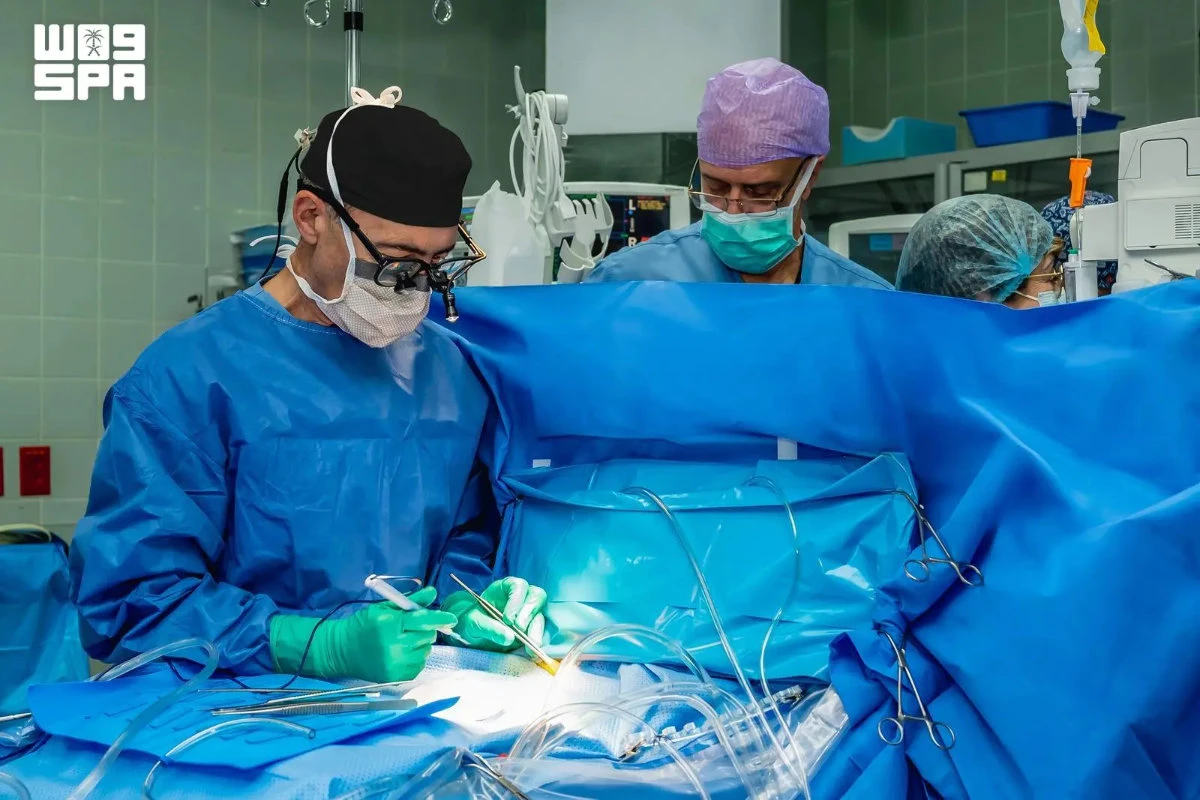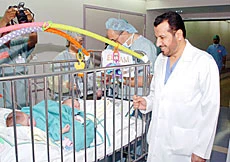
RIYADH, 5 March 2006 — It was another success for the surgical team in King Abdul Aziz Medical City (KAAMC). And it was yet another honor for the nation.
Under the directives of Custodian of the Two Holy Mosques King Abdullah, Dr. Abdullah Al-Rabeeah, CEO of KAAMC and chief surgeon, along with a team of Saudi specialists, successfully separated the Moroccan conjoined twins Hafsah and Elham.
Dr. Al-Rabeeah said that the fifth, most critical stage in the operation had been a success and that the twins were in stable condition after the surgery which took nearly 18 hours.
In a statement to the Saudi Press Agency, he said, “We thank God for making this operation a success like the ones before.”
It is the eleventh successful surgical separation of conjoined twins at the hospital. Al-Rabeeah’s team has already led 10 successful operations to separate conjoined twins.
The king has supported operations to separate conjoined twins from countries such as Egypt, Poland, the Philippines and Malaysia.
A live feed of the operation was transmitted to millions of viewers via the Internet on the webpage www.conjoinedtwins.med.sa
Hafsa and Elham arrived in the hospital on Jan. 2, and the doctors who examined them at the time said the twins were too underweight to be operated upon. A multidisciplinary team was formed and after the assessment was completed, work-up and investigations decided to proceed with the separation operation. Last week the doctors said the twins attained a combined weight of 9.4 kilograms.
Hafsah and Elham were joined at the abdomen and pelvis, sharing one anus and one urinary opening.
The twins are also joined at the spinal column, and share one pelvis and genitourinary system with duplication of the uterus of each twin. It was further established that both twins have the congenital heart disease known as VSD or ventricular septal defect — multiple holes in the wall separating heart’s ventricles.
The multidisciplinary team decided to proceed with the separation despite the risks with the success rate ranging between 60 and 70 percent.
The surgical team successfully separated the spinal cord and the lower part of the vertebral column. The urethra was dissected on each side to finalize the separation of the urinary tract followed by separation of the urinary bladder that was shared by the twins. The separation of genital and urinary systems was done by first separating the genital system.
Speaking on the initial stages of the operation, Dr. Muhammad El-Gammal, anesthesiologist, said the twins’ initial vital signs were stable during the operation.
“We started off with the anesthesia phase and then by inserting the tubes for artificial breathing. It was our job to make sure that all vital signs of breathing, blood pressure and bodily functions were stable throughout the long operational period. Our work did not finish throughout the entire operation until we handed the twins over to the Intensive Care Unit,” he said.
He said that the anesthesia phase lasted for two hours, as planned.
Commenting on the difficult stages of the operation, Dr. Muhammad Al-Namshan, pediatric surgery consultant in the operation, said all of the stages were equally important since one stage relied on the other.
“We realized that most of the shared organs were in the backside of the twins so we decided to leave the separation of the urinary system, stomach and anus to the final stages,” he said.
“All of the stages were critical and required extreme care and preciseness. We managed to separate the sexual organ area from the front. The separation of nerves was also extremely important since we had to make sure that it would not affect the twins’ ability to move or direct a muscle in the future,” he added.
Speaking on the separation of the spinal cord, Dr. Ahmed Al-Ferayan, neurological consultant in the operation, said that many of the nerves were shared between the twins so the medical team had to flip them over to make the necessary detachment of the nerves from the back side.