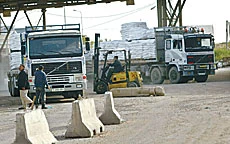
GAZA CITY, 21 March 2006 — Under international pressure, Israel yesterday briefly opened the main goods crossing into Gaza after bakeries ran out of flour and stocks of food stuffs ran low in most shops in the strip.
Six trucks carrying flour and sugar went through the Karni terminal, Palestinian officials said. The amounts were tiny compared with the needs of 1.4 million Palestinians in the Gaza Strip, they added. Palestinians have reported shortages of bread and other staples in Gaza because of the closure of Karni, which handles most goods traffic with the Jewish state.
An Israeli Army spokeswoman said the crossing was open for two hours before being shut again. “The crossing closed because of a security alert,” she said.
Salim Abu Safiya, the Palestinian security chief for crossings into Gaza, said Karni was open for 30 minutes.
“The Israelis need to stop using this silly method and these silly alerts...It’s a drop in the sea of the needs for Gaza,” Abu Safiya said, referring to the shortages in Gaza.
He said Karni is supposed to open again today. “But after what happened today I can’t trust the Israeli promises any more,” Abu Safiya said.
On Sunday, a senior United Nations official warned of a possible humanitarian crisis in Gaza.
Adding to the humanitarian crisis was political tension over a Hamas victory in January elections. Gunmen from the ousted Fatah party stormed government buildings, briefly took over a power plant and blocked a vital road in the Gaza Strip.
Nine people were wounded in five separate firefights with Palestinian police.
Fatah activists — including nearly 60,000 members of the security forces — fear for their government jobs once Hamas takes power.
The bloodiest of the five confrontations yesterday took place at Gaza’s government compound. Three dozen gunmen demanding jobs charged toward the complex, firing in the air. Some burst into the Finance Ministry, while others began firing at random, wounding a doorman outside the adjacent Foreign Ministry before Palestinian police pulled up in jeeps and began exchanging fire with the attackers.
An AP reporter was in the Foreign Ministry at the time of the attack. Just yards away from him, two stray bullets hit a security guard in the legs. Other ministry employees ran for cover, pressing close to walls or hiding under tables as bullets smashed windows.
Police eventually stormed the ministry, arresting three gunmen from the Fatah-affiliated Al-Aqsa Martyrs’ Brigades. Two gunmen and two security officials were wounded in the firefight.
Dozens of gunmen also exchanged fire with members of the security forces at Palestinian police headquarters.
Earlier in the day, gunmen blocked a road leading to the Erez crossing, briefly took over Gaza’s power plant and entered a military hospital.
About 35 gunmen traded fire with policemen who tried to remove them from the road leading to the Erez crossing point, which President Mahmoud Abbas had been scheduled to use yesterday morning to leave Gaza for the West Bank. Two gunmen and a policeman were wounded.
Hamas’ designated foreign minister, Mahmoud Zahar, blamed the violence on Fatah mismanagement. “We are going to deal with it by the proper means in order to solve these problems,” Zahar said.
Hamas leader Ismail Haniyeh on Sunday night presented Abbas with the list of his Cabinet. It comprises 24 ministers, with 19 positions held by Hamas members with some independents and technocrats.
Hamas leader Saeed Sayem was made interior minister, putting him in charge of several security agencies. Mariam Saleh was the only woman in the Cabinet while Tannous Abu Eita was the only Christian.
— Additional input from agencies