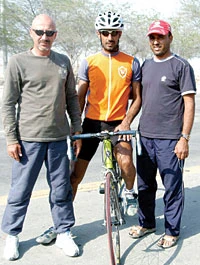
JEDDAH, 6 April 2007 — For Fathi Al-Muslim cycling goes beyond training and practicing. It is a passion, a life-long hobby. Not surprisingly, Al-Muslim went on to become one of the best Saudi cyclists.
As the nature of his job, physical education teacher, takes him from one city to another Al-Muslim is a perfect example of one doing a promotion of cycling in the countryside.
Born on Feb. 17, 1979, Al-Muslim landed a teaching position in Tabuk and then in Al-Jubail at the Royal Supreme School there after finishing his bachelor’s degree. “For some people here riding a bicycle at my age is considered funny, but the youth fortunately looks to it differently,” he said. “I used to watch one of my school friends Bandar Al-Maghrour, God bless his soul, do cycling and I enjoyed watching him. He encouraged me to join the club and so I did,” he said. In 1993, Al-Muslim joined Mudar club in the Eastern Province with his friend. In 1995, he joined the national team that competed in the Gulf Cycling Championship in Dubai, where he emerged champion in one event. “It was a new and advanced phase for me where I learned discipline, commitment to training and following a healthy diet,” he said. “Though the districts competitions were fun representing your country was more challenging. It was all kind of mixed feelings and that is the beauty of it.” Al-Muslim also participated in the 3rd Gulf Championship for Men’s in Abha in 1996 and won his first gold medal. “The moment I stood among the two other winners and No. 1 written under my foot on the podium I could not believe it. It was indescribable to be able to compete with veterans and to beat them all! People started believing in us so I tried not to let them down. I wanted this happiness in their eyes for us to last,” he said. In 1997 he won first place in the time trial event in the 3rd Gulf Championship for youth in Taif. He took 4th place in the 4th Gulf Championship for men in UAE in 1998, 3rd place in 8th Arab Championship for men in Egypt in 1999, 3rd place in 10th Arab Championship for men in Syria in 2001, 3rd at the 5th International Saudi Race in KSA in 1999, 1st at the 6th Gulf Championship in Bahrain in 2002, 3rd place in 11th Arab Championship for men in Egypt in 2002 and 2nd place in Arab Championship in Tunisia in 2003. The best record they achieved in Asian Games was placing 17th in Busan in 2002.
Last December’s Asian Games in Doha was a forgettable one as they were there merely to participate after barely a month of training failed to put the team in competitive shape.
“I was fortunate to secure good places at Gulf and Arab Championships and wish to do the same at Asian and World Championships soon,” he said. Working with national coaches like Zuhair Marzoug was the key element and the one who played a big role in what they became today.
“He was offering his continued emotional support in addition to financial support, but what matters for him was teaching us honesty in matches,” he said.
He also cited the efforts being exerted by other national coaches like Ameen Al-Hulaili and Moroccan Abdulaziz Abbad to make them a better team.
Cycling is an entertaining hobby, he said. It provides one with joy as he breathes in fresh air and helps maintain body shape. One must train his body to endure long roads and races. They train six days a week with the club, and daily with the national team. Beautiful roads make it more enjoyable, like in Slovakia where the national team normally train or in Abha and Taif where they manage to improve their skills and endurance due to height of the region and the low of the oxygen.
“France and Italy are, of course, one of the world’s best places to pursue this hobby,” he said.
In cycling, he said, the cyclists develop fondness of their bicycles, too. He for example takes care of his bicycle as if it was his car and takes it with him wherever he goes. “The best types are from Italy and it may be worth of SR 40, 000, but I have one that I bought with my own money and worth of SR 5,500. I keep it in my bedroom,” he said.
“It has been with me for five years, I have many good memories with it, even if I got a new one I’ll always keep it.”
The longest time Al-Muslim spent on a bike was during the 215km race in Egypt, which lasted for six hours and 20 minutes. The game requires long hours of your day, which is why it was a bit difficult for him to even get engaged. “But I am planning to do so soon and hope I can manage all,” he said.
Al-Muslim has had his share of cycling-related injures.
The heaviest crash he had been through was when he was a student at King Saudi University in Riyadh during training in the campus at night. He took a nasty fall near a roundabout injuring his mouth bone structure and bruising his face, arms and legs. “I underwent surgery and the doctor closed my mouth for the injury to heal and I barley ate for months. Only liquids were easy for me to swallow.”
After six months and while training again, he suffered another accident. “I seriously thought of quitting as life became so precious when you see death twice in less than a year! But then I just missed cycling and kept coming back.” His parents pressured him to stop it since the beginning especially whenever they hear about the death of a cyclist, which happened a lot of times.
“Sometimes you follow all the rules, yet a car appears and you are dead! So it is not always our carelessness as the culprit.” There are no set places for them to train, so they train in the streets whenever possible and try to stay on the safest roads. This is what he teaches his students before teaching them cycling, to follow the roads’ safety rules and regulations like wearing helmets when going on a ride. He also encourages them to join clubs to improve their skills.
“It is good that they are interested in such sports, and we need to make use of this interest,” he said. Hence, he suggested forming cycling races in his school throughout the year.
He was encouraged to do so because of his students’ fondness of this hobby. He said he was surprised when he was working in Tabuk and then in Al-Jabail that while in training his students would show up on a regular basis to watch him and take photos of him. “It is very encouraging that there are some people who notice you and appreciate what you are doing, so I must set a good example for them, he said.”
Craving media attention, Al-Muslim said it means a lot whenever cycling gets media coverage especially of their performances abroad.
Al-Muslim enjoys swimming and roller-skating with friends during his leisure time at the cornice of the Eastern Province. He tried to do stunts and daredevil moves on his bicycle twice but fell on his back. “I knew then it was not meant for me so I stopped thinking all about it,” he said laughing at his folly.
One of 28-year old Al-Muslim’s big dreams is to see cycling become more popular among clubs in all provinces and for businessmen to support it so more cyclists would rise. The Saudi Cycling Federation has been there for 45 years, but we need more qualified leaders, he said, those who want to make a difference and can do so financially and management wise for the game to grow. His future plan is to open a new bicycle shop with a friend because, “it is always hard to get good bicycles, spare parts and accessories here. Whenever we want something we have to get it from abroad. So we want to have it all available with an expert bicycles’ technician.”