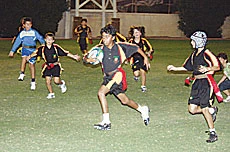
JEDDAH, 23 June 2007 — Jeddah Rugby Football Club Under 11’s (JRFC) beat a French invitation team from Lotus 4 Compound in a tough ‘Tag rugby’ match (a non contact version of the game) recently. In high scoring matches, little quarter was given by either side. The JRFC Under 11’s well developed ball-awareness and ability to shut down the opposition’s passing kept the French tied down and resulted, over a best-of-three match series in a ten tries to five victory for Jeddah.
The French, shadowing the national style, used their practiced ball handling skills to good effect and kept the game open and flowing with wide ground-covering maneuvers and peppered with inventive and ambitious sequences of moves. Several sparkling runs from the three-quarter line that broke through JRFC’s sharp defense and produced surprise scores on more than one occasion.
In a second invitation match with an Under 16’s side from Lotus, the contest was no less fierce. JRFC under 16’s attacks were based on determined tackling that eventually broke down the seemingly endless energy of the French and brought potentially try-scoring moves to a thumping halt. Seizing on the opportunity for some loose handling, JRFC stole the ball from and used the opportunity for short hard runs through the French line to score.
The matches had all the intensity and competitiveness of a full international – but none of the team members of either side in either of the two sets of matches was more than 15 years old, many very much younger. The international edge to the matches, played on JRFC’s home ground at the American School in Jeddah, was taken as seriously by the junior teams as their senior international counterparts.
Jo Marshall, JRFC’s junior team coach said after the game that the Under 16’s team had only begun contact rugby this year. “Seven to eleven year olds we restrict to tag rugby,” she said, “which is where the speed, ball skills and stamina develop. It’s hard to believe the 12 to 15 year old team has taken the step up to contact in their stride so well.”
JRFC Juniors has a broad program of training for rugby enthusiast and encourages young players as young as seven years old to get involved. Thirty or more players in the seven to eleven year group regularly turn out for training with the enthusiasm for the sport spreading up through the older groups.
“All thanks goes to the other coaches and parents for all their support this year without whom the club would not exist,” said Marshall.
“The game has a lot to offer a young player,” said Marshall, a teacher and former women’s South of England rugby player. She identified the focus on teamwork and determination as probably the most important non-physical benefits.
“You need to be fit and have a basic set of skills to enjoy the game– and that is what the training is about,” she said. More important she felt was the development of the abilities to work within a team and contribute to the team’s success rather than try to be an individual star.
“If you are good enough, maybe you will be a star. But a star is supported by the coordinated hard work of the team — and that is the important part and the lesson the young players take into their school and home lives for the future.”