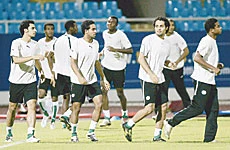
HANOI, 25 July 2007 — A hectic travel schedule has left Saudi Arabia’s players struggling to shake off the effects of jet lag ahead of today’s Asian Cup semifinal against defending champions Japan.
Saudi Arabia’s Brazilian coach Helio Cesar dos Anjos claimed the grueling travel arrangements had handed Japan an unfair advantage heading into today’s match.
Japan booked their place in the semifinals by beating Australia on penalties on Saturday but because they were already in Hanoi, they did not have to move camp.
Saudi Arabia, on the other hand, spent the whole of Monday traveling from Indonesia to Vietnam after their quarterfinal win over Uzbekistan in Jakarta on Sunday night.
Anjos said his players had arrived in Hanoi on Monday night feeling tired and weary after the long trip from Indonesia but there was no point in complaining.
“Yesterday Japan were training and preparing for the game while we were traveling for a marathon 12 hours to get here,” Anjos told a news conference yesterday.
“This is a problem but we cannot use this as en excuse. We just have to get out there and play the game.”
Japan, the defending champions, are wary of an “all-new” Saudi Arabia led by danger man Yasser Al Qahtani as the long-time rivals gear up for their semifinal.
Saudi Arabia and Japan have dominated the Asian Cup for the past two decades, with each country winning three of the last six tournaments.
Saudi Arabia won the title in 1984, 1988 and 1996 while Japan were crowned champions in 1992, 2000 and 2004, beating the Saudis in the first two of those finals.
“We are the two powerhouses of Asian football,” Anjos said.
“Both teams know each other very well. We have similar styles and techniques so it will be a game of details.” Saudi Arabia beat Japan 1-0 in their first qualifying match last year but Japan won their return match 3-1 and Anjos said they were the favorites to win in Hanoi.
“We expect to have a lot of problems against Japan,” he said.
“They are the best team on the continent. They are very good, but we are not afraid either.
“We all have the right to dream. We are happy to be in the semifinals but we want more.”
Saudi Arabia were highly impressive on the counterattack against Uzbekistan but Dos Anjos is wary of the different problems Japan will pose. And he expects his defenders to be just as over-worked as they were against the former Soviet republic.
“In the evaluation after every match the first thing I do is look at the quality of the opposition and Uzbekistan were a very good, tough team,” said Dos Anjos.
“That’s why we had many problems and we will have problems against Japan as well, but we will try to correct those problems against Japan so they have less success.” Dos Anjos stopped short of saying that his team are underdogs but he did extoll Japan’s virtues. “I agree that Japan is a powerhouse in Asian football. They have the best selection on the continent.
“But the most important thing is they know their game. They are very good, very tough, they play the ball around well, they are the best team on the continent.” However, Dos Anjos is still hoping to return to Jakarta for the final on Sunday.
“Everyone has the right to dream and be confident and I’m confident,” he said.
Japan coach Ivica Osim has warned that the defending champions will face an unknown quantity when they clash with long-time rivals Saudi Arabia in semifinal.
“They are a completely new team with only the goalkeeper and four other players held over from our last game,” said Osim.
“They are more aggressive and play modern football. They have a number of players whom we may find difficult to deal with,” added the 66-year-old Bosnian, who led the former Yugoslavia to the 1990 World Cup quarterfinals.
Saudi Arabia, who last won the title in 1996 but failed to reach the knockout stage in 2004 for the first time in two decades, have shown solid form through the tournament, whipping Uzebekistan 2-1 in the quarterfinals. They posted two wins and a draw in the group stage. Dos Anjos overhauled the squad after replacing fellow Brazilian Marcos Paquetta in March.
He said his side’s loss to the Blue Samurai in November “doesn’t matter at all.” “We are a new team and we have a chance to win,” he said.
Al-Qahtani leads the Saudi strikeforce alongside Malek Alhawsawi with Japan’s hardman center back Yuji Nakazawa tasked with keeping them at bay. Osim said he had confidence in his back four. “Our defenders are capable and I don’t feel it necessary to change them,” he said.
Japan and Celtic playmaker Shunsuke Nakamura said his side must stop the Saudis from launching lightning counterattacks, as they have done so successfully in the tournament so far. Nakamura, who will link up with Frankfurt striker Naohiro Takahara on Japan’s offensive, set up the sole goal in their defeat of Saudi Arabia 1-0 in the 2000 Asian Cup finals. Saudi Arabia also lost to Japan in the 1992 final.
At stake for both sides is a place in the final against either South Korea or Iraq, who play their semifinal in Kuala Lumpur also today. Japan, who won one game and lost another against the Gulf side in Asian Cup qualifiers last year, are surprised that the Saudis have changed so much under Dos Anjos.
“They’ve got a lot younger and they are quite physically strong,” said Japan midfielder Yasuhito Endo after watching videos of Saudi Arabia’s 2-1 quarterfinal defeat of Uzbekistan.
Endo said Japan, bidding for a third straight Asian Cup, need to guard against Al-Qahtani who has scored three goals so far, as well as his frontline partner Malek Alhawsawi as “they are fast.”
“Saudi Arabia also have a technical midfield who can feed accurate passes to the couple,” he added.