
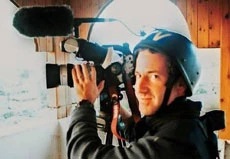
JERUSALEM, 7 August 2007 — Britain and Israel face a diplomatic and legal showdown this week over the death of James Miller, an award-winning British filmmaker who was shot by Israel soldiers while working on a documentary in the Gaza Strip more than four years ago.
Israel has failed to respond to an ultimatum issued by Lord Goldsmith, the former attorney general, to his opposite number, Meni Mazuz, on June 26 to launch a criminal investigation within six weeks against the officer suspected of firing the fatal shot. The deadline expired yesterday.
Tel Aviv is refusing to be stampeded. In a previous case — that of a British student, Tom Hurndall, killed by an Israeli sniper in 2003 — it eventually yielded to British pressure and court-martialed the soldier concerned. He was sentenced to eight years in prison for manslaughter.
The army’s first instinct, as shown in both cases, is to protect its soldiers. A military spokesman said, “a cameraman who knowingly enters a combat zone, especially at night, endangers himself.”
Moshe Cohen, a spokesman for Israel’s Justice Ministry, said in a written statement that an earlier British request had been thoroughly checked and a decision to close the Miller case had been reported to London. “Now that the British authorities have decided once more to approach us, the matter will be attended to.... A response will be provided in an acceptable fashion, as soon as possible, in accordance with the timetables of the Israeli authorities.”
Miller was filming near Rafah in the southern Gaza Strip with Saira Shah, who was named television reporter of the year in 2002 for Beneath the Veil and Unholy War, documentaries the two had shot for Channel 4 in her native Afghanistan. Miller, who doubled as cameraman and director, had earlier won an Emmy and a Royal Television Society award for films on Serbian massacres in Kosovo. He was an experienced war photographer, having covered conflicts in Lebanon, Sudan and Algeria for a news agency.
Death in Gaza shows the two journalists leaving the home of a Palestinian family in the turbulent Rafah refugee camp at night, carrying a white flag. They were accompanied by a local crew from Associated Press Television News (APTN).
In an investigative report in October 2003, the journalist John Sweeney wrote: “They had walked about 20 meters from the veranda when the first shot rang out. The team froze. For 13 seconds, there is silence broken only by Saira’s cry: ‘We are British journalists.’ Then comes the second shot, which killed James. He was shot in the front of his neck. The bullet was Israeli issue, fired, according to a forensic expert, from less than 200 meters away. Immediately after the shooting, the IDF said that James had been shot in the back during crossfire. It later retracted the assertion about where in his body he was shot, but until today it has maintained that he was shot during crossfire. There was no crossfire on the APTN tape.”
Miller’s death was captured on video and was included in the film Death in Gaza, released by HBO in 2004, which went on to win three Emmys. Miller had gone to the troubled region to film children on both sides of the conflict, but he was killed on his last day in Gaza before he could film the other side of the story.
In April 2006, a London jury at St Pancras coroner’s court returned a verdict of unlawful killing and said that Miller, 34, had been “murdered”. The Israeli Army had dropped the case for want, it said, of enough evidence to prove guilt beyond reasonable doubt.
The coroner, Dr. Scott Reid, wrote to Lord Goldsmith inviting him to “consider starting criminal proceedings in the UK against members of the Israel Defense Forces (IDF) for an offense of willful killing”.
The only soldier who has been named, though only by rank and surname, is Lt. Heib, who commanded the armored vehicle from which the fatal shots were fired.
To try him in Britain, Lord Goldsmith’s successor, Baroness Scotland, would have to seek his extradition, which Israel would be expected to resist.
Miller’s family accused Israel of “an abject failure to uphold the fundamental and unequivocal standards of international humanitarian and human rights law”. They are suing the Israeli government in the Tel Aviv magistrates’ court for compensation.