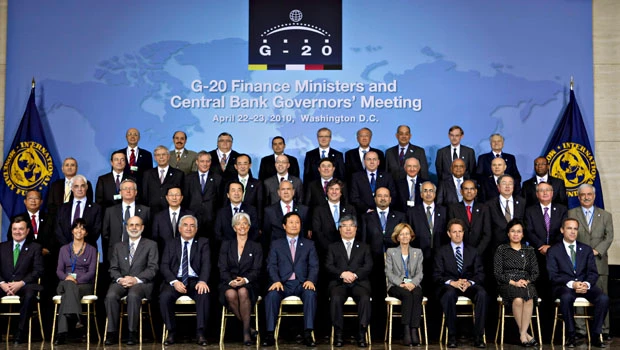
- WASHINGTON: Global finance officials worked Friday to resolve differences in overhauling bank regulations, even as they wrestled with a pressing debt crisis in Greece that threatens to unravel gains in steadying the fragile world economy.
The International Monetary Fund issued a statement stressing that the 186-nation lending agency was prepared to process Greece's request for emergency loans quickly, and IMF Managing Director Dominique Strauss-Kahn scheduled one-on-one discussions for the weekend with Greek Finance Minister George Papaconstantinou.
Greece's call for help came as finance ministers and the heads of central banks from the Group of 20 major economies held closed-door discussions at IMF headquarters with the goal of resolving differences over various bank reform agendas being pushed by the United States and other nations. The group was to issue a joint statement late Friday.
"Financial reform remains for us the essential theme for the G-20," German Deputy Finance Minister Joerg Asmussen told reporters before the talks began.
The G-20 is composed of the world's richest industrial countries as well as fast-growing developing nations such as China, Brazil, India, South Korea and Russia. It has taken over as the prime policy-setting body for the global economy.
The United States was being represented by Treasury Secretary Tim Geithner and Federal Reserve Chairman Ben Bernanke. The talks Friday were in advance of weekend meetings of key policy boards of the IMF and its sister lending institution, the World Bank.
All the discussions were being overshadowed by Greece's debt problems, which have roiled global financial markets for weeks.
Greek Prime Minister George Papandreou on Friday called for the activation of a joint euro zone-IMF financial rescue for his debt-ridden country.
In response, Strauss-Kahn issued a statement saying his organization was ready "to move expeditiously" on Greece's request. IMF officials said emergency talks between an IMF team that arrived in Athens at the beginning of the week and the Greek government were continuing.
Greek officials said that Papaconstantinou, while in Washington, would have one-on-one discussions with finance ministers of Russia, Brazil and China over the weekend and would have a joint meeting with Strauss-Kahn and European officials on Saturday followed by one-on-one talks with Strauss-Kahn on Sunday.
"It's clear that the Greek situation is a very serious one," Strauss-Kahn told reporters Thursday. "There is no single way, no silver bullet to solve it in an easy manner."
Meanwhile, Greece appealed for a debt rescue from the EU and IMF on Friday and said that help should arrive within days, in a dramatic turn for the euro zone at risk from Greek contagion.
Prime Minister George Papandreou told his nation in a televised speech that the aid was a "national need" which would "offer us a safe port to allow our boat to float again." But German Chancellor Angela Merkel, whose government has been reluctant to provide aid to Greece, declared that the rescue package would be activated only if the stability of the euro were threatened.
Merkel spoke after the EU said it did not see any "obstacles" and would give "rapid" treatment to the request for a three-year debt rescue worth up to about 45 billion euros ($60 billion) in the first year at concessionary rates of about five percent.
Once Greece has put forward a savings plan, Merkel said on Friday, "The European Commission, the European Central Bank and the International Monetary Fund would have to determine whether there is a situation whereby the stability of the euro as a whole makes it necessary to provide an aid program for Greece." Papandreou made his plea before a nation facing unprecedented austerity, just the day after the latest in a series of strikes against massive reforms.
But Greece is in a desperate dilemma, and its credibility has been fatally undermined by a series of statements showing that it has misreported key data for the euro zone ever since it gained access as an early member.
The country has overall public debt of about 300 billion euros ($399 billion) - or twice the debt of Britain, a far bigger economy.