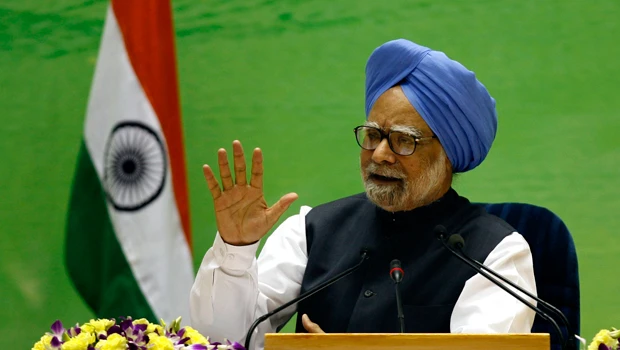
- NEW DELHI: Indian Prime Minister Manmohan Singh said on Monday he failed to do enough in his first year, but defended himself against criticisms of weak leadership and said progress would soon be made on concerns like high inflation.
Inflation would moderate to around 5 to 6 percent in December, he said. Inflation is running at nearly 10 percent and is a major worry for the government as it has raised prices of basic foods and increased the chance of interest rate hikes.
Singh, who is 77 and underwent heart surgery last year, spent much of a rare 90 minute news conference fending off questions over his leadership after a series of crises ate into his parliamentary majority and stalled many reform bills.
Often seen as the "reluctant" prime minister appointed by Congress party head Sonia Gandhi in 2004, Singh said he was not thinking of retirement. But he hinted he could eventually make way for family scion Rahul Gandhi.
Despite being freed from the shackles of needing communist support in the second term, his government has floundered on inflation, struggled against a Maoist insurgency, and managed its political allies so badly its substantial parliamentary majority dwindled.
"I would be the first person to admit that we could have done more," Singh said in a statement given during a rare news conference in New Delhi to mark the first year since the Congress-led coalition government was reelected to a second term.
"The work is incomplete right now," Singh said later at the news conference, and with that the case "there is no question of retirement."
Singh has disappointed many investors with a slow pace of reforms that investors say are needed to ensure India can sustain fast economic growth and compete with the likes of China.
The press conference was one of only a handful he has given since first coming to power in 2004. It appeared an attempt to show he was pushing policies rather than reacting to problems ranging from the global credit crunch to a cricket corruption scandal.
Singh touched upon issues varying from economic growth to Pakistan diplomacy and the question of his succession.
But he gave nothing new away, in line with his image of a reticent politician who is uncomfortable both with 21st century PR techniques and calls for faster action on policies.
"I sometimes feel younger people should take over ... I would be very happy to make place for anybody the Congress party chooses," he said, responding to a question on whether he was willing to make way for Rahul Gandhi.
"Rahul is very qualified to hold a Cabinet post," Singh said. The prime minister added he had asked Gandhi several times to join the government cabinet, but he had so far refused.
The share and bond markets showed little reaction to the conference and the benchmark 10-year bond yield was unchanged at 7.42 percent
Outlining government policy, Singh said India was willing to discuss all "outstanding issues" with nuclear foe Pakistan, implicitly suggesting the government would talk to Islamabad about the dispute over Kashmir critical to the countries' relations.
It was another sign of New Delhi softening its approach to Islamabad after the 2008 Mumbai attacks when Pakistan-based militants killed 166 people.
"India cannot realise its full development potential unless we have the best possible relations with our neighbours, and Pakistan happens to be the largest neighbour of ours," he said. "The trust gap is biggest problem."
Singh said he had been assured India would get access to David Headley, a Chicago man who pleaded guilty of working with the Pakistan-based Lashkar-e-Taiba to plan the strike. New Delhi says it could get more information on militant networks targeting India if it was allowed to interrogate Headley.
Singh said he hoped political parties would pass a delayed nuclear liability bill needed to allow entry of U.S. atomic energy firms into India.
He said the central government along with state governments would take more steps to battle inflation, and that he sees growth in 2010/11 rising to 8.5 percent.
Despite investor criticism, the government has won praise for a sound fiscal policy that has helped protect India from the worst of the global credit crisis. Growth is one of the fastest in the world and there have been some tentative steps to reforms.
Many investors remain optimistic India eventually will take steps to open the insurance, banking and retail sectors to overseas players, and India still attracts many foreign firms.