- Summit sets aggressive deficit-cutting targets and leaves bank tax choice to individual nations
TORONTO: Agreeing to disagree and abandoning the endeavor to have a common approach, leaders of the G20 nations agreed to have a "differentiated response" to the economic and financial crisis the world is facing today.
Accepting a compromise on post-recession economic policy, the G20 leaders agreed to aggressive deficit-cutting targets, yet allowed the respective countries to pursue their own approach in meeting their national objectives.
This was an apparent trade-off between US President Barack Obama, who favored continued economic stimulus spending to head off a double-dip recession, and the European leaders led by German Chancellor Angela Merkel, who wanted G20 countries to move swiftly to reduce debts run up during the 2008-09 economic slowdowns.
"Advanced economies have committed to fiscal plans that will at least halve deficits by 2013 and stabilize or reduce government debt-to-GDP ratios by 2016," read the G20 communiqué. This was a compromise between the two positions as Obama had publicly expressed his concern that cutting stimulus spending too quickly could hurt the global recovery. The leaders also agreed to support economic growth policies and recognized that some countries will start cutting their budget deficits later than others.
"We are committed to taking concerted actions to sustain the recovery, create jobs and to achieve stronger, more sustainable and more balanced growth," the communiqué said. "These (actions) will be differentiated and tailored to national circumstances."
The G20 has also concluded it will be left up to individual countries to decide whether they want to impose a bank tax or establish some kind of a rainy day fund to offset another financial collapse that sparked the worldwide recession.
The final communiqué, while commenting on the issue of energy subsidies, emphasized the need to phase them out over time "based on national circumstances" and "taking into account vulnerable groups and their development needs."
The leaders also called on the world's emerging economies to allow their currencies to float more freely, so as to balance world trade.
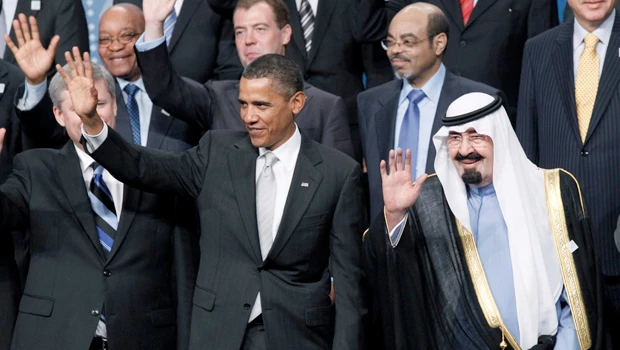
Custodian of the Two Holy Mosques King Abdullah, seated next to Obama, was seen in intense discussion with world leaders. With heads of state and government from 20 developed and developing nations gathered around a large round table at the Metro Toronto Convention Center, the summit's host, Canadian Prime Minister Stephen Harper, early on Sunday laid out the challenge that confronted them, urging them to take decisive action on mounting national debts and warning that failure to act could derail a fragile recovery. He underlined the need to strike a proper balance between sustaining economic growth and pulling back fiscal deficits.
"The recent skittishness of markets is telling us they are awaiting our actions, actions that must be decisive but also coordinated and balanced," Harper said. "Here is the tightrope that we must walk, to sustain recovery it is imperative that we follow through on our existing stimulus plans," he added.
"But at the same time, advanced countries must send a clear message that as our stimulus plans expire, we will focus on getting our fiscal houses in order," he underlined.
As the leaders debated key issues at the convention center, outside police arrested more than 500 people in a major crackdown in two areas. About 70 people were arrested at a University of Toronto building near Russell Street and Spadina Avenue for wielding "street-type weaponry," police said. Officers seized black clothing, bricks, bats, sharpened sticks and bottles. Raids were carried out at the Bancroft Building, the Earth Science Center and the Graduate Students Center. Police also arrested four people after witnesses saw them emerge from a manhole near the G20 summit security zone early Sunday morning. A spokeswoman for the Integrated Security Unit said the safety of international leaders at the summit was never at risk.