- Although he is aware of the achievement of Farouq Al-Zoman, the first Saudi to climb Mount Everest in 2008, Bandar bin Khalid bin Fahd Al-Saud aims to become a dedicated Saudi mountaineer.
Though sustaining this harsh passion would be a tough task, this ambitious, young and vibrant man is aiming for the top, literally.
Bandar, who has known the realities of life in a desert, rediscovered his passion for climbing when he found that the workaholic lifestyle he adapted soon after graduation was affecting his health.
He graduated in 2006 and returned from the USA to Riyadh to build a career in marketing, only for it to take over his life. Bandar describes his lifestyle at the time as less than healthy.
“When I went back to the US on a trip, I tried on some of my older clothes and they didn’t fit me. It was then that I realized that only working was having an effect on my lifestyle,” said Bandar. He decided to get fit by taking up climbing once again.
“When in France, I had rock climbing in the fifth grade and was on the rock climbing team for my school.”
Although Bandar practiced rock climbing for about a year only, he returned to climbing in 2007 in a big way and decided to pursue it as more than a hobby.
Chasing his dream, Bandar searched online and found that there was just one other Saudi who had tried it previously, but nothing more was heard of him.
Bandar then decided to take on the mission of becoming a dedicated climber and “that’s how it started.”
A 12-day course in Alaska gave Bandar the start.
“It was difficult, it was cold, harsh and it was boring but... it was a big change as the sport is very scientific and you have to take care of your body.”
“Before I went on this trip, I was doing one hour, five days a week on the electric machine. On two of the five days, I had a backpack to get my shoulders used to the weight. It was about 25 kgs,” says Bandar of his training.
Bandar admits he wasn’t ready for what he was about to face, especially the different challenge of climbing.
“Well, one of the most important things is something called “Self Arrest” — to stop yourself in a fall with your ice ax. It’s the first step to becoming a climber.”
After 12 days, Bandar really took to the sport, loved it as it was challenging to a level that no other sport can take you.
“It’s challenging because instead of playing other people, you were playing yourself. You want to go home, you want to leave, you want to go to sleep — you can’t. You’re really fighting yourself.”
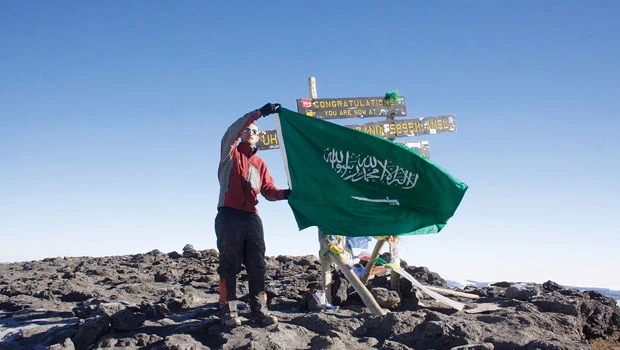
After Alaska, Bandar decided to go on a trip to Mount Kilimanjaro in July 2008, the highest mountain in Africa, with some of his friends.
“At around 5,500 meters, I experienced what’s called AMS (Acute Mountain Sickness). It hits the majority of people, it’s genetic and had nothing to do with fitness.” AMS symptoms included headache, nausea, stomach pain, dizziness and fatigue. Bandar, nevertheless, was able to take it.
Bandar and his group were hit with constant rain until they reached about 4,000 meters, even when it was sunny it was still very cold. Above cloud level, climbers could encounter a serious illness called high altitude cerebral edema (HACE), which is swelling of the brain due to the lower pressure.
“It’s very dangerous as sometimes your lungs start to swell,” he said, adding oxygen masks are not used because it’s too low in altitude for oxygen. It is at around 7,500 meters that climbers need oxygen. “It’s difficult but your body can do it,” he added.
Scientifically, climbers should gain 1,000 feet per day, but not more, through training. So therefore Kilimanjaro should be an 18-day climb, according to Bandar. “But it’s not. It’s a five-day climb because they want to get the customers in and out as soon as possible.”
The nature of mountaineering and the stress it puts on the body exposes any weakness in your body, Bandar said, adding that many people die because they don’t know the limits of their bodies.
Climbers train for the technical parts of the climb on site.
“I train daily, I’m always in the gym and I have a routine, but whenever I have a big expedition coming up I move to sports-specific training six months in advance,” Bandar points out.
A personal trainer helps him with his mountaineer specific course. After his trip to Kilimanjaro, Bandar decided to step it up a little, so he took a trip to Antarctica.
Describing it as the most difficult trip that he’s taken so far, Bandar said: “It was supposed to be 14 days, but it ended up taking 35 days.” Bad weather and conditions made it worse. The Vinson is the highest mountain in Antarctica. The remoteness and isolation of the mountain adds to its appeal and also to its danger.
“The trip started with us going from Riyadh to Chile, that’s where the company we used is based.” Bandar had to wait five days before going to Antarctica because of bad weather. “So we were already five days late.”
In Antarctica, the weather was beautiful and the team spent two hours at the summit, unheard of in the mountaineering world. Bandar explained that as the summit is usually so cold and the mountaineers are exhausted, having run out of food and water, they just want to climb down.
“The more time you spend away from the camp, the more you expose yourself to danger,” he said.
“In Antarctica the weather is so strange. As you are climbing the sun would be shining, so you’d be sweating on one side, and on the other side, the side in the shadow, you’d be freezing.”
“On Dec. 27, we had reached base camp and now we had to wait for our plane, the Twin Otter, which can land on snow, to pick us up and take us back to our Antarctica base camp, which is called Patriot Hills.”
The group was then hit by bad weather and ended up being stuck, although at base camp, “which was not a big issue.”
Bandar related the situation of a group of skiers who got caught in the storm. The Nordic explorers were alone on a 30-day expedition from the tip of Antarctica all the way to the South Pole.
“One skier had spilled his fuel, without which one cannot boil snow to make water, therefore you can’t have food. He was in a bad situation, and though he sent out an SOS, no one could send help to him.
On the third day he made his way to base camp and was quickly flown out to Sweden, where his fingers and toes were amputated. But he is still coming back next year,” Bandar said.
“Eventually on that trip, we ran out of food — and we were isolated. Our guide, however, remembered that they had buried food four years ago and he called the company in the US and got the coordinates of the buried food. We later dug it out. Although the expiry date of the food was long gone, this was Antarctica and it was a battle of survival more than anything else.”
Bandar is not thinking of Mount Everest any time soon. To him it’s a rather large expedition. And he has other more appealing mountains in his sights.
Bandar’s family accepts his passion and understands how he values it, and they support him.
“It has become part of who I am, I don’t see myself ever quitting, I can see how some families would worry; it’s really not for the reckless as there is an old saying among the mountaineers: ‘You have old mountaineers and bold mountaineers, but you have no old bold mountaineers’.”
“You really have to know your body, know your limits and be able to take on different aspects that are in your level,” he said.
“My family knows that I am responsible enough to know my limits. I am sure they worry; any family would, when their son is completely out of communication for three to four weeks at a time.”
Currently, Bandar is on a 21-day trip to Mount McKinley in Alaska, and he described it as “the most beautiful place on earth.”