- Quitting smoking is one of the most challenging things for a person to do.
- But with the holy month of Ramadan just around the corner, it is the ideal time for smokers to show their will by saying, “I will quit this habit.”
Quitting smoking is one of the most challenging things for a person to do. But with the holy month of Ramadan just around the corner, it is the ideal time for smokers to show their will by saying, “I will quit this habit.”
Many doctors advise that the fasting month of Ramadan is the best month to kick the habit, as it already imposes a personal resolve throughout the day when the faithful submit to the will of God by refraining from food and water.
If you can be smoke-free for those long hours of fasting, why not just continue to ignore to pick up the butt for the remaining period? A simple question, to which there is no answer. But the oft-used quip is: “It is difficult.”
As an ex-smoker myself, I know how they feel. It is not that they do not want to quit, but the fact that the burning stick has become a crutch for them makes them repeatedly reach out to the pack and just light up.
Despite being aware of the dangers of smoking, many smokers often find it difficult to quit.
Regardless of the constant awareness campaigns on the possible heart diseases and many serious respiratory and cardiovascular diseases caused by smoking, as well as family admonishments and requests and the personal debilitation caused by the deadly habit, smokers continue to just puff away their health.
If you are a smoker struggling to quit, it is either the fact that it is a crutch you cannot do without, or the fact that you cannot handle the withdrawal symptoms associated with nicotine addiction that saps your will to quit.
To both these issues, the holy month of Ramadan offers partial solutions. But again, as you show the will to fast during the day for the whole month, if you can show the will to hold on after the month, you would be well on your way to quitting this habit.
As you fast you are already handling the withdrawal symptoms, so when you break your fast do not break your will to quit smoking. Reach for the other stick during the period you are allowed to eat, drink and smoke. That stick is the miswak.
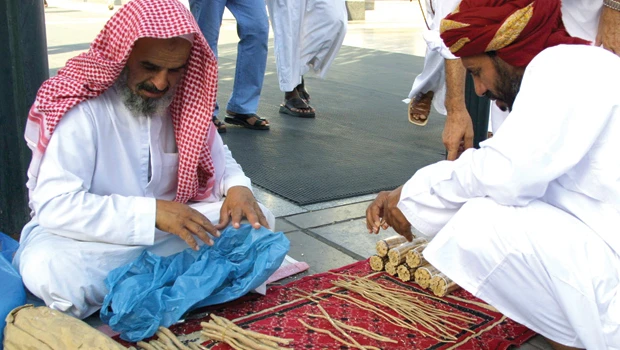
The miswak, available in the souk or outside a mosque, with street vendors displaying small bunches of twigs cut in equal sizes and tied together, is the possible answer for those who seek to quit smoking.
It provides a crutch when you need to smoke, for it provides you with the stick that you associate with as a possible pressure-reliever when the craving for a smoke heightens.
Its healthy properties also adds to dental hygiene, and indirectly helps in making you healthy as you no longer inhale and exhale the dangerous smoke.
According to Arab News columnist Mariam Alireza, from time immemorial the bark of the arak tree has provided a healthy alternative to smoking.
Miswaks or siwaks from the arak tree (also called Salvadore persica), a short evergreen tree that grows in Middle Eastern and African deserts, are a perfect substitute.
The roots of the tree have been used for hundreds of years for oral hygiene, and are still used for the same purpose.
And in the month of Ramadan, when the faithful follow Sunnah, they can follow Prophet Muhammad (pbuh) by using miswak.
“The Prophet brushed his teeth, using a tooth stick known as miswak,” says Islamic scholar Adil Salahi.
“When you peel off the skin at the top, its fibers serve as a toothbrush. When the Prophet woke up at night, the first thing he did was to brush his teeth. He used to say: ‘Brushing one’s teeth cleans one’s mouth and pleases the Lord.’”
So once again Ramadan presents the opportunity to the diehards to change their ways. And the only thing is that once you quit smoking, stick to your decision and don’t be like the famous American author Mark Twain, who said: “It’s easy to quit smoking. I’ve done it hundreds of times.”
Don’t be a repeat offender. Just say no to smoking by kicking the cancer stick and picking up the magical twig.