- In the sense that a tattoo has been since 1688 a signal calling soldiers or sailors back to their quarters at night, an air force tattoo that occupies two full days might seem a trifle inappropriately named.
However in the sense of a tattoo marking the end of something, then the Royal International Air Tattoo held at the small Gloucestershire village of Fairford in rural England to mark the 70th anniversary of the Battle of Britain, did mark a calling together, an anniversary and a closing.
The most poignant sight of the entire meeting for many a septuagenarian at the show was the sight of the iconic fighter aircraft of WWII — both English and German — flying together in tight formation over a military airfield in a display of goodwill and camaraderie, a final closure for some of the more senior visitors to the display.
Seventy years ago this year these flimsy warplanes were fighting grimly to the death over the skies of southern England in the Battle of Britain and now were flying in disciplined patterns together.
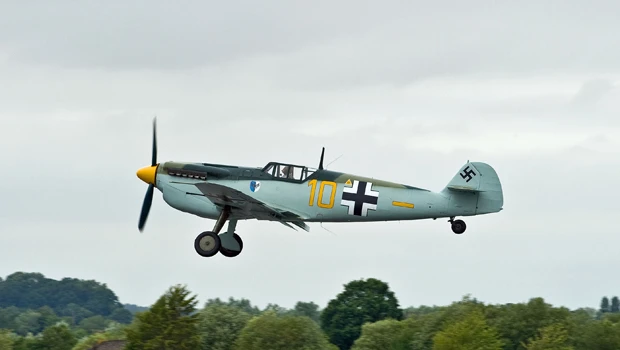
Messerschmitt Bf109, (NB Small f is correct) Hawker Hurricane and Supermarine Spitfire — names that resonate with past aggression and have become the stuff of military legend flew at low altitude over the airfield, their engines a melodious rumble creating the characteristic harmonic that typified a squadron or two passing over during their wartime role.
Rolls Royce produced the Merlin engine that powered the Spitfire, Hurricane, Mosquito and Lancaster fighters and bombers, but it is ironic that the Bf109, the foremost German fighter of WWII, started and ended its life with British engines. Rolls Royce engines at that.
When Willy Messerschmitt was designing the 109 he specified the 610 horsepower Jumo 210 engine that was so new that none were available. Instead he was obliged to use a Rolls-Royce Kestrel VI engine of 695 hp. The Messerschmitt was initially designed around a much less powerful engine than the 1000 horsepower plus Merlin engine that British designers were to put in their new fighters. When they changed to the Daimler-Benz engine spower plant output rose dramatically. The fastest of all the Bf 109s was the K-14, fitted with the DB605L engine, reportedly capable of 455 mph powered an engine of 1,500 hp boosted to 2,000hp for short periods. Only two were ever used in combat.
It would be easy to see a gathering of warplanes and materiel (This is correct spelling for the goods of war) as simply a celebration of violence and power. There was doubtless a portion of military “wannabees” and psychopaths among the tens of thousands of visitors of all ages who gathered over the two days of the event. Moreover the frequent use of the word ‘defense’ in an industry that builds machines that seem designed only for the purpose of unleashing enormous firepower on perceived enemies is certainly up for debate.
However, the celebration or criticism of conflict was not why the overwhelming majority of people attended. It was to experience the vicarious thrill that comes from simply being close to hugely powerful cutting edge technology, watching vastly skilled and improbably young pilots hurl warplanes about the sky like aerial skateboards and pressing a nose against a window pane in awe at seeing for real what is unattainable for most people. And of course, to just experience the noise, and it is noise of an entirely different order of magnitude from daily life.
The soft puttering of small trainer aircraft acted as a gentle almost summery prelude akin to distant lawn mowers on a warm and sleepy afternoon. The genteel thrumming of veteran piston engines provided the central movement and the coda was a gut-wrenching ear-shattering visceral roar provided by the latest generations of fast jets. It was a matter of debate whether the Typhoon or the F22 Raptor was the loudest of the main contenders; it did not really matter in all events. You cannot argue with someone you cannot hear. The noise was beyond hearing; so loud you did not hear it but felt it as a pain in the ears and as a violent shaking of the gut that left anyone within 200 meters deaf for minutes afterwards. It is genuinely indescribable but a reminder of just how much superb engineering goes into producing weapons of war and the power under the control of some mother’s son.
Or indeed daughter. For the first time a female pilot, Kirsty Moore was at the controls of a BAE Hawk as part of the RAF Red Arrows display team and flying as Red 3 in the nine-aircraft formation.
Normally to be found as an operational pilot at the controls of a GR4 Tornado, Moore applied for and went through the incredibly challenging selection process to join the team. No tokenism here, for at the speeds, g-forces and very high skill levels needed for close formation display flying there is no room at all for error.
A former Red Arrows squadron leader confided to me that after all the selection processes are complete, the final and toughest test is set by the team members. “It the simple question; do we get on with this person and can we trust him (now her) with our lives?” If either question is answered with a ‘no’ then that is the finish of it.
On the way out during the last display of the day, I passed two bemedalled RAF veterans in crumpled linen suits, RAF berets and brilliantly polished shoes. They were leaning on walking sticks and intently gazing skyward with rheumy eyes. Overhead a perfectly restored 70-year-old Spitfire was performing an elegant gavotte partnered by the latest iteration of RAF fighters, the Typhoon. It was both a symphony and threnody for two generations played with the roar of engines, each the cutting technology of its day.
Built seven decades apart they were both flown in their day by pilots often just a few years out of college and who are expected to risk their lives as part of the job description. There was a beguiling grace and a frightful power to the scene.
I looked more closely. That was not rheum in the old pilots’ eyes; those were tears.