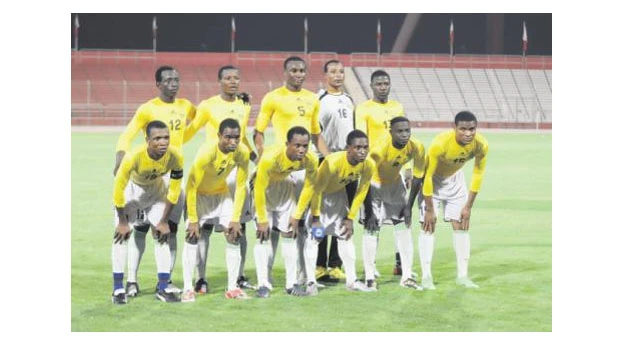
- JEDDAH: World attention is once again focused on the murky world of match-fixers after allegations that millions were made on betting over a match between a fake Togo soccer team and Bahrain’s national team on Sept.
- 7.
Togo later said it had never sent its national team to play in the game and its football authorities are investigating. Togo's sports minister said he would ask FIFA — soccer’s governing body — to investigate.
Bahrain, who are ranked 75th in the world, had the ball in the back of the net eight times during the match, but five goals were disallowed as a result of offside decisions which were described in local media reports as "questionable".
It is now feared that the whole fixture was set up by agents working for a Southeast Asian betting syndicate who had staked a fortune on the result of the game.
Richard Solitoko, spokesman for Togo's Football Federation, said a number of officials, including the former secretary general of the federation whose signature appears on correspondence with Bahrain football authorities, have been summoned for questioning.
Kodzo Samlan denies writing the letter that accepts Bahrain's invitation to play the international, and has called it a “forged document.” “I quit the interim football federation as its secretary general in May this year so I could not have written that letter,” Samlan told The Associated Press this week.
It is thought that Samlan's signature may have been forged to trick the Bahrain Football Association (BFA) into thinking the team was a genuine Togo team.
Bahrain's coach Josef Hickersberger has expressed his frustration claiming the whole match was a waste of time for his players, who are currently preparing for an international tournament.
He said: "They were not fit enough to play 90 minutes. The game was very boring. Basically it was not good for us because we wanted to get information about the strength of our team."
Bahraini soccer fans called for an open investigation. "There is a big question mark regarding this match. An independent inquiry should probe the case from all angles," Moosa Habib, coach of Manama Club, told Arab News. A player from the Manama Club played in the match.
"A technical committee of the BFA decides on the match to be played where a voting process is done and a decision taken by a majority. But if an individual has approved this match then its a big mistake," Habib added.
The Togolese team's French coach, Thierry Forge, confirmed that the team was anything but Togolese. "After our CAN 2012 game against Botswana in Gaborone (1-2) on Saturday, Sept. 4, the team dispersed. It was impossible to be in Manama. I do not know who played but they were not part of our group," he says.
"We would like to know who was there. Were they local players? If yes, how were they able to travel, buy tickets and leave the country? It's really weird."
A BFA spokesman told the Gulf Daily News that they had received all the official documentation for the match, including the players' passports. He rejected reports that the match was organized by a fake football agent, saying the agent in question had always been "100% all right" and was now cooperating with the investigation.
Britain’s The Daily Telegraph quoted sources close to the BFA as saying that the agent behind the friendly match was Wilson Raj Perumal, who has a conviction for match-fixing and has failed to answer bail in his native Singapore, where he has been convicted on an unrelated matter.
In 1995 Perumal was jailed for a year for match-fixing and he is currently under investigation by the football authorities in Zimbabwe after allegedly taking a club side to Malaysia last year and passing the players off as the national team.
Perumal denied Wednesday having anything to do with the scandal. Speaking from Britain, where he claimed he was on holiday, he told the newspaper: "You have got the wrong person. I do not have anything to do with football. I do work within sport but this has got nothing at all to do with me."