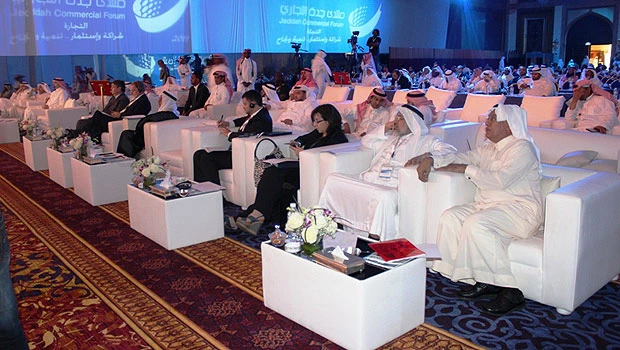
- JEDDAH: Businessmen expressed their dissatisfaction with media’s continuous attacks on traders who are accused of greed and jacking up prices at the Jeddah Commercial Forum on Wednesday.
Abdullah Binzagr, a Saudi businessman, called on media representatives to provide a balanced perspective of the price-rise, both from the points of view of consumers and traders.
“I would be dishonest if I say we don’t increase prices. We do increase prices, but not without a reason,” Binzagr said.
The conflict between traders and media was extended to the press conference, which was held following the session.
A heated debate emerged between businessmen and reporters, both attacking each other of “lack of transparency and accuracy.”
Binzagr told reporters, who accused businessmen of not answering phone calls: “Media does not address traders’ losses. When the summer vacation was extended that had a bad effect on products. Traders had to sell chicken, for example, for lesser prices, no one reported that.”
Atiya Al-Zahrani, a Ministry of Commerce and Industry’s Jeddah-based department head, said the main reason behind the price increase across the Kingdom is the huge importation business, which automatically links local prices to those at international market levels.
Al-Zahrani stressed the need for increasing the awareness of consumers on the quality of products and urged them to be vigilant about fake items.
Mohammad Khaiat, an economics professor at King Abdulaziz University, said studies had shown that prices had increased in the last few years by 39 percent, which created a general dissatisfaction among the pubic.
Khaiat called for a monitoring center that can study the market behavior and price patterns.
Speaking at the press conference, Hussein Abudawood, a businessman, said: “Watch the prices of oil, the higher they go the more we will suffer from inflation. Wait for some more years — prices will increase more and the government will need to find solutions.”