
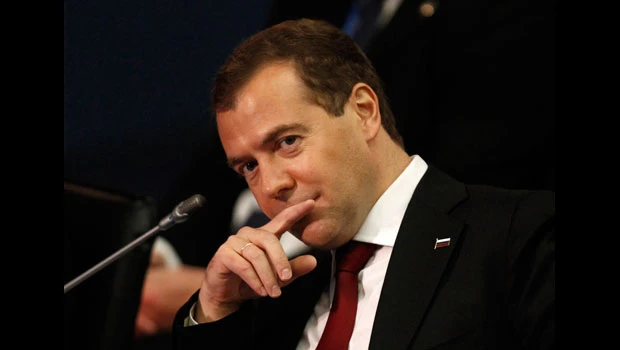
- ST PETERSBURG: Russian President Dmitry Medvedev called for less state involvement in the economy and promised more privatization in a speech which set him apart from Prime Minister Vladimir Putin.
Many foreign investors were impressed by his address, in which he warned of stagnation Russia if did not modernize and criticized the centralization of power under Putin, although others have questioned his ability to carry out such reforms.
Some said the speech showed his desire to stay in power after next year’s presidential election.
But the failure to conclude a gas supply deal with China in time for signing at the St Petersburg International Economic Forum took some of the gloss off Russia’s answer to Davos.
The 30-year supply deal between Russia, the world’s largest energy producer, and China, the largest consumer, could be worth up to $1 trillion but a disagreement over pricing meant negotiations will have to continue.
Medvedev told the forum: “The Russian economy should be dominated by private enterprise and private investors. The state should protect property and the choice of those who knowingly risk their money and reputation.”
Russia has announced a privatization program intended to raise about $10 billion this year but, describing the government’s plans as too modest, Medvedev said: “The government will have to adjust its program by Aug. 1.”
His economic aide, Arkay Dvorkovich, said: “We can have 50 percent more next year from privatization, so instead of $10 billion we can have $15 billion.”
Medvedev also said corruption had to be wiped out and efforts made to ensure the economic stability propped up by high oil prices did not become stagnation. “The notorious stability could hide another period of stagnation,” he said.
Some analysts say the Russian economy could stagnate if Putin returns to power in 2012. Medvedev also issued a warning about the political system created by Putin because it concentrates a lot of power in the hands of one person.
“If everything starts to work on a signal from the Kremlin ... it means the system is unsustainable, ” he said.
Putin, 58, and Medvedev, 45, have not said which of them will run in the presidential election in March.
Medvedev was Putin’s chosen successor in 2008, when the constitution barred him from a third straight term, but the prime minister has remained Russia’s paramount leader and the final decision lies with him.
“I see this as a campaign message: Medvedev has decided to declare clearly that he is planning to stay for a second term, said Gintaras Shlizhyus, an economist at Raiffeisen bank. But he added: “Everyone understands that Putin has the last word.”
GAS SUPPLY DEAL REMAINS ELUSIVE
Medvedev had hoped the gas supply deal, which would help power Beijing’s booming economy and allow Moscow to diversify exports away from Europe, would be agreed in time for it to be signed with Chinese President Hu Jintao during the forum.
But a source close to the talks said Russian state-controlled gas export monopoly Gazprom and China National Petroleum Corp (CNPC) had not been able to close the gap on price terms.
The Chinese want a fixed price and the Russians are seeking to uphold the oil market link that underpins Gazprom’s existing export contracts.
Both sides played down the problem, and negotiations are expected to continue. Russian Energy Minister Sergei Shmatko said Russia and China must both show flexibility.
Russia did, however, manage to sign a 1.2 billion euro ($1.52 billion) deal with France at the forum, under which Paris will supply Moscow with two Mistral class helicopter carriers made by a French-led consortium.
The deal was the biggest signed at the forum, where foreign investors voiced concerns about the Russian investment climate — corruption, bureaucracy, the weak rule of law, poor property rights, political uncertainty and a lack of skilled labor.
“If you invest a lot of money in a business in a place like Russia you want some certainty and some predictability,” said Jorgen Buhl Rasmussen, chief executive officer of Danish brewer Carlsberg, before adding he saw good opportunities in Russia.
Many investors also said Medvedev had failed to carry out many of his reform promises as president but some said they saw a new determination in his speech at the forum.
Jim O’Neill, chairman of Goldman Sachs Asset Management, said concerns about Russia were overblown and it deserved its place in the BRIC group of developing economies.
“Contrary to the e-mail I get every two hours about why I should drop the R from BRIC, I quite like Russia,” he said.