
- Friday 8 July 2011
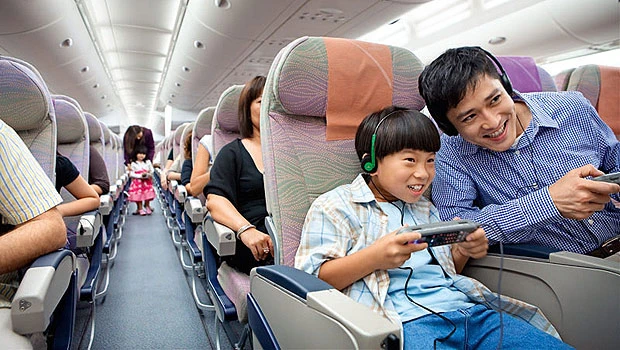
For the seventh year in a row, Emirates Airline’s "ice" inflight entertainment system has been awarded the "World’s Best Airline Inflight Entertainment" award at the 2011 Skytrax World Airline Awards. The awards are based on voting by over 18.8 million airline passengers from 100 different nationalities. “We are proud to have our efforts recognized once again and we can assure our passengers that we won’t be resting on our laurels at all; we’ll be working harder than ever to make sure that our passengers continue to have the best entertainment experience in the air,” said Patrick Brannelly, Emirates’ Vice President Corporate Communications Product. Skytrax CEO Edward Plaisted added: “Emirates seems to have a very firm grip on this title, having been named the winner of the award for many successive years.” Inflight Entertainment (IFE) has become a key competitive benchmark for airlines worldwide. Emirates has maintained its industry-leading position by continuously investing in and expanding its entertainment offering; resulting in an incredible range of movies, television and music from around the world. Emirates latest IFE system, ice Digital Widescreen ("ice" stands for information, communications and entertainment), offers a staggering choice of over 1,200 channels of entertainment, including over 280 movies from around the world, hundreds of TV choices and thousands of music tracks from contemporary to classical. As well as investing in the latest entertainment content and newest systems, Emirates has recently finished upgrading the hardware on its existing A330-200 and A340-300 fleets to a new digital IFE system; bringing ice to every seat in Emirates First Class and Emirates Business Class. Also, Emirates now has more than 90 aircraft equipped with AeroMobile, which allows mobile phone use inflight, and will soon roll out A380 aircraft equipped with WiFi Internet connection.
Etihad Airways is continuing to build its presence in France with the signing of a new commercial agreement with French Railways (SNCF). The deal — Etihad’s 32nd — will allow Etihad passengers to book flights beyond Paris Charles de Gaulle airport (CDG), by connecting onward to SNCF’s 2,000 km high-speed TGV rail routes, and vice-versa. The seamless air-rail connections comprise 20 cities in France including: Bordeaux, Le Mans, Lille, Lyon, Marseille, Nantes, Rennes and Strasbourg. Tickets can be booked online via etihadairways.com, the airline’s contact centers, or through travel agents selling Etihad tickets. Etihad Airways Chief Commercial Officer Peter Baumgartner said: “We’ve just gone double daily to Paris, and combined with this exciting new codeshare with SNCF, it illustrates Etihad’s growing commitment to passengers traveling to and from France. Allowing them to book tickets closer to their departure and arrival points is a fantastic proposition to our customers. The high-speed rail infrastructure already in place, and the proven credentials of SNCF and Etihad will allow passengers a seamless travel experience through Paris CDG airport on to the TGV network and vice versa.” Etihad Airways began operations in 2003, and in 2010 carried more than seven million passengers. From its hub at Abu Dhabi International Airport, Etihad serves 68 cities in the Middle East, Africa, Europe, Asia, Australia and North America, with a fleet of 57 Airbus and Boeing aircraft, and 100 aircraft on order, including 10 Airbus A380s, the world’s largest passenger aircraft.
Singapore Airlines has reached agreement with Airbus to lease another 15 A330-300 aircraft, providing additional growth opportunities to the airline. Under the terms of the agreement the aircraft will be delivered new from Airbus production line between 2013 and 2015. They will be operated by Singapore Airlines on routes within Asia as well as to points in Australia and the Middle East. The aircraft will be powered by Rolls-Royce Trent 700 engines. They will be leased for a minimum of six years, with an option to extend the lease term, and will join 19 Trent 700-powered A330-300s already in service. “The A330s will enable us to add more capacity on regional and medium range routes and further strengthen Singapore Airlines’ network offering. These new planes will also provide enhanced levels of comfort to our customers and boost operational efficiency,” said SIA CEO Goh Choon Phong. “Together with the additional A380s that we are taking delivery of this year, as well as Airbus A350s and Boeing 787s on order for the years ahead, the lease of the A330s is consistent with our longstanding policy of operating a young and modern fleet.” The A330-300s will be configured in a two-class layout featuring the Airline’s latest cabin product and service offerings. The business class cabin features a new seat specially designed for regional and medium-range routes, in a 2-2-2 configuration. The seat converts into an incline lie-flat bed offering exceptional levels of comfort, privacy and functionality. The Economy Class cabin is laid out in a 2-4-2 configuration, featuring a new-generation seat which is also available on the Airline’s Airbus A380 and Boeing 777-300ER aircraft. Ergonomically designed to provide customers an unsurpassed level of comfort, the seat provides more personal space and increased legroom. All seats feature the new KrisWorld, Singapore Airlines’ award-winning in flight entertainment system.
Expansion of Dubai Airport is extremely good news for the Middle East Airlines that are undergoing fleet expansion plans, according to aerospace and defense analyst Frost & Sullivan. It added: “This increase in fleet size will create a need for more parking space and infrastructure in the long run, which in turn will bring more passenger traffic to the airport. Dubai Airport serves as a hub for many big airlines that have a global presence and bring traffic to Dubai. With this massive airport expansion program, Dubai aviation industry will witness growth and in turn add to the growth in the global aviation industry. However, the rising oil prices can prove to be a challenge as this may force airlines to increase air fares and cut routes, which may have a negative impact on the passenger traffic and airlines’ profitability.”