- Week two of Shubbak presented more of the complexities of contemporary Arab culture, ranging from the perplexities of public spaces throughout the region, to the presentation of a problematic selection of books on the Arab world and a range of socially engaging cinema.
Starting the week was the anticipated opening of the Bidoun Library hosted by the Serpentine Gallery. This is the latest edition of the mobile selection of books and other printed material put together by the non-profit initiative, Bidoun Projects, and part of the Middle Eastern culture publication, Bidoun Magazine. Having previously been installed at New York’s New Museum and Art Dubai, London’s edition has two particular focuses: the presentation of any printed material found about the Egyptian revolution, coinciding with the summer edition focusing on the revolution, and a response to the threatened state of London’s public libraries. Also unique to this edition is a one-off section of books found at the abandoned Iraq Embassy of the former German Democratic Republic by Berlin-based artists Sophie-Therese Trenka-Dalton and Hannes Schmidt. What makes the library so strong and unique is its critical approach to the books it includes. Out to find any published pieces that refer to the Middle East, it questions what the concept of “Middle East” is, in terms of dialogical reference as well as a Western view on it. Most of what is displayed was found in London. With the aim of finding the “cheapest” books in the region, the selections range from comic books and other caricaturizing material to political documents from 1991’s Gulf Crisis, as well as publications about the Middle East’s emerging art scene.
Later in the week, was the first in a two-part talk about architecture in the Arab world. The talks served as the opening discussion for an ongoing photography exhibition of public spaces in the Arab world, which showcased images from mosques, souqs, squares and malls. There were also pictures of the types of free, public spaces the Arab world has traditionally been accustomed to, such as a couch on the side of the street, a broken down car used as a settee, or hand-built benches with barasti style (made of palm leaves) shades. A bulk of the photos displayed were commissioned with the assistance of civilian journalism news wire Demotix, but also included fine-art photography from Bahrain-based Camille Zakharia and emerging photographer Charlie Koolhas and architectural renditions from firms Austin Smith: Lord and Mossessian & Partners, among others. This exhibition will be up at the Royal Institute of British Architects till Sept. 24.
Attempting to discuss the development and use of public spaces in the Arab world, as one audience member put it, it was an ambitious discussion, aiming at various concepts of “public space” throughout the culturally and topographically diverse region of the Arab-speaking world. The discussion looked at the developing use of malls as new public areas, akin to the old souqs. Speakers also went into architectural design concepts in building new town developments around the Gulf. Most relevant to public space however, were the presentations by Cairo-based architect Shahira Fahmy on the grass-roots self-organization laid out in Tahrir Square during the 18-day revolution (and still going on today): a genuine popular use of public space. Murray Fraser, professor of architecture at University College London spoke of his work with the Palestine Regeneration Team (PART), whose projects are based on social mapping and low energy consumption. Finally, adding the new media angle was Turi Munthe, chief executive officer of Demotix, talking about the online, virtual public space, which has played an integral part in the ongoing political and social changes.
The idea of public spaces in the Arab world is a constantly changing one. The geographic lay out of towns continue to shift from organic to private to, in some areas, militarized. Yet, the current fad sprawling Middle Eastern cities is the glass and steel high-rises and hi-design developments. Modernist Lebanese architect Bernard Khoury stated flatly that “the region does not have public spaces,” which is not to the true definition of what applies to a general public — a very important point to be made for the future of the Arab world. Moving forward toward more corporate structures, such as malls and business districts, the Arab world is constantly in danger of building towns made up of exclusive spaces. The Arab world’s current focus on “hi-profile” architecture and grand image-fitting structures will in the long run, be detrimental to development, rather than an asset, due to its focus on the privileged class.
The next talk in this series, presented by NOUS and RIBA as part of Shubbak, will discuss the Future of Architecture in the Arab world.
This week’s chosen film event was the exciting series of Emirati short films, programmed by the London-based INIVA at Rivington Place in conjunction with the Dubai International Film Festival (DIFF). The series was successful at choosing four films that each presented a different complexity of contemporary life in the UAE.
“End of December” focuses on a retired man whose memory only holds the Dubai of his younger years. A disillusion that can be said to plague many people in the Gulf, this film comments on our fast-changing society and our personal relationship with the places that are turning fast from recent realities into nostalgic memories.
“Malal” takes its audience on a walk with a lonely girl on her honeymoon in Kerala. Hoping to catch a glimpse of some elephants, instead she gets lost and is helped by a young, local boy. After their day together, they develop an affinity to each other that cannot be pursued. Reflecting on the ongoing arranged marriage dynamic of the Middle East, this film looks at the possibility of a freer romantic interaction that doesn’t look at class or ethnicity.
“Slow Death” looks at the way contemporary Gulf society deals with migrant workers. The main character has been digging graves in Dubai for over 30 years and wishes that he himself could die there too. However, about to retire, he legally has one month to leave back to a home that he hasn’t considered in decades. This is an issue that has now come into question as the Gulf’s industrialization age is maturing and many expats are reaching retirement.
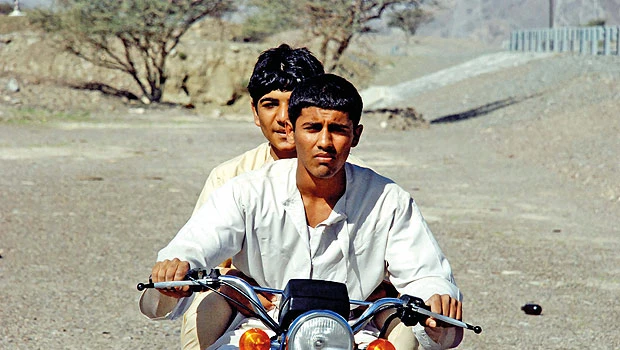
Finally, “Sabeel” presents a side of the UAE not popularly presented in the media: The rural side where the less urbanized are living, at most parts, less privileged lives. The film is about two young boys living in a farm who sell their fruit and vegetables along the barren road. With a sick mother at home, audiences witness the hardship endured by the people outside of the glitzy limelight of sci-fi Dubai.
Seeing these short films address such pertinent questions was a very exciting way of engaging with the social issues of today’s UAE. To know that young artists are concerned with contemporary regional issues is reassuring towards a future of critically engaging creative filmmakers.
Next week, the final week of Shubbak promises more architecture at RIBA, some film at the Tate and a Serpentine hosted Egyptian style sha’abi party in Hyde Park.