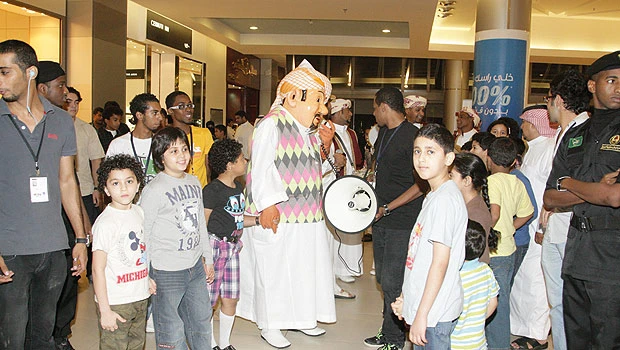
- A traditional wedding singer performs as the groom walks by wearing a sunset orange turban, while his friends and family surround him with their dancing sticks.
- Children are running around, playing in the Harah (district) bringing joy and laughter to the people who live there.
You will find a man standing behind a large pot of ful (beans) and another man standing next to him selling traditional homemade bread. Neighbors exchange home-cooked meals.
In front of a house, old men gather to chat at the mirkaz, a corner where men come together and storytellers relate their tales. These men will provide solutions when the local residents have problems.
These are the 35-year-old memories that Am Mahmoud shared with Arab News. He relived them in “Old Jeddah,” an exhibition held at the Red Sea Mall, Jeddah. The exhibition reflects on the beautiful, simple life of our ancestors in Jeddah. Its aim is to revive the memories of the old Red Sea Bride by offering information to the young inhabitants about the life of their ancestors.
The idea behind the event is to picture the old Hijazi cultures, traditions, customs and music through art. Professional painters have drawn images of life in old Jeddah to document the life of their grandparents who all lived in Jeddah more than 50 years ago.
There is even a mirkaz where an actual hakawati (storyteller) narrates his stories and delivers traditional poetry.
Moving around the mall, we see a folklore troupe singing and dancing, and playing games that used to be played by all inhabitants. Actual house utensils from the old times as well as replicas are also on display, including an ironing tool that uses coal, a jar used for potable water, and a ful pot.
A 100 artists drew live in front of an audience surrounded by folk and traditional dances. They are competing to be one of 10 winners who will be honored at the end of the event.
It took the organizers a week to assemble the exhibition, collecting the replicas and edifices picturing life in the old city of Jeddah. They said two days after the opening, visitors of various age groups started to come to the exhibition in large numbers. The old visitors relive their old, simple life while the young ones try to learn more about the lives of their fathers and grandfathers.
Fatima Baazeem, one of the organizers, told Arab News that young and old visitors interacted positively with the displayed items. She said foreign visitors wanted to know more about the Hijazi traditions, which were now fading.
“We were surprised by the number of volunteers who applied to help with the event that aims to celebrate the memory of their old city,” she said. “We gave them assignments according to their interest and age group until we had 20 volunteers from both genders,” she added.
Duaa Thabit, another woman organizer who came up with the idea for the exhibition, said they were keen to organize the event to preserve the old Hijazi norms and traditions.
"Our beautiful Hijazi life had begun to fade. People in other countries are eager to maintain their old traditions for future generations, and we thought of doing the same for our younger generations," she said.
Thabit said people in neighboring Arab countries like Egypt and Syria preserved their old traditions in films and TV series. "We do not have museums or documentaries to keep our traditions for future generations, so we came up with this exhibition to celebrate and document our own," she explained.
The exhibition has already attracted a large number of foreigners as well as young Saudis, according to Thabit. "The old Saudi visitors reminisce about traditions and join us in explaining the old norms of Hijazi life to non-Saudi visitors. The young audience enjoy the exhibition, as they are interested in knowing about the old life in this modern city," she added.
The aim of the exhibition is to document Jeddah’s old life after the application to include Jeddah’s downtown historic center as a United Nations Educational, Scientific and Cultural Organization (UNESCO) World Heritage Site was withdrawn in order to refurbish the old Jeddah downtown area following a downpour that devastated the area.
“We wanted to celebrate our heritage by hosting an event that everyone could visit and enjoy,” she said. “We wanted the younger generation to learn about the older generation by listening to the Hakawati and by looking at the displayed pictures and items,” she explained.
The exhibition is held at a big commercial center so it can be visited by a large number of residents and tourists during the summer vacation. It will last until the 16th day of Ramadan (Aug. 16). All the paintings will be put on sale when the exhibition is over.