- JEDDAH: Arab News has obtained from special security sources the details of the crimes committed by the terrorist cell of Turki Al-Dandani which began operations in February 2003 in a series of attacks that resulted in the death of 239 Saudis and expatriates.
Eighty-five members of the cell are currently being tried for those attacks.
Al-Dandani's group was the second terrorist cell in Saudi Arabia under the leadership of Khaled Al-Haj of Al-Qaeda in the Arabian Peninsula. Investigations revealed that the cell established a number of groups in various regions:
* Riyadh Group consisted of a number of individuals under the leadership of Al-Dandani himself. Its tasks included aiding and abetting militants, gathering information about targets, wiring cars with explosives and recruiting suicide bombers.
* Qassim Group was under the leadership of Rakan Al-Saykhan, who was in charge of acquiring arms. The group was responsible for manufacturing and storing explosives before they were sent to Riyadh to be used to commit acts of terror.
* Al-Kharj Group was charged with collecting intelligence on Prince Sultan Air Base, one of the targets of the organization. It also recruited militants for the planned attack and transported weapons and explosives to the area.
* South Group was responsible for collecting intelligence on the air base in Khamis Mushayt and assembling explosive devices for the planned attack.
* Al-Ahsa Group transported Al-Dandani out of Riyadh a day before the 2003 attacks and hiding him in Al-Ahsa.
* Al-Jouf Group is accused of aiding Al-Dandani's escape from the Kingdom.
* Al-Darieyah Group was the group that is accused of carrying out the attack on residential complexes and school buses in Riyadh in 2003.
These groups are collectively referred to as Al-Dandani's groups. Together they are accused of committing nine criminal acts:
1. Members of the group clashed with security personnel on Jan. 25, 2003. Two group members were arrested in that skirmish, but Al-Dandani was able to escape.
2. On Feb. 19, 2003, an explosion occurred at a hide-out of the terrorist group in Riyadh's Al-Jazirah district. A member of the group died in the explosion, which is believed to have been accidental. Police found hand grenades, guns and ammunition, as well as audiovisual footage of Prince Sultan Air Base. After the incident, the government announced it was seeking 19 men in connection with the groups' activities.
3. A number of militants clashed with security personnel and citizens at Al-Roshan apartment complex. In the clash, militants carjacked a vehicle in a failed attempt at escape. All of the men involved in this incident were arrested or surrendered.
4. On May 7, 2003, security forces identified the location of Al-Dandani and a number of accomplices and started pursuit. During the chase, militants fired at pursuing forces and stole vehicles in their successful bid at escape to a remote area of farms and rest houses. Once there, they met up with Khaled Al-Haj and left for a hide-out in one vehicle.
5. Detained radical Ali Al-Khudair issued an illegitimate fatwa saying it was not against Islam to murder American citizens. Meanwhile, the South Group met with Al-Dandani in Riyadh, who asked the group's members to conduct reconnaissance on King Khaled Air Base in Khamis Mushayt and to amass arms for a planned attack.
The leader of the South Group obeyed the orders. He took photos of the air base's entry points and runway and recruited a man to assist him in the manufacture of explosive devices.
An initial plan to sneak in and detonate explosives at the air base's housing facilities was scrapped and replaced with a plot to take down an aircraft with an SA-7 shoulder-fired missile.
In April 2003, members of the group also received orders from Al-Dandani to transport 128 kg explosives from Riyadh to Al-Kharj. They hid the explosives and forged permits to enter the air Base. On May 15 of that year security forces caught one of the members of this group and seized arms and explosives. Other members were caught after this raid.
6. In March 2003, the group planned to attack Prince Sultan Air Base in Al-Kharj with the explosives brought there.
7. Militants were caught on May 9, 2003, attempting to enter Al-Zihour Residential Complex in Al-Darieyah to detonate explosives.
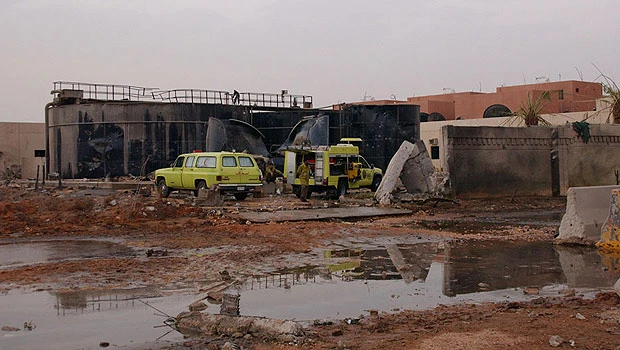
8. On May 14, 2003, the militants successfully detonated explosives at three residential quarters in Riyadh: Grenada, Seville and Janadriyah.
9. Following the attacks, Al-Dandani was smuggled under a woman's abayah out of Riyadh to Al-Ahsa and then Al-Jouf. He was tracked by security forces to Al-Jouf on July 3, 2003. Al-Dandani and three of his accomplices committed suicide before they could be captured alive.
The trial of the 85 terrorist who were members of Al-Dandani cell began on June 26. The first court sessions informed the defendants of the list of charges against them. Prosecutors are asking for the death penalty for all but six of the accused who face long prison terms.