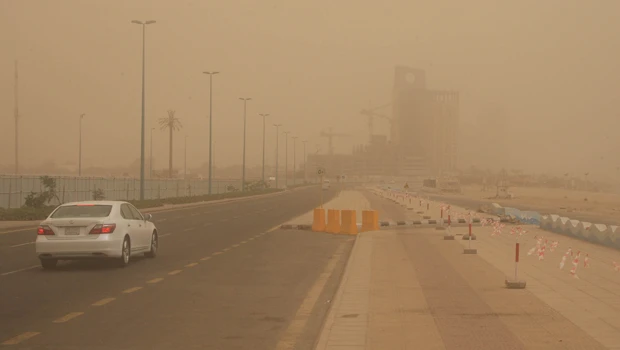
- JEDDAH: The eve of the holy month of Ramadan brought with it a huge wind-borne dust cloud that enveloped the Kingdom’s west-coast cities from Jazan to Jeddah.
Visibility dropped to well below a kilometer and the sun struggled to penetrate the sickly yellow haze as a faint white disc.
Borne by a southerly wind, the dust is predicted to remain over the Makkah region Monday and may well envelop Madinah on Tuesday and Wednesday. The bilious khaki cloud stifled the cities, trapping the heat radiating from urban infrastructure already warmed by the 45C temperatures.
Manual workers on building sites and cleaning the dusty streets donned face masks against the dust and itinerant car washers downed their buckets and cloths in dismay as there were no takers.
The Presidency of Meteorology and Environment (PME) issued a warning on its website that visibility would continue to be less than one kilometer in Makkah and the coastal areas of Jeddah, Laith, Qunfudah and Jazan.
The hot and humid wind is expected to continue, raising more dust and the PME did not rule out the possibility of temperatures in excess of 50C in some places.
Hospitals in Jeddah on Sunday recorded a 30 percent increase in the number of people complaining of breathing problems and respiratory complaints over the last two days as the haze took hold of the city.
The head of the Al-Thagr Hospital in Jeddah, Muhammad Bajubair, said sharp changes in the weather and the increased heat over the past few days have been the main factors for the rise in the number of patients in the city hospitals.
With the haze enveloping the city, susceptible individuals, particularly those suffering from asthma, allergies and lung conditions, need to take extra precautions. Moreover, those with sensitive eyes, elderly and children need to be careful, Bajubair said.
The PME warned motorists to be extra cautious on the highways as the weather is expected to be hazy in Jeddah and Makkah over the next two days. The Jeddah traffic department warned motorists against speeding and recommended the use of hazard lights if and when visibility drops.
Ramadan requires abstention from food and water for a long period during the day. This year it will be a particularly grueling challenge as the fasting period extends over 14 hours.
“People should drink lots of water before fasting, and try to remain indoors for the majority of the fasting period, and also not be exposed to the heat,” Bajubair added.
Other precautions against extreme dehydration and heat exhaustion include seeking out cool environments, minimizing physical exertion and pacing work during the day.
The dust cloud is mainly microscopic particles of sand (silicon carbide) that are abrasive. Their inhalation could aggravate existing medical conditions but also carries another threat; airborne contaminants picked up by the wind that land on the food displayed on street stalls that are commonplace as the breaking of fast approaches each day.
To minimize risk of picking up an infection, it would be wise to wash fruit and vegetables thoroughly before consumption and ensure any cooked food on sale is under cover and away from precipitating dust.
A useful precaution is to learn to recognize the symptoms of dehydration and act before they become severe. The Mayo Clinic’s website (www.mayoclinic.com/health/dehydration/DS00561/DSECTION=symptoms) has a useful list.