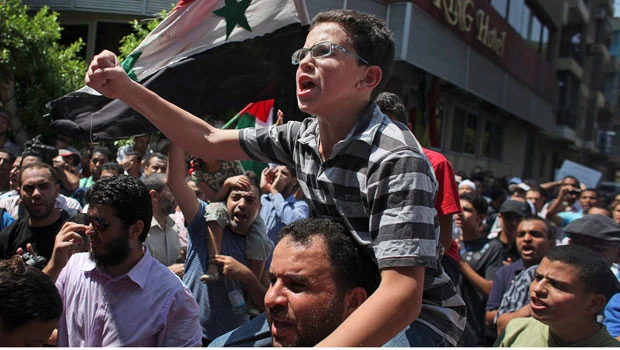
- AMMAN/DUBAI : At least 59 Syrian civilians were killed in armored military assaults by President Bashar Al-Assad’s forces on Sunday, prompting the Arab League to join calls on the nation's authorities to immediately stop acts of violence.
Arab League Secretary-General Nabil Elaraby issued a statement expressing “growing concern and strong distress over the deteriorating security conditions in Syria due to escalating violence and military operations in Hama and Deir Al-Zor and other areas of Syria,” Qatar’s state news agency QNA reported.
A grassroots activists’ organization, the Syrian Revolution Coordinating Union, said among those killed by Assad's loyal troops Sunday were 38 in the eastern city of Deir Al-Zor and 13 in the Houla Plain, 30 km (19 miles) north of the city of Homs, which were stormed by tanks and armored vehicles early on Sunday.
“These are preliminary figures. The numbers of casualties are escalating by the hour,” activist Suhair Al-Atassi, a SRCU member, told Reuters by phone from Damascus.
Elaraby’s statement was one of the strongest made by an Arab leader since the start of the Syrian uprising. Elaraby, who took office in May, started his new job by visiting Syria but declined to give details of a meeting with Assad.
In his statement that was also carried out by the Egyptian news agency MENA, Elaraby said: “There is still a chance for the reforms that were announced by President Bashar Al-Assad to be accomplished,” and called on the Syrian authorities to “stop all acts of violence” immediately.
He also called on the Syrian political powers and government to engage in serious talks, adding that the Arab League was ready to help to get Syria out of its crisis.
Elaraby’s predecessor Amr Moussa said only that he was worried about the clashes in Syria and signaled division in the 22-member body over how to proceed.
Gulf Arab states broke months of silence on Saturday to express concern about over the violence in Syria. Syrian authorities say gunmen have killed 500 police and soldiers since March.
Turkey, which borders Syria, said Sunday it would send its foreign minister to Damascus on Tuesday to deliver a strong message condemning the crackdown on the protesters. Turkish Prime Minister Recep Tayyip Erdogan said his country’s patience was running thin and that Turkey could not remain a bystander to the violence.
Syria’s reaction was quick. State-run TV quoted Assad’s adviser, Buthaina Shaaban, as saying that Turkey’s foreign minister “will hear stronger words because of Turkey’s stance that did not condemn until now the brutal killings of civilians, members of military and police.”
Gulf Arab countries broke their silence Saturday on the bloodshed, calling for an immediate end to the violence and for the implementation of “serious” reforms in Syria. In a statement posted on its website, the six-nation Gulf Cooperation Council expressed deep concern and regret for “the escalating violence in Syria and use of excess force.”
Syria’s state-run TV quoted an unnamed official as saying the GCC statement was ignoring the sabotage that armed groups are conducting.
Assad again promised to pursue reforms, SANA reported, something he has promised before but failed to deliver.
In the Vatican, Pope Benedict XVI urged Syrian authorities to refrain from using violence against peaceful protesters demanding political reforms.
The pope, speaking to pilgrims during his weekly blessing, called on Syria’s government to respond appropriately to “the legitimate aspirations of citizens,” urging both sides to return to a peaceful coexistence.
“I follow with great concern the dramatic and growing episodes of violence in Syria, that have provoked numerous victims and grave suffering,” Benedict said from his summer residence south of Rome.
The Syrian government’s crackdown has left more than 1,700 dead and drawn strong international sanctions and condemnation against President Bashar Assad’s regime.
Benedict also referred to the ongoing conflict in Libya, which he said cannot be resolved through armed force. He called on the international community to redouble efforts to draft a peace plan for the country using constructive dialogue.
The military assault on Deir Al-Zor, about 400 km (250 miles) northeast of Damascus, came a day after UN Secretary General Ban Ki-moon told Assad he was alarmed by the escalating violence and demanded he rein in the army.
“In a phone conversation with President Assad...the Secretary-General expressed his strong concern and that of the international community at the mounting violence and death toll in Syria over the past days,” the UN press office said.
Ban “urged the president to stop the use of military force against civilians immediately,” it added.
Facing international condemnation, including from Syria’s regional allies, Assad on Sunday defended the military campaign against what Damascus portrays as an armed insurrection.
“Dealing with outlaws and convicts who stage highway robbery and seal off cities and terrorize the population is a national duty,” state news agency SANA quoted Assad as telling visiting Lebanese Foreign Minister Adnan Mansour.
An Assad adviser said neighboring Turkey, which condemned the attack on Hama as an atrocity, should not meddle in Syrian affairs and warned Foreign Minister Ahmet Davutoglu he would get a frosty reception when he visits Damascus on Tuesday.
The Syrian Revolution Coordinating Union said most casualties in Sunday’s attack on Deir Al-Zor were in Al-Joura district in the west of the city.
A resident told Reuters: “Early this morning columns of army tanks and bulldozers, under cover of heavy rounds of gunfire, stormed into the western and northern entrances of the city and dismantled barricades set up by residents.
“A dozen tanks are taking position in the main square in Jubaila market in the northern sector of Deir Al-Zor,” the resident, who gave his name as Abu Bakr, said by telephone.
Syria has barred most independent media since the start of the uprising against Assad, making it hard to verify accounts from residents, activists and authorities.
Residents of Deir Al-Zor, situated on the Euphrates river in a province bordering Iraq’s Sunni heartland, had been bracing for an assault on their city.
A video posted on the Internet last week showed a tribal meeting discussing preparations for armed resistance to any military move against them.
Deir Al-Zor resident Abu Bakr, from the Jubaila area which has seen some of the largest anti-Assad demonstrations in recent weeks, said mosque loudspeakers were blaring “Allahu Akbar (God is greatest)” on Sunday.
Another resident said tanks and armored personnel carriers had crossed the Euphrates and deployed in the center of town.
“Shells are now hitting Al-Joura district,” he said, the sound of machinegun and tank fire echoing in the background. “No one dares go out in the street near the main square.”
In a separate assault on the Houla plain north of the central city of Homs, Syrian forces killed at least seven villagers, activists said.