- Edge of Arabia began with a focus on artistic exchange between Saudi Arabia and the United Kingdom.
- Since its first exhibition in 2008, the foundation has taken its show to Berlin, Venice, Dubai, Sharjah and Istanbul.
Their latest conquest is one to be proud of. Not only did they break past the United States border and enter a new continent, but work from the two artists that form part of Edge of Arabia’s co-founding team is now part of the permanent collection at the Los Angeles County Museum of Art (LACMA).
Ahmed Mater and Abdulnasser Gharem are the first Saudi Arabian contemporary artists whose work has been acquired by a major American museum.
In recent years, there has been a concerted effort at LACMA to build its Middle Eastern and Islamic collections. Spanning from the early Islamic to medieval periods, the most recent focus has been toward contemporary works. Curator of Islamic collections Linda Komaroff’s statement reflects on the importance of the collection.
The website devoted to this section states that the LACMA “has only just begun” collecting Middle Eastern works in Islamic contexts.
Advocating the importance of contemporary arts inspired by Islamic tradition, Komaroff writes that audiences “should not be exploring this art as a means to better understand the past. The collection can also be seen as a way to build creative links between the past, the present, and the future.”
This effort took significant steps forward when LACMA director Michael Goven visited Riyadh in Jan. 2010. Attending the launch of the Global Competitiveness Forum, he had a very productive meeting with Edge of Arabia. Back in Los Angeles, Goven and Komaroff maintained their communication with the Edge of Arabia team and were particularly interested in the two pieces by Mater and Gharem.
“I was deeply impressed by what I saw and also by what I heard from the artists themselves. At the time, I thought that Gharam’s Al-Siraat (video) and one of the Ahmed Mater’s Illuminations (print series) would make wonderful additions to LACMA’s collection. I am therefore delighted that one year later both artists are represented at LACMA. We are especially grateful for the gift of Ahmed Mater’s Illumination Diptych (Ottoman Waqf), which was made expressly for us and looks to be one of the finest examples in this series,” Goven explained.
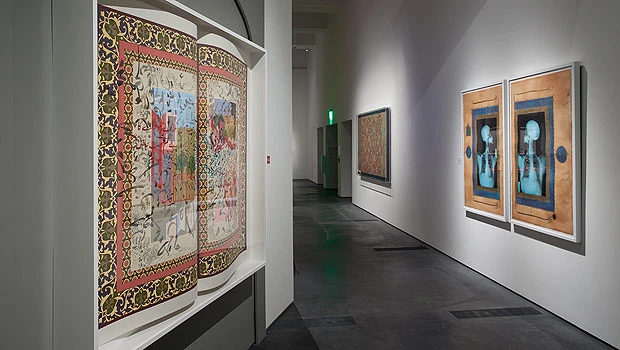
Ahmed Mater’s piece is now showing as part of the current exhibition there entitled “Gifts of the Sultan: The art of giving in Islamic courts.”
The exhibition, highlighting the role of gift giving in Islamic culture and tradition, touches on diplomacy, rites of passage and piety. Including pieces from three continents, it mainly covers a time span between the 18th and 19th centuries. Only a small portion of the show consists of contemporary works, of which Mater’s print is a part. Komaroff describes Mater’s work as inspired by Islamic art books, “with illuminated borders, chapter headings, and verse markers.” For this piece, commissioned for the exhibition, he “includes the word waqf, a notation often found in manuscripts of the Qur’an, which in legal terms designates a charitable donation,” she added.
Running parallel with the theme of the exhibition, the two-part print was gifted to the LACMA and will remain there as part of the permanent collection after the exhibition runs its course in early September. “It is an important and welcome addition to our growing collection of contemporary Middle Eastern art,” Komaroff said.
While Gharem’s piece is not included in the current exhibition, it is a strong example of the motive set forth by Komaroff of linking past and present aesthetics.
The video performance documents a night when the artist and his assistants went to a broken bridge in the Tihama region.
This particular bridge, expected to shelter people from an expected oncoming flood, collapsed despite its concrete make and sturdy appearance. The work uses this tragic event as a comment on the paths people choose in the spiritual sense and the trust they put in those choices. The shaky video work of a suspended road, covered with the word “al siraat” sprayed all over it, is set the sound of a man singing soulful melodies. “The medium is absolutely contemporary,” Komaroff explains, “but the rhythmic repetition of the single written word Al Siraat (meaning path) which is both decorative and potently meaningful, connects it with classical Islamic art.”
Edge of Arabia sees these acquisitions as testament to the interest in Saudi contemporary art by international institutions and collectors. Edge of Arabia director Stephen Stapleton said, “There is a growing recognition that the Edge of Arabia artists are producing original and historically significant works which both challenge and enrich audience’s understanding of contemporary Arab culture and society.”