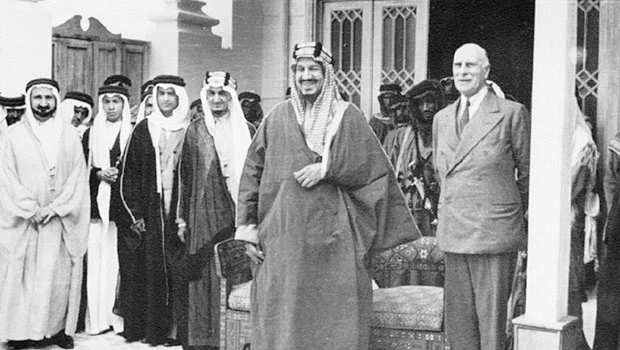
- A broom used to clean the Kaaba, maps of the Arabian Peninsula, a plan of the city of Makkah and a telegram from Bahrain to England dating back to the spring of 1938 have all been on display at London’s Royal Geographical Society for the past month.
These artifacts however, are merely support to the impressive collection of photos documenting the voyage of HRH Princess Alice, the granddaughter of Queen Victoria, to Saudi Arabia that year. She was the first European royal to ever visit the Kingdom.
Among the areas public cultural institutions in the Gulf have started to look at in recent years is public access to historical, archival material, whether in the form of academic collections or museum exhibitions.
This is now being developed in Bahrain, whose Ministry of Culture is planning renovation of architectural heritage across Muharraq and Manama. It is happening in the UAE, where the Abu Dhabi Authority for Culture and Heritage manages an ongoing program looking at areas of visual, intellectual and folkloric arts. In Qatar there is a grand and popular development of national museums focusing on history, art and sport.
Saudi Arabia, however, thought about this 25 years ago. Having built the King Abdulaziz Public Library (KAPL) in Riyadh, part of the venture was to collect objects of cultural and historical significance, putting the library in the position today to boast over 1 million artifacts and media, including books, coins, microfiche and other items, from the nation’s past.
The KAPL, built in 1985, collects these items for the sake of having ownership of national cultural heritage. “Our aim is to create an historical and educational collection and resource that can be used to promote our culture at national and international events and exhibitions,” said Dr. Adbulkareem Al-Zaid, deputy supervisor at the KAPL, in his statement at the opening of Princess Alice’s exhibition.
In the development of this collection, an image center was established holding rare photos dating back to the late 19th century. The images included did not just arise from the local vaults of Saudi, but from countries around the world. Among them is this series of photos taken by Princess Alice on her unique trip to “Arabia.” Working with the Royal Geographical Society (RGS), the KAPL is continuing its research to find historical visual material, including film, microfilm and video, to acquire the rights to bring this material home and as mentioned by Al-Zaid, tour the world.
This summer, Princess Alice’s photos were put on display at the central London RGS gallery. The exhibition, entitled “Journey of a Lifetime,” highlights a history of a country seldom seen in a visual, historical context but also put forward the relationship Britain has had and maintained with the Kingdom of Saudi Arabia. The trip is among the most well documented journeys. Princess Alice’s interest in photography and writing left her diary full with commentary on every event of her travels and a collection of over 300 photos. In addition, 30 years later, Princess Alice penned a book entitled “For My Grandchildren,” recounting stories from many of her travels including this one.
Princess Alice was invited to Saudi Arabia by the then Prince Faisal, son of King Abdulaziz, when they met at Ascot in 1936. Not intended as an official visit, the event in retrospect has a great place in the building of relationships between the two Kingdoms. Weary at first to be invited as a woman, knowing well that women did not customarily travel the peninsula, Princess Alice accepted.
Two years later, in 1938, she and her husband, the Earl of Athlone, flew to Egypt and traveled to Sudan from where they began their two-month trip. Eager for adventure and travel, the couple took part in an extraordinary journey, even in today’s standards. By camel, horse and car caravans, they went from Jeddah to Makkah, Riyadh and Dhahran. It was an ominous year in Europe; Britain was at the frontline of the impending Second World War; while oil was only just discovered in the eastern shore of Saudi Arabia.
The photos on display are mainly snapshots taken by and of the princess. She and her husband are photographed with helpers and companions, but also with King Abdulaziz himself, Prince Faisal and other members of the Royal Court. Other images show the Princess at the gate of Makkah, in the desert drinking coffee out of a traditional finjal (small Arabic coffee cup), and wearing customary black abaya.
Among the most interesting images were ones that show the clear and drastic changes that the landscape of Saudi Arabia has endured. These were the images of the towns and architecture of 1930s Makkah and Riyadh. Gateways into cities were made of mud with features such as wind towers and other details designed to optimize the creation of a breeze in the hot desert. Images of the markets show vibrant scenes offering a snapshot of the general public against the backdrop of medieval looking archways and wooden shuttered shop fronts.
To widen the context a little bit more, the exhibition also included items from explorers contemporary to Princess Alice whose texts, maps and images were held in the RGS library. Jan Turner, deputy librarian at the RGS, assisted in the research for the display. She commented that including the work of and about the Arabist and explorer Harry St. John Philby shows the great connection between the RGS and KAPL collections.
Philby spent years as King Abdulaziz’s advisor and later converted to Islam, changing his name to Abdullah. Princess Alice and Philby met in Saudi Arabia, and she described him in her book as “very knowledgeable,” but she also touched on some prejudice, a reality then just as now, stating that he was not much liked by the English because of his conversion to Islam and closeness to the king.
Archives and histories of this kind are crucial to understanding cultural and political pasts that the present can build on. This exhibition is rich in its telling of the historical relationship between Britain and Saudi Arabia.
It also offers a glimpse into the nature of the politics at a crux of global and regional change. But clearly, the photos on display also present a new view of a Saudi that the public, particularly in the West, doesn’t usually see; a Saudi Arabia that was full of energy, about to face a major shift in its cultural, economic and national structure.