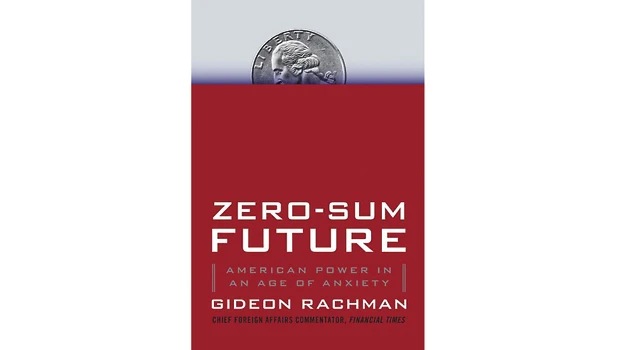
- How a globalized world turned into a divided one
In this first book, Gideon Rachman, chief foreign affairs columnist for the Financial Times, tells a timely story of how what was supposed to be a more open and globalized world turned into a more divided one and how years of euphoric prosperity gave way to an age of anxiety.
It all started with the collapse of the Lehman Brothers in the fall of 2008, which signaled the premises of the worst financial crisis since 1929. Replacing international cooperation, competition and rivalry between countries have returned on the political scene.
“A win-win world is giving way to a zero-sum world,” says Rachman. “Zero-sum logic, in which one country’s gain looks like another’s loss, has led to a sharp rise in tensions between China and the United States.”
To understand the reasons behind the present, somber mood, we need to review the recent past, dominated by two key events: The creation of a globalized economic and political system with the opening of China in 1978 and the 2008 financial crash. Interestingly enough, the policy of reforms instigated by Deng Xiaoping was largely ignored by Americans and Europeans at the time. Margaret Thatcher and Ronald Reagan, in particular, were far more interested in the end of the cold war than in the economic transformation of China. Both of them also ushered their countries into an era dominated by free-market ideas and private enterprise.
Rachman rightly observes that from 1978 to 1991, free-market reforms, whether in Europe, Asia or Latin America, were pushed through against a background of national economic crisis. James Kynge, author of one of the best books on the rise of China, “China shakes the World” (reviewed in this column), points out that the reason for the economic reforms in 1978 was essentially due to a shortage of cash and a “payment crisis.”
From 1991 to 2008, the world witnessed a period of supreme American power. The US had it all: Economic, financial, military and technological power. Its success was legitimized by Francis Fukuyama’s end of history thesis, which stated that the cold war had ended ideological competition and liberal democracy would reign supreme.
Al Gore explained this new thinking during a brainstorming session in the White House in 1994: “Ours is becoming a global civilization. There is a universal sense that democracy is humankind’s chosen form of political organization and that the free market is humankind’s chosen form of economic organization.” Bush reiterated the same ideas five years later when he said: “Economic freedom creates habits of liberty. And habits of liberty create expectations of democracy…Trade freely with the Chinese and time is on our side.”
However, in the wake of the financial crisis, deregulations and the abolition of capital control were no longer seen favorably and governments, which had been in retreat since the opening of China and Thatcher and Reagan’s economic successes, stepped back in to save their economies.
The return of the state spread not only to the Western countries but also to China and the oil-rich countries. Ian Bremmer, a political analyst noted in 2009: “Governments, not private shareholders already own the world’s largest oil companies and control three-quarters of the world energy reserves.”
Sovereign Wealth Funds (SWFs) invest on behalf of cash-rich governments. They are controlled by oil rich nations in the Arabian Gulf and by Asian nations like China, and they play a big role in the global economy. The sovereign funds now control more capital than private hedge funds. By 2009, the SWFs already accounted for one-eighth of global investment, and the figure is rising.
Governments are also concerned about the security of the supply of food: “If the market cannot be relied upon to provide these crucial products, the implication is clear: the state will intervene. That will probably mean more agricultural protectionism as governments pursue ‘food security.’ Asian and Middle Eastern nations, in particular the Saudis and Gulf Arabs, have also begun leasing large tracts of land in Africa in an effort to grow food that is reserved for their own nations,” says Rachman.
The rising price of foodstuffs threatens the stability of many poor countries. One of the causes of the surge in prices is due to widespread crop failures. Furthermore, industrial farming is straining water supplies. A shortage of water is threatening the future growth of both the Chinese and Indian economies. According to Brahma Chellaney, a leading Indian thinker, “the battles of yesterday were fought over land. Those of today are over energy. But, the battles of tomorrow will be over water.”
Globalization has created growth at the expense of rising inequality. Elites, whether Russian oligarchs, Chinese factory owners or bankers, to name but a few, have amassed gross fortunes while a large part of the world, “the bottom billion,” is left behind. Poverty, failed states, climate change, resource shortages and terrorism are some of the main issues, global in nature, which can only be solved through international cooperation. So far, however, the drive for global solutions through the UN, the G20 and the European Union has fallen short.
The G20 means a lot to the future of international politics since it brings together the leaders of all the world’s major powers but China and the US are bent into preventing it from becoming “an effective new instrument of international government.”
The UN, despite its General Assembly where all countries are represented, is relatively powerless. The true power is detained by the Security Council, but according to a UN official, the failure to reform the Security Council is “a cancer in the system.” The most blatant expression of the dysfunctional nature of the UN was the failure of the 2009 UN-sponsored climate change talks in Copenhagen.
As for the EU, Rachman uncovers some of its nasty secrets:
“High-sounding commitments are sometimes ignored or thrown overboard in a crisis… Other European rules are simply massaged away or ignored if they become too inconvenient. Well before the Greek crisis, the EU rules limiting budget deficits had been almost defined out of existence when they became too tough for France and Germany to accept.”
Both China and Russia are proud and defiant particularly in their rejection of Western Liberalism, as they are both pushing for a popular nationalistic agenda. Their assertive foreign policies have attracted followers such as Brazil, South Africa and Turkey. Brazil struck an oil deal with China and voted against UN sanctions on Iran in 2010. When South Africa obtained a nonpermanent seat on the UN Security Council in 2006, it often vetoed Western-backed resolutions on human rights in Zimbabwe, Iran and Uzbekistan. As for Turkey, it is increasingly focusing its foreign policy toward the Middle East and Asia. It is turning away from the West which has repeatedly thwarted its efforts to join the EU. In June 2010, Turkey surprised many Western analysts by voting against American-sponsored sanctions against Iran.
Since the world’s major powers are having greater difficulties in cooperating, “it is increasingly urgent to break the zero-sum logic of the emerging international order,” says Rachman. “The most important question of all is the preservation of the international economic system that fostered globalization… a breakdown of the system would slow the world economy in ways that would damage the livelihoods of ordinary people all over the world.”
Although China has become the world’s largest player, (it has the largest currency reserves also is the world’s largest exporter and producer), the US is the undisputed symbol of democratic and free-market values. Therefore, “a strong, successful and confident America remains the best hope for a stable and prosperous world,” concludes Rachman.
“Zero-Sum Future” gives us a brilliant and clear account of how and why the world’s major powers embraced globalization and where we are heading as international politics are becoming unstable, unpredictable and dangerous. This incisive book is intelligent, engaging and essentially readable.