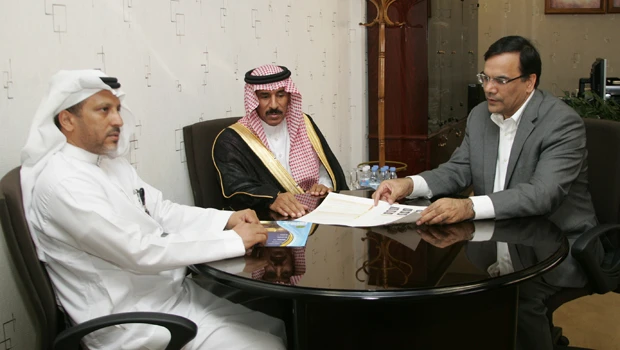
- DAMMAM: King Fahd University of Petroleum and Minerals has created a leadership-development program for its administrators that may set a new standard for human resources in Saudi businesses and universities.
About 80 employees ranging from directors general to functional managers took part in the program, which gives them the opportunity to meet with the university’s senior management and get insights into their perspectives and priorities.
“The university aims to develop the leadership and management competencies of its service-sector administrators so that they can support its educational and research programs more effectively and efficiently,” said Muhammad A. Al-Khaldi, dean of Faculty and Personnel Affairs. “The competencies include self-awareness, interpersonal understanding, team development, integrity, planning and organizing, process focus, conflict management, advocate customer service, influence and achievement orientation.”
The dean said the unconventional initiative presented unique hurdles.
“The development of a relevant competency model that reflects KFUPM’s management environment was a daunting task. Measuring the impact of a leadership is always a challenge.”
What distinguishes the program is the research to create something based on Saudi culture and needs rather than simply adapting a pre-existing model.
“It is definitely first such human-resource development program in Saudi public-sector organizations in the Kingdom,” Al-Khaldi told Arab News. “It is a unique, innovative and first-of-its-kind program for a Saudi university. We studied several leadership and management-development programs for non-academic leaders in leading US universities including MIT, Stanford, University of Michigan, University of Arizona and UK universities such as Oxford and Cambridge. However, ours is a homegrown program that is based on tested human behaviors that yield to success in our environment. For this purpose, we modeled the behaviors of KFUPM’s successful managers and used that as a key input to the competency model.”
Although some businesses worry that putting employees into leadership programs will prompt them to seek jobs elsewhere, Learning and Development Program Director Iftikhar Nadeem said the university’s experience has been extremely positive.
“Any endeavor to improve its human capital results in higher levels of performance and loyalty," Nadeem said, noting that participants get the opportunity for an accelerated career path. “As a matter of fact, a recent employee-engagement survey indicates higher levels of employee involvement, motivation and loyalty. No one has left the university since the start of the program. We believe that the program will help us become an employer of choice as development opportunity is a key attraction for entry-level staff.”
Added benefits of the program are better outcomes than with outsourced development programs conducted here or abroad as well as cost savings for the university, which already has top-notch facilities and highly qualified staff to oversee and conduct the associated activities.
Participants spoke enthusiastically about the initiative.
“Initially many of the managers thought that it was a waste of time,” said Mohammed A. Al-Shehri, assistant director general of public relations and information. “But when we started attending the program’s sessions we realized it increased our motivation levels. Soon the word went out, and everyone started looking forward to it and enjoying it.”
Al-Khaldi noted that buy-in from all concerned was one of the keys for the program.
“We had to convince the university management about such an ambitious program,” he said, but with the support of visionary leadership and the support of KFUPM Rector Khaled S. Al-Sultan and the university administration the challenges were successfully met.”