- ATHENS: Greece named former European Central Bank vice-president Lucas Papademos on Thursday to head a crisis government, ending a chaotic search for a leader to save the country from default, bankruptcy and an exit from the euro zone.
A somber Papademos called on Greeks to unite behind him after months of divisive politicking, as he sets about securing a bailout from the European Union that will impose yet more hardship on a nation already suffering soaring unemployment.
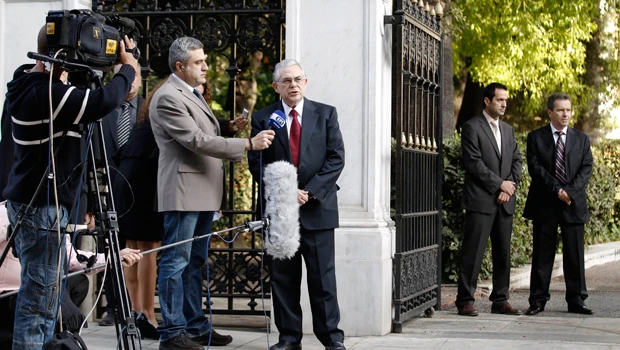
“The Greek economy is facing huge problems despite the efforts undertaken,” Papademos said as he emerged from the coalition talks brokered by President Karolos Papoulias.
“The choices we make will be decisive for the Greek people. The path will not be easy but I am convinced the problems will be resolved faster and at a smaller cost if there is unity, understanding and prudence.”
The coalition will be sworn in at 1200 GMT on Friday, a presidential official said after Papademos struck a deal on the national unity government with outgoing Prime Minister George Papandreou and the opposition leader.
Papademos, a respected figure in European capitals and on financial markets, said the coalition had the specific task of implementing a 130-billion-euro ($177 billion) bailout deal with the euro zone before calling an early election.
He cuts a grey and uncharismatic figure in the colorful and chaotic world of Greek politics, but also has a reputation for being calm at a time when the nation is clamouring for stability.
Greeks reacted with exhausted relief that an internationally-recognized technocrat will be in charge after four days of often shambolic negotiations between party leaders on forming the coalition.
“After three days of farcical comedy, Greece has today a prime minister who is fully qualified to succeed in the task he has been assigned to,” said Costas Panagopoulos, head of pollsters Alco.
“The fact that the parties finally managed to cooperate is also very positive. I hope that the big gap between political parties and Greek citizens will now start shrinking.”
But analysts abroad were cautious on whether Papademos can impose the tough austerity required by the 130 billion euro bailout deal on a Greek people who have already staged a wave of strikes and protests against budget cuts and higher taxes.
“It’s going to be extremely difficult for them to implement these measures because there will be very strong public opposition to them,” said Jennifer McKeown, senior European economist at Capital Economics in London.
“Some of these measures will be pushed through but in the long run the situation will not improve until Greece leaves the euro zone and devalues its currency,” she said.
Analysts also say Papademos, a man with no political experience, may struggle to exert his authority over hardened party figures in his cabinet.
Greeks were just thankful the coalition agreement had been sealed after long-running negotiations during which party leaders struck a deal to install the speaker of parliament as premier, only for it to collapse at the last minute.
“It is the only good thing in this case, which has made us all a laughing stock,” former Greek President Costis Stefanopoulos told Mega TV shortly before the coalition was announced.
In a sign of the daunting problems he will face, the statistics service ELSTAT reported unemployment jumped to a record high of 18.4 percent in August — at the height of the tourism season when the rate traditionally falls — from 16.5 percent in July.
Papademos said he had set no terms to any political leaders before accepting the job but government sources said he had driven a hard bargain.
These included a demand that Papandreou’s socialist PASOK and the New Democracy party of Antonis Samaras give a written undertaking to support the euro zone bailout package, whose stipulations are likely to be highly unpopular with voters.
EU Economic and Monetary Affairs Commissioner Olli Rehn, exasperated by broken Greek promises, has already insisted the leaders sign up before receiving even an 8 billion euro instalment from Greece’s original bailout deal pulled together last year.
Unless Greece gets that money, it will default next month when big debt repayments come due. However, Germany and France have made clear they will not compromise the euro zone’s stability for the sake of Greece, and told the nation it must decide whether it wants to stay in the bloc or not.
Samaras had long argued that the spending cuts, tax rises and job losses imposed by the outgoing socialist government under orders from the EU and IMF had deepened Greece’s crippling recession, now in its fourth year.
Political leaders had agreed the coalition should govern only until elections pencilled in for Feb. 19.
However, reverting to the dry language he once used at the ECB, Papademos signalled he would not be bound by that date if work remained to be done.
“The exact time has not been determined yet but there is, as a point of reference, the framework of principles which were formulated at the previous meeting of the political leaders,” he said.