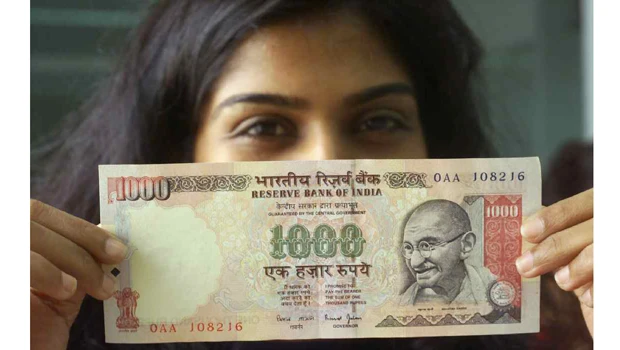
- JEDDAH: There is something for Indian expatriates in the Kingdom to cheer about.
- Their rupee fell to a 32-month low against the dollar on Tuesday, which in turn benefits them in their remittances.
A weak rupee will push up the fiscal deficit further. India imports around 70 percent of its requirement of oil and the government will have to pay more for it in rupee terms.
The rupee fell nearly a percentage point to hit 50.70 to the dollar in morning trade — its weakest since March 2009, Agence France Presse reported on Tuesday.
Commenting on rupee’s fall, Jarmo T. Kotilaine, chief economist at the National Commercial Bank, said: “The Indian rupee is clearly under considerable pressure, partly because of the global risk aversion, partly because of two main challenges facing the Indian economy. The first one is the persistent inflationary pressures, which have now hovered, in the low double digits since early 2010. The other is a cluster of signs that the economy is beginning to lose some momentum with indications of both industrial and service sector activity becoming increasingly mixed in recent months.”
Kotilaine added: “Even though the Indian economy is very resilient due to the strength of domestic growth drivers, the recent developments suggest that not all is well. In the event of a significant increase in global risk aversion, India would likely run into problems analogous to those seen in 2008-2009.”
The rupee is already Asia’s worst performing major currency this year, having tumbled by close to 12 percent against the dollar so far in 2011. The currency was hovering in a range Tuesday between 50.40 and 50.70 and analysts say the rupee could test the 51 to the dollar mark soon if the euro weakens further.
Reactions from a cross-section of Indian expatriates was mixed.
According to Gyan Prakash Agarwal, group chief business development officer at Al-Suwaidi Holding Co., this is a classic glass-half-full-half-empty scenario.
“For those who are importing goods or raw materials into India, a weak rupee is certainly not good news because they are being forced to pay more, but for those who are exporting their goods to the outside world, a weak rupee is like a bonanza, because they are getting more money,” he told Arab News. “Importers are the ones who will face the heat of a weakening rupee and exporters are ones who will reap a rich harvest.”
For the expatriates, Agarwal says, it may turn out to be a relief, albeit temporary. “A weak rupee may be good news for them for the time being but they will be in a for a shock when the dollar gets corrected which I expect it to happen sooner rather than later,” he said. “That is when their calculations and savings scenario will get awry.” Agarwal feels the rupee will settle between 48 and 49 vis-à-vis the dollar.
Danish Abdul Ghafour, managing director of a Jeddah-based advertising agency, said a weak rupee will induce a false sense of increment among the large Indian expatriate community in Saudi Arabia and other GCC states. “They will be able to send more ... So yes this is good news (for the expatriates) in the short-term but it certainly is not good for the Indian economy ... A 100-rupee bill is in essence equal to 10 rupees in value now,” he said.
Mohammad Nahid Siddiqui, assistant professor at Dhahran’s King Fahd University of Petroleum & Minerals, called it a worrisome development. “From what I am reading, this will lead to massive inflation,” he said. “For those expatriates who have sent their children abroad for higher studies, they will be the hardest hit, because they have to pay in dollars and pounds, and naturally they will now have to shell out more rupees.”
Siddiqui says those who are remitting money to India, such as the Indian expatriates working in the Gulf, will be happy. “But one has to look at the entire economic scenario before deciding whether this is good news or bad news,” he said.
The rupee’s slump comes at a bad time for India, which is battling near double-digit inflation. A falling rupee pushes up the cost of imports such as oil on which the energy-starved country is dependent. Oil refiners are the biggest dollar purchasers in the local currency market.
India’s economic growth is already slackening as a result of 13 interest rate hikes since March 2010 to curb inflation, which at 9.73 percent is the highest among major global economies, AFP said. The rupee touched a record peak of 39.4 to the dollar in February 2008.