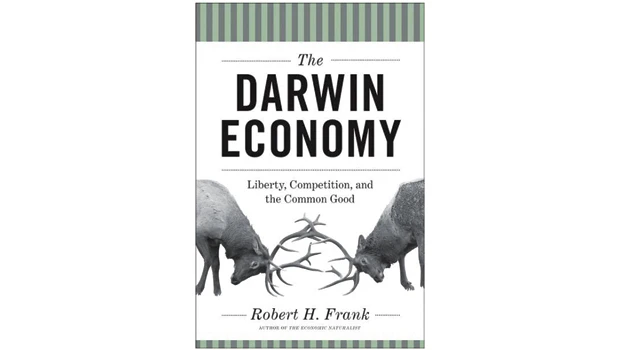
- "The Darwin Economy” gives us a refreshing insight into behavioral economics, a branch of economics rooted in psychology that has gained momentum in recent decades.
- The author is an economics professor at Cornell’s Johnson Graduate School of Management and a regular columnist for the New York Times.
When asked how Darwin’s insight into competition is relevant for economics, Robert Frank predicted that “If we were to poll professional economists a century from now about who is the intellectual founder of the discipline, I say we’d get a majority responding by naming Charles Darwin, not Adam Smith. Smith, of course, would be the name out of 99 percent of economists if you asked the same question today. My claim behind that prediction is that in time, not next year, we’ll recognize that Darwin’s vision of the competitive process was just a lot more accurate and descriptive than Smith’s was.”
One of the main ideas of the book is that individual interests expressed in free markets do not always produce outcomes that are best from the perspective of the group. This Darwinian understanding of the competition, according to the author, is currently lacking in our view of things.
Darwin’s view of the competitive process is fundamentally different from Smith’s invisible-hand theory, which states that “Impersonal market forces channel the behavior of greedy individuals to produce the greatest good for all.” Darwin made his observations on competition not among people but among individual members of plant and animal species. He concluded that natural selection favored traits and behaviors, as they improved the reproductive fitness of the animals that bore them. In other words, if a trait made the individual better able to survive and reproduce, it would be chosen. He acknowledged that the same variation that served the individual’s interest would also serve the interests of its species.
As a number of countries – especially in the eurozone – are experiencing serious economic problems, most economists privilege Keynes’ approach based on the belief that a depressed economy cannot recover rapidly on its own and that governments only have the capacity to boost significantly spending in times of deep recession. On the other hand, the economist Lee Ohanian believes that government spending won’t help and “higher taxes on incomes or expenditures that ultimately accompany higher spending depress economic activity.” This means that if the government spends borrowed funds now, consumers will discover that the resulting debt means higher taxes in the future, which will encourage them to refrain from spending. Those cutbacks will offset the increased government spending dollar for dollar, leaving no net stimulus.
As a result, many psychologists describe economists as having a “high IQ but no clue.” Behavioral economists believe that few consumers have an idea of how big the national debt is now and how it might affect their future tax bills.
In the years following World War II, incomes grew under three percent for families all along the income scale. However, around 1970, income growth slowed, except for families near the top of the income distribution. Their incomes have been growing at record high rates. CEOs of some of the largest firms in the United States earned 40 times more than the average American worker in 1980, but now they earn 400 times as much!
The rise in super incomes has also triggered a soaring pattern of consumption. Top earners simply spend because they have more money, but much of this extra spending has been profoundly wasteful.
“Total consumer spending is more than twice as large as total government spending; my assertion that there is more waste in the private sector than in the public sector should not strike any reasonable observer as implausible. The search for ways to eliminate private waste is still in its infancy. The good news […] is that private waste is actually much easier to eliminate than public waste,” writes Frank, who believes in giving people a maximum amount of flexibility and possible ways of solving problems they had not thought of.
Applying Darwin to economics provides new ways of thinking about taxation and the role of government in a free society. It also reminds economists and bankers how much they have neglected the humble wisdom with which they must confront uncertainty. The deep uncertainties that surround the function of banking mean that it is futile for experts to make judgments on what needs to be done. The protests by the “indignant ones” show that a growing number of people around the world will no longer accept that a privileged minority does not feel the pain it has helped inflict on everyone else.
Frank suggests the best solution is not to forbid harmful behaviors, but to tax them. By doing so, we can make the economic pie larger, eliminate government debt, and provide better public services without requiring sacrifices from anyone.
The question, however, is if this can be achieved. Is it feasible?
Economy’