- JEDDAH: Saudi Arabia announced a record SR690 billion ($184 billion) surplus budget on Monday and said it would continue its programs to achieve sustained and balanced development all over the country, giving top priority to education and manpower training.
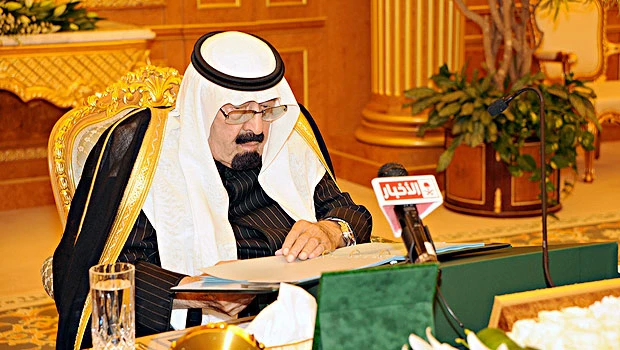
Custodian of the Two Holy Mosques King Abdullah, who unveiled the budget during a special Cabinet session at Al-Yamamah Palace in Riyadh, said the budget was aimed at strengthening the Kingdom’s development and creating more jobs for Saudis.
The budget, which projected SR702 billion ($187.2 billion) in revenue, has allocated SR168 billion for education and manpower training, SR87 billion for health and social development, SR58 billion for water, industry, agriculture and infrastructure, SR35 billion for transport and communication and SR29 billion for municipal services.
“We have allocated SR265 billion for new development projects as well as to complete the existing projects,” King Abdullah said in an address to the nation, which was read out on his behalf by Abdul Rahman Al-Sadhan, secretary-general of the Cabinet.
King Abdullah said allocations have been made to set up 700 new schools, complete new university campuses and vocational and technical training projects, establish 17 new hospitals and build new sports cities and social care centers.
Referring to the welfare projects worth over $100 billion he had announced in March 2011, King Abdullah said the new budget would support those projects.
“We hope these projects would improve the living condition of Saudis,” he added.
The new projects included 500,000 new housing units valued at SR250 billion.
King Abdullah has issued a royal decree that allows the finance minister to allocate money from the surplus of 2011 to pay for housing projects and increase the capital of Public Investment Fund to cover the cost of Haramain Railway that will link the two holy cities of Makkah and Madinah via Jeddah.
The new budget will continue to support the Kingdom’s efforts to achieve scientific and technological progress and the national plan for communications and information technology as well as state-owned lending organizations for the development of agriculture, industry and small and medium enterprises (SMEs).
Finance Minister Ibrahim Al-Assaf briefed the Cabinet on national, regional and international financial developments and the main features of the budget.
He said priority has been given to education, health, scientific research, security services, water and sewage, roads and electronic transactions.
The minister said the Kingdom’s gross domestic product (GDP) for 2011 was expected to reach SR2.163 trillion with an increase of 28 percent compared to the previous year.
He attributed the increase to a 40.9 percent growth in the petroleum sector.
The Kingdom’s non-oil public and private sector is expected to achieve a growth rate of 14.3 percent in current prices.
Saudi economists said the new budget would accelerate economic growth.
“King Abdullah is committed to building a 21st century economy which has at its core Saudi human capital developing whilst raising expenditures at a healthy pace, reducing its debt burden and encouraging private sector participation,” Saudi economic analyst Turki A. Al-Hugail told Arab News.
“High spending is justified given the needs of the country without jeopardizing its fiscal considerations. Saudi Arabia has the luxury for the time being and for the medium term to keep on spending responsibly without any fiscal risks," Al-Hugail said.
He added: "The government can afford to spend more and apply counter cyclical policies without deficit financing. Saudi Arabia is among a few countries within the G20 which can afford to spend and reduce its debts."
Jarmo T. Kotilaine, chief economist at the National Commercial Bank, said: "The Saudi budget highlights both the strong economic performance of the Kingdom last year and the tightness of the global oil markets which allowed Saudi Arabia to increase production while benefiting from higher oil prices. The end result is a fiscal outcome that is enviable by global standards in the current environment of worldwide austerity."
Fueled by the estimated 6.8 percent real growth last year, the Saudi budget posted revenues that — at SR1.1 trillion — were double the budgeted total for 2011.
Even as expenditures exceeded the budget by some 38.6 percent, the Kingdom ended up with a healthy SR224 billion surplus, equal to an estimated 10.4 percent and the very opposite of the fiscal reality of many crisis-struck Western nations, he said.
Omar Al-Juraifani, a Saudi financial and economic analyst based in the Eastern Province, said there is a need for increase in non-oil income to support future development of the Kingdom.
During the budget session, King Abdullah reminded the ministers that it was on this day (60 years ago) King Abdul Aziz issued a royal decree to establish the Kingdom’s first council of ministers.
“We are now enjoying the fruits of that seedling planted by King Abdul Aziz, the founder of Saudi Arabia,” he added.
King Abdullah also welcomed the new ministers who joined the Cabinet recently and wished them success in their new careers.
He said the important resolutions taken by the GCC summit in Riyadh and thanked Gulf leaders for supporting his proposal to shift the GCC from the phase of cooperation to union.
In his statement, Al-Assaf said he expected a GDP growth of 6.8 percent in fixed prices in 2011 with 4.3 percent growth of the petroleum sector, 7.8 percent for non-oil GDP, 6.7 percent for the public sector and 8.3 percent for the private sector.
He also expected an overall private sector contribution of 48.8 percent to the GDP.
Nonoil downstream industries were to grow by 15 percent, telecommunications and transport sector 10.1 percent, electricity gas and water 4.2 percent, construction 11.6 percent, trade, restaurants and hotels 6.4 percent and financial services, insurance, real estate and business services 2.7 percent.
In a statement ahead of the budget, David Robinson, the IMF's mission chief for Saudi Arabia, said the Kingdom’s near-term outlook remains strong because of this year's surge in oil revenues, which boosted the country’s fiscal and external balances.