- The exhibition and auction of Middle Eastern contemporary and modern art was held in Abu Dhabi this month to celebrate 20 years since Christie’s inaugural sale in the region
DUBAI: Abdul Halim Radwi
‘Afaq Halima’
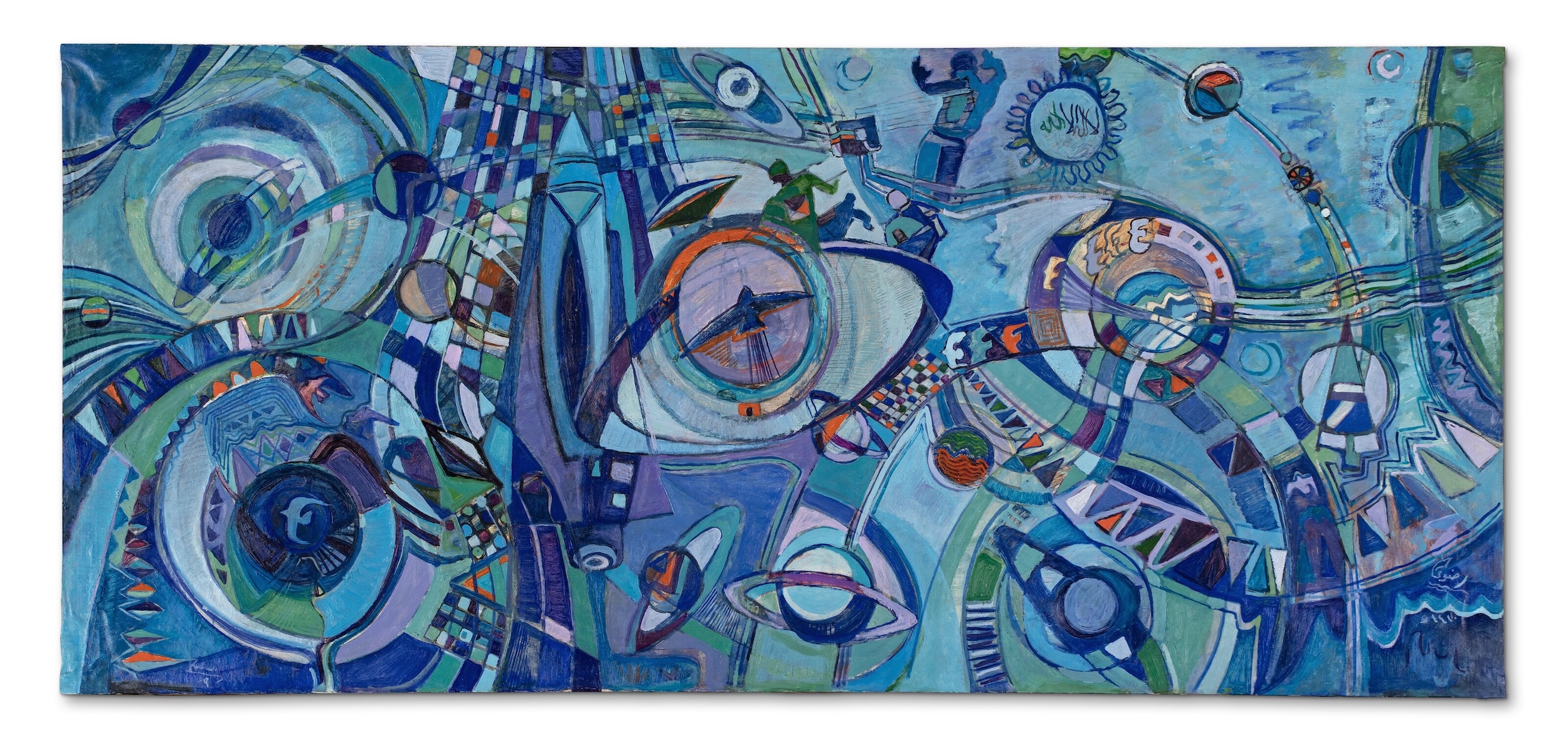
The Makkah-born artist — widely considered to be one of the most significant in the Kingdom’s modern art movement — created this “monumental canvas” in 1989 — “a moment of profound optimism surrounding the possibilities of technological advancement and scientific exploration the collective imagination of the Arab world,” according to show notes from Christie’s. “This sense of optimism was particularly resonant in Saudi Arabia following Prince Sultan bin Salman Al Saud’s journey into space in 1985, as the first Arab and Muslim astronaut in history. His achievement became a powerful symbol of national progress and modernization, while the mission’s inclusion of the Arabsat-1B communications satellite gave the journey particular significance within the wider history of Arab scientific achievement.” Radwi responded to all this with a painting that manages to “evoke movement, exploration and explansion” through “symbolic imagery, chromatic experimentation and complex geometric layering of orbital and circular lines.” That imagery includes a dove — a recurring theme throughout Radwi’s work — and the abstract “planetary rings” that “invite an association with” tawaf — the pilgrims’ circumambulation of the Kaaba during Hajj.
The notes continue: “A profound sense of transcendence and ethereality permeates the canvas. The spectrum of blues opens the horizon onto the possibility of discovery and a feeling of infinity, creating an expansive visual field against which warmer accents of orange and green emerge as moments of energy … Ultimately, the work embodies Radwi’s vision of a modern Arab world in which scientific discovery, technological advancement and cultural heritage coexist within a shared visual language.”
Ahmed Mater
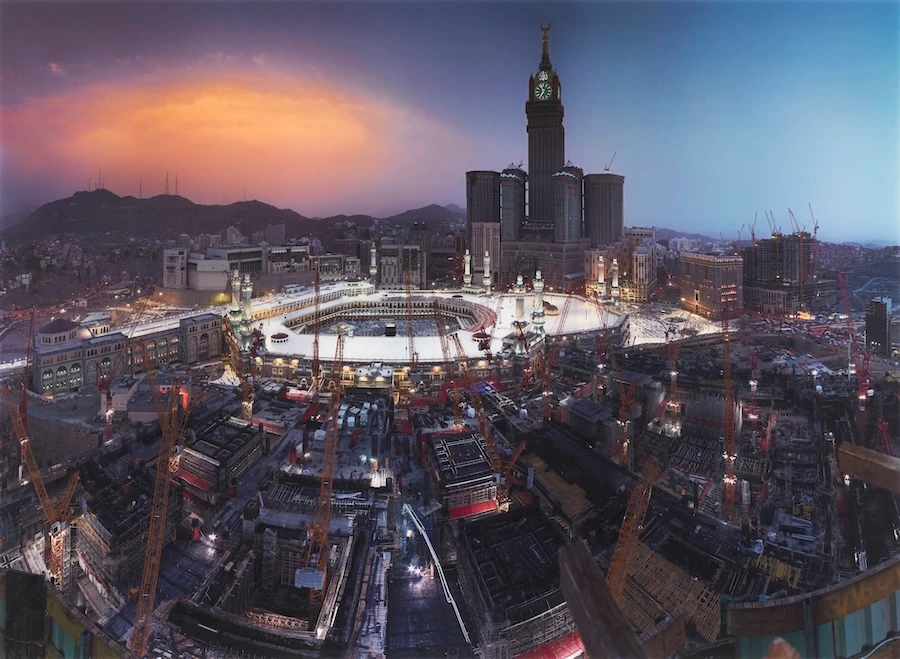
‘Golden Hour’
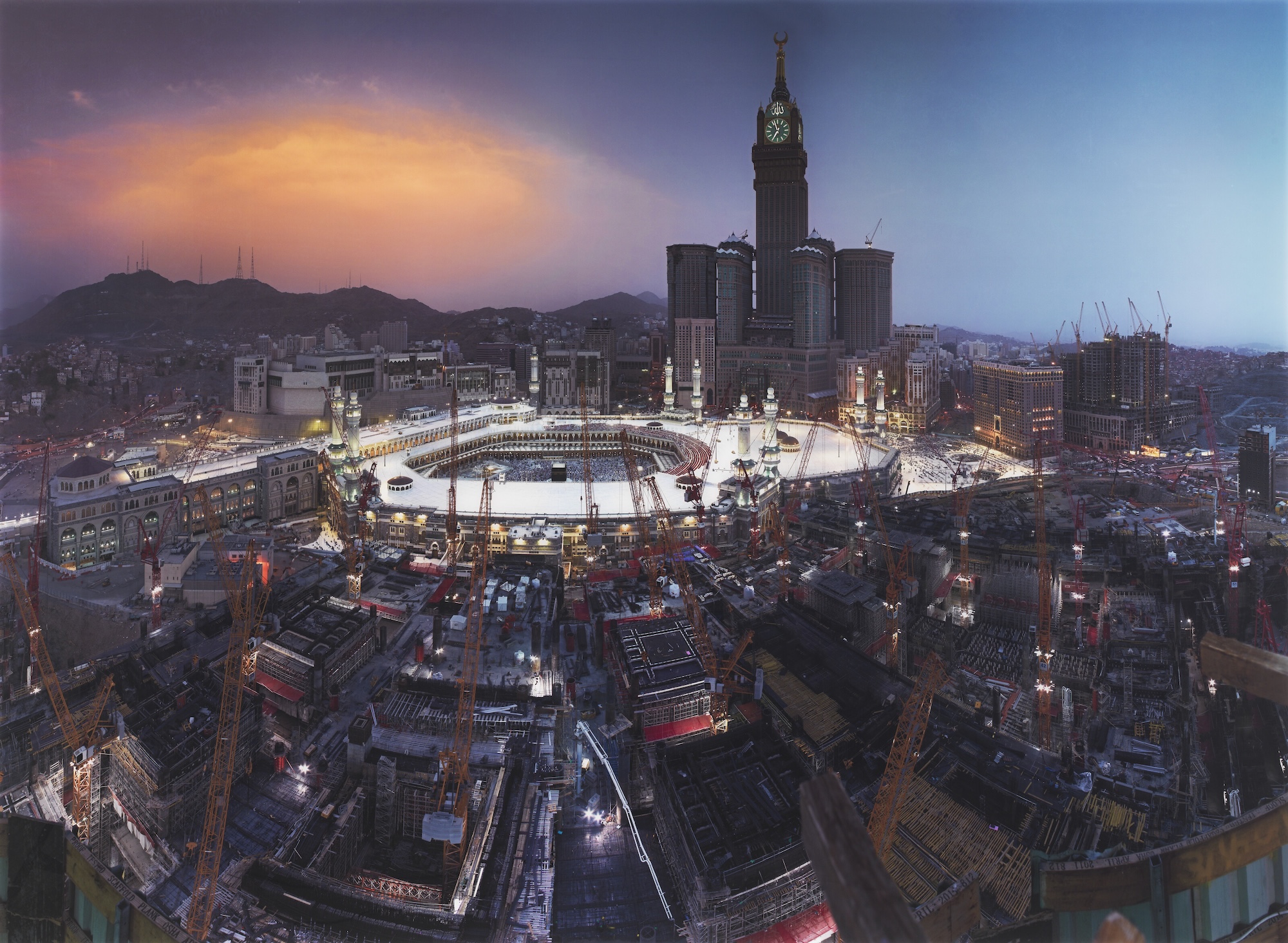
In Mater’s ongoing “Desert of Pharan” series, in which this 2011 work is, the auction notes suggest, “the central work,” the Tabuk-born artist examines the rapid urban transformation of Makkah “and the shifting relationship between public and private space.” The notes explain: “While the city is home to more than a million residents, its infrastructure has been radically reshaped to accommodate the millions of pilgrims and visitors who arrive every year … Mater’s project traces the encounter between Islamic tradition and the forces of globalization, examining a city whose significance within the global imagination remains deeply rooted even as its physical form is undergoing profound change. Economic ambition, technological advancement, religious obligation, global mobility and the specific geography of the Hijaz converge here, producing a landscape in which ancient ritual and accelerated modernization occupy the same space … Rather than resolving the contradictions between them, Mater leaves them open, creating an image in which Makkah’s past, present and future are held simultaneously.”
Dana Awartani
‘You Are The Universe in Ecstatic Motion I’
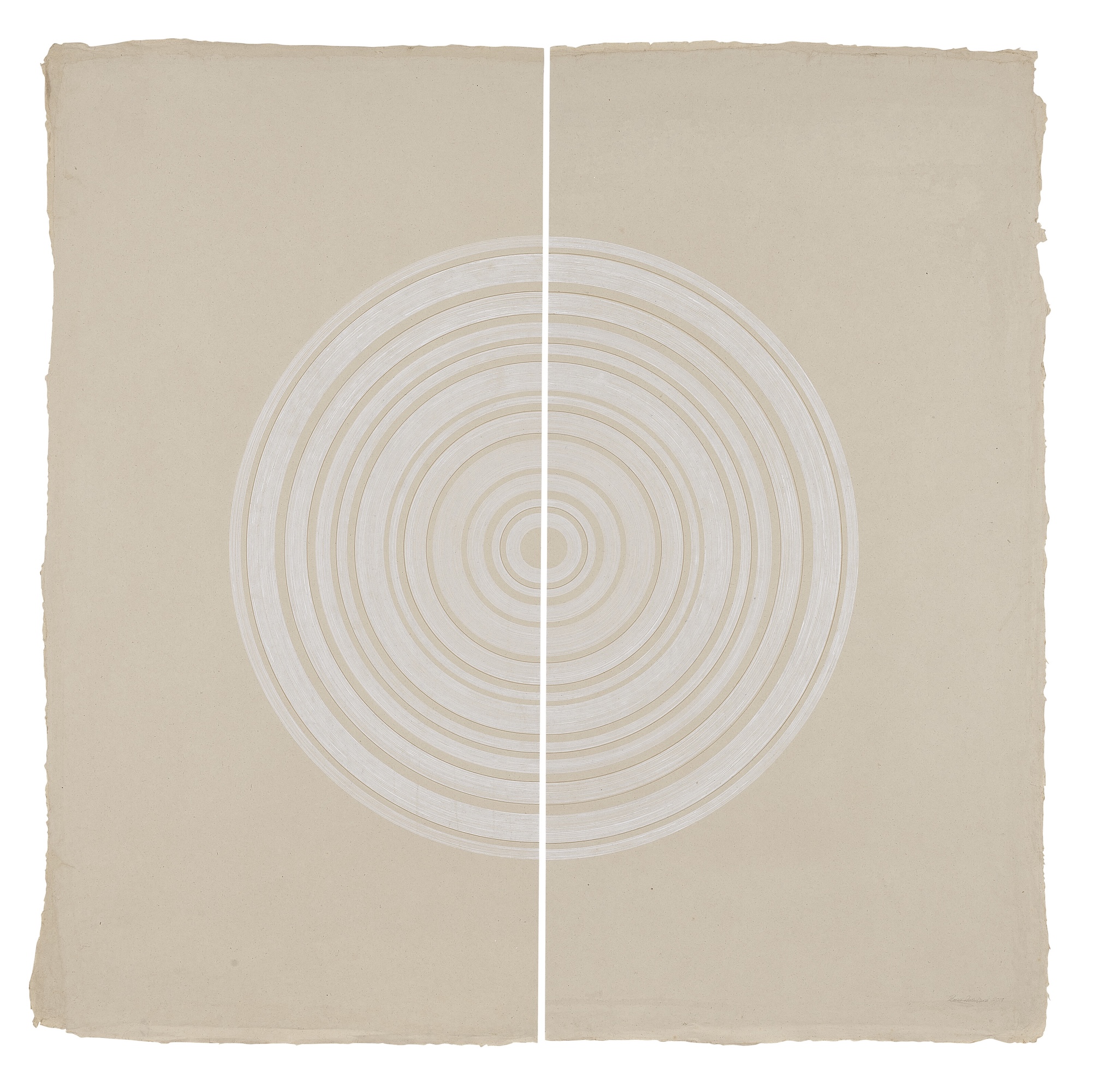
The title of this 2019 work from the Jeddah-born Palestinian-Saudi artist’s “When Fire Loves Water” series comes from lines attributed to 13th-century Sufi poet Jalal al-Din Muhammad Rumi. “It evokes an understanding of the individual not as separate from the universe, but as contained within and inseparable from a greater whole,” the show notes state. This work — created on handmade paper, they add, “adopts a more restrained visual language” than the majority of Awartani’s oeuvre, “returning to one of the fundamental sources of her artistic language: Sufi mysticism … Stripped of elaborate ornament and color, the work distils her longstanding engagement with sacred geometry to one of its most elemental forms: the circle … The eye is carried around rather than across the work: there is no obvious point of departure or conclusion, only a circular movement that repeatedly returns towards its source. Despite this sense of motion, the composition retains a striking stillness, its rhythmic repetition assuming an almost meditative quality.”
Manal AlDowayan
‘Time Betrays’
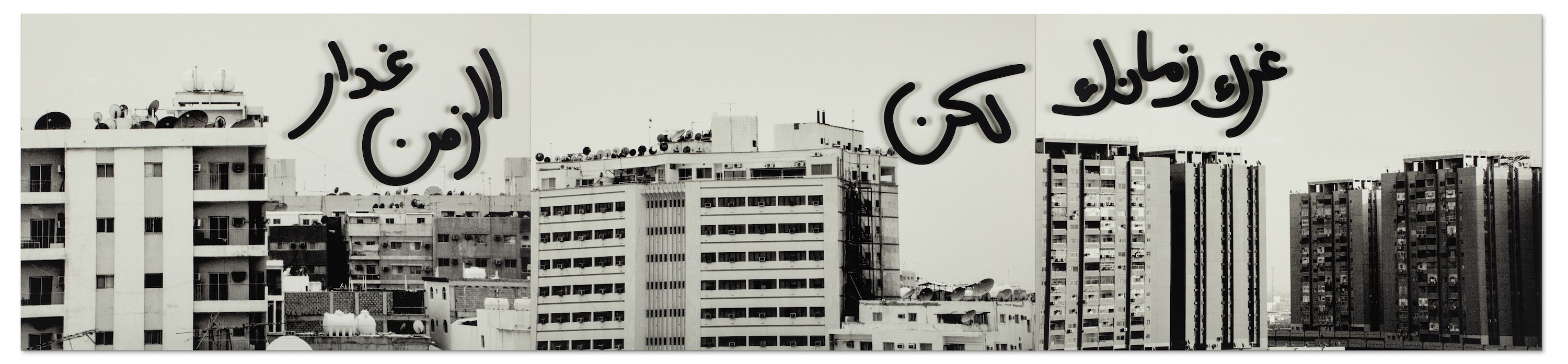
The acclaimed Dhahran-born artist’s 2010 piece — part of her “And We Had No Shared Dreams” series — consists of three black-and-white prints. The series, Christie’s states, “examines the complex relationship between the individual and the rapidly transforming urban environment. Focusing on the psychological effects of demographic change, urbanization and globalization, it explores how individuals negotiate their sense of identity and belonging within increasingly congested and anonymous cities.” The three photographs in this piece are each inscribed with a spray-painted question: “Do you long for me?”; “Are you mine forever?”; and “Do you share my dreams?” The notes state: “Deprived of color, the city becomes less a record of place than a fragmented recollection or psychological landscape. Against this restrained photographic ground, the illuminated aluminum lettering acquires particular force. Light functions not only as a material element but as a metaphor for attention, longing and communication. The words appear to demand recognition from the city, while simultaneously illuminating questions that remain unresolved.”