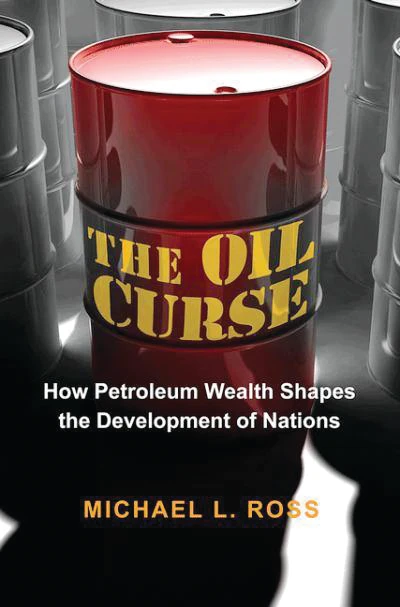
The Oil Curse examines the politics of oil, a timely issue and a key global phenomenon. Despite an academic approach and a plethora of charts and tables, Michael Ross presents new research in a clear and concise style. Professor of political science at the University of California, he is disarmingly honest when he admits that after reexamining previous studies, he was embarrassed to find more than “a few errors, omissions, and hard-to-defend assumptions”.
In this book, Michael Ross explains why “oil is typically a curse, why some countries have escaped the curse, and how more countries can turn their natural resource wealth from a curse to a blessing”.
It is interesting to note that until developing countries nationalized their oil industries in the 1960s and 1970s, major oil companies such as British Petroleum, Shell, Exxon and Mobil exerted a great influence on the oil-producing countries. These oil companies, known as the Seven Sisters (Exxon, Chevron, BP, Mobil, Texaco, Gulf and Royal Dutch Shell), overpowered Iraq’s oil industry until 1972, the year the foreign-owned Iraqi Petroleum Company was nationalized.
The weakening of these major oil companies began in the 1950s with the birth of “independent” oil producers and culminated with the foundation of OPEC (Organization of Petroleum Exporting Countries) in 1960. Nowadays, the oil trade is run by National Oil Companies, private-sector firms and hybrid companies which are owned both by the state and private companies.
Due to an increasing global demand, petroleum, the world’s largest industry will continue to grow. It is expected that within the next 25 years, the demand for oil will rise by 28 percent, and for gas by 44 percent. The number of oil producing countries is also growing and has now reached 57. Furthermore, oil priced at $10 a barrel in January 1999 was $145 a barrel in June 2008. The booming oil prices are encouraging companies to invest in poor and politically unstable countries. Belize, Brazil, Chad, East Timor, Mauritania and Mozambique have joined the rank of oil producers since 2004.
One of the core arguments of the book is that the political and economic problems of the oil states are linked to the unusual properties of petroleum revenues (large size, unusual source, lack of stability, and secrecy).
“How governments use their oil revenues to benefit the few, or the many, is certainly important. But whether governments spend these funds wisely or foolishly, oil revenues have far-reaching effects on a country’s political and economic well-being ” says the author.
Contrarily to what people might assume, if oil boosts the government revenues, it hardly helps and can even affect negatively other industries in the private sector. An International Monetary Fund study stated that between 1960 and 2004, the oil production in the Republic of Congo, had no direct impact on the development of the non-oil economy.
Moreover, many of the world’s recent oil producers in Africa, the Caspian Basin and Southeast Asia are also low-income countries with a risk of conflicts. And studies have shown that a number of these countries have only enough petrol for another decade. A civil war would indeed annihilate these countries’ hopes to invest their oil revenues in order to escape from poverty.
After scrutinizing some 50 years of data, the author refutes the claim that oil is a ‘resource curse’, a term first coined in 1993. If indeed, petrol producers were affected by the economic slump from 1971 to 1989, they grew approximately 40 percent faster than the rest of the world between 1990 and 2006.
“If oil really was an economic curse, the countries with the greatest per capita oil wealth, like Saudi Arabia, Libya, Venezuela, and Gabon, should be among the world’s poorest countries. They are in fact much richer than neighboring countries with little or no oil” says Michael Ross.
Much of the oil world is hidden from the world. Even today, consumers ignore the country of origin of the petrol they put into their cars. The author advocates for more transparency with the disclosure of information released by governments, subjected to independent audits and made public.
In his concluding remarks, Ross mentions that the London-based International Accounting Standards Board provides standards which are used by over 120 countries when they submit financial statements. He suggests that these standards which, at present, allow the petroleum and mining industry to avoid disclosing their payments to specific governments, should be reformed.
“Adopting reforms that bring greater transparency to the oil business could have a far-reaching effect”.
This Oil Curse leads us into the hidden world of the oil business. It presents some surprising discoveries and provides important information in a very accessible way. It is the most up-to-date book on a timely and important topic.
The Oil Curse