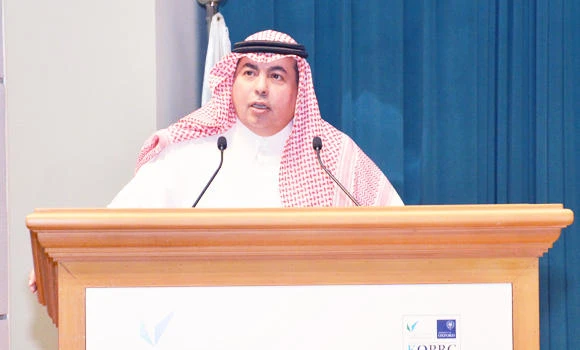
The 4th Petrochemicals Forum, organized by King Abdulaziz City for Science and Technology, (KACST) in association with the University of Oxford, was opened by Prince Turki bin Saud bin Mohammed Al-Saud, vice president of KACST for research institutes.
Prince Turki said that although oil is the natural resource of the Kingdom, its value lies not in its production but in its added values accrued as a result of concerted efforts made by various organizations such as Saudi Basic Industries Corporation (SABIC).
“We have to do advanced research in the field of petrochemical industry through joint ventures to reap better benefits from this natural resource,” he said.
Prince Turki pointed out that a large number of Saudi students are enrolled in the universities of Oxford and Cambridge to enhance their knowledge in the field of petrochemical industry which will eventually benefit the students as well as the country.
“We also have a student exchange program between the two bodies.”
Hamed Al-Muqrin, chairman of the scientific forum, outlined the cooperation agreement with the University of Oxford.
He said the forum is an annual event between the KACST and the University of Oxford to enhance the cooperation between the two organizations under the agreement.
The joint scientific cooperation between KACST and the University of Oxford is the first of its type in the Arab world in the refining and petrochemical fields and comes within the strategic plan set by KACST with the aim of transferring and localizing petrochemicals technology in the Kingdom.
KACST and the University of Oxford have created a joint research center called KACST-Oxford Petrochemical Research Center (KOPRC).
The work of the center is focused on developing a solid acid catalyst for alkylation processes, developing a process to convert the fossil remains of distillation to olefins and developing catalysts to convert carbon dioxide to chemicals .
The collaboration is also hoping to transfer and nationalize techniques in the areas in the development of human resources.
KACST is both the Saudi national science agency and its national R&D laboratories.
KACST plays a key role in science and technology policy making, related data collection, funding of external research and other related services such as scientific publishing and managing the patent office.
Its responsibilities include proposing a national policy for the development of science and technology and relevant strategies, supporting scientific research and technology development, conducting applied research advising government, fostering national innovation and technology transfer between research institutes and the industry, and fostering international cooperation in science and technology.
Oxford was the first university in the English-speaking world. Its aim is to remain at the forefront of centers of learning, teaching and research.
Oxford is one of the leading chemistry research departments in the world with around 80 academic staff carrying out international-level research, and an annual research income of around £15 million.
The department is currently engaged in a number of innovative themes of work, including catalysis, sustainable energy chemistry, advanced functional materials, synthesis, interfacial science, innovative measurement and photon science, chemistry at the interface with biology and medicine, kinetics, dynamics and mechanism, and theory and modeling of complex systems.
Advanced research in petrochemicals vital