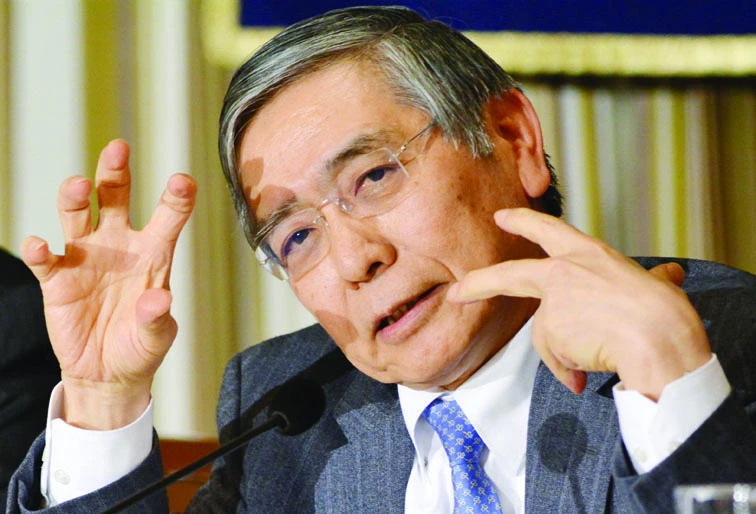
Tokyo: The head of the Bank of Japan on Friday acknowledged that Tokyo's attempt to conquer years of deflation had been "very challenging", but said it was a key test case for other central banks.
The unusually downbeat comment from Haruhiko Kuroda underscores the scale of the task he and Prime Minister Shinzo Abe face as they look to revive Japan's fortunes with a vast monetary easing program and government spending blitz, dubbed Abenomics.
The scheme, launched in 2013, kicked off a sharp decline in the yen and a stock market rally, but efforts to drag the country out of years of deflation have been met with mixed success — and growing doubts among many economists.
Kuroda, who marked two years in the job on Friday, said the bank would press on with its plan to hit a 2.0 percent inflation target, though hopes to reach that goal within the next year look increasingly slim.
"Over the last 20 months, the inflation rate has been positive but I think deflation, or I should say the deflationary mindset, has not been completely eradicated," he told the Foreign Correspondents' Club of Japan, adding that his job was only "halfway" done.
"We have enough tools to combat deflation and achieve price stability...but it's been very challenging."
While deflation may sound good for Japanese consumers, it means people tend to put off buying because they do not expect prices to rise and hope they might even get goods cheaper down the line.
That, in turn, hurts producers and holds back their expansion and hiring plans — bad news for the wider economy.
The BoJ's stimulus plan — which scoops up bonds and other assets at a rate of about 80 trillion yen ($679 billion) annually — is aimed at changing that psychology and kickstart the world's number three economy.
Growth picked up in the beginning, but Tokyo's decision to hike sales taxes last year hammered consumer spending and pushed Japan into a brief recession.
Worries spiked again Tuesday when the central bank said tumbling world energy prices could push inflation to zero, or even negative.
That stirred speculation that the BoJ will expand its easing program again this year, as the European Central Bank kicks off its own quantitative easing scheme to ward off deflation in the euro zone, while other central banks from Australia to Sweden also loosen monetary policy.
Japan's struggles, and the BoJ's response, will be a crucial lesson for the world, Kuroda said.
"If there is a risk of deflation, policy authorities should make every effort to prevent the economy from falling into it," he said.
But "even if the economy becomes trapped in deflation, it is possible to overcome deflation through innovative monetary policy. By succeeding in getting the economy out of deflation...the (BoJ) hopes to provide a case in point."
BoJ chief says war on deflation ‘very challenging’