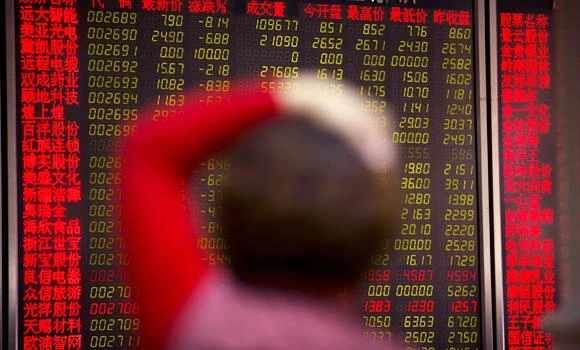
Hong Kong: Chinese shares plunged more than six percent on Thursday as economic clouds settled over a G20 meeting in Shanghai, while Japanese stocks gained on higher oil prices.
Shanghai nosedived, hit by tightening liquidity and concerns a rally that has added 10 percent since mid-January has outstripped the health of the world’s number two economy.
Weakness in China, a key driver of global growth, and gyrations in the oil market are expected to hang over a two-day meeting of G20 finance ministers in commercial hub Shanghai starting on Friday.
The gloomy outlook for the global economy has added to pressure on central bankers to unleash fresh monetary firepower to help stimulate growth and reassure investors.
The Shanghai benchmark tumbled 6.41 percent by Thursday’s close, down around a quarter so far this year, while the Shenzhen index on China’s second exchange dived 7.34 percent.
Hong Kong retreated for a third day, and closed down 1.58 percent.
“The economy hasn’t shown signs of stabilization and policies are still coming out one after another,” Central China Securities analyst Zhang Gang told AFP.
Energy and materials companies led Wall Street higher on Wednesday, as a rise in crude prices helped US stocks claw back ground from their biggest fall in two weeks.
The gains helped Japanese shares add 1.41 percent, the first time they have closed higher in three days.
Electronics maker Sharp closed down 15 percent on news it had accepted a multi-billion-dollar bailout from the parent company of Taiwan’s Foxconn.
Cooling growth in Asia’s largest economy, a key importer of raw materials, has sent commodity and energy prices spinning and saw global stocks notch one of their worst starts to a year in living memory.
The Asian regional shares benchmark, the MSCI Asia Pacific Index, has been at its most volatile in four years over the past month, according to Bloomberg News.
Falling commodity prices have hurt exporters like Australia, whose currency slumped Thursday on news that companies are planning to invest their least in nine years.
Sydney-listed shares in BHP Billiton tumbled 1.11 percent Thursday after the global miner announced it would axe more than 1,750 jobs.
Adding to the concerns, the International Monetary Fund warned on Wednesday the world economy is “highly vulnerable,” and said it would likely cut its 2016 growth forecast of 3.4 percent.
US Treasury Secretary Jacob Lew has said G20 finance ministers will not deliver an “emergency response” to the market turmoil this week, as the world was not in crisis mode just yet.
“It would be nice to see some collective statement from the major central banks that they’re aware of the problems,” Shane Oliver, head of investment strategy at AMP Capital Investors in Sydney, told Bloomberg News.
“I don’t hold out a lot of hope. We’re not in enough of a crisis yet to see a crisis response.”
Reflecting the concerns, oil prices eased in Asia on Thursday, resuming their downward trend after news that US gasoline stocks fell helped revive prices in the previous session.
Crude has fallen more than 13 percent this year on concerns of a lasting global supply glut. News that Iran and Saudi Arabia would not be willing to curtail production saw prices plunge on Tuesday.
The US benchmark contract for delivery in April fell 45 cents to $31.70 in Asian trading on Thursday, while Brent crude for April fell 48 cents to $33.93.
Tokyo — Nikkei 225: UP 1.41 percent at 16,140.34 points (close)
Shanghai — composite: DOWN 6.41 percent at 2,741.25 points (close)
Hong Kong — Hang Seng: DOWN 1.58 percent at 18,888.75 points (close)
Euro/dollar: UP at $1.1022 from $1.1008 on Wednesday
Dollar/yen: FLAT at 112.15 yen from 112.15 yen on Wednesday
New York — Dow: UP 0.3 percent at 16,484.99 points (close)
London — FTSE 100: DOWN 1.6 percent at 5.867.18 points (close)
Chinese shares tumble as G20 ministers gather