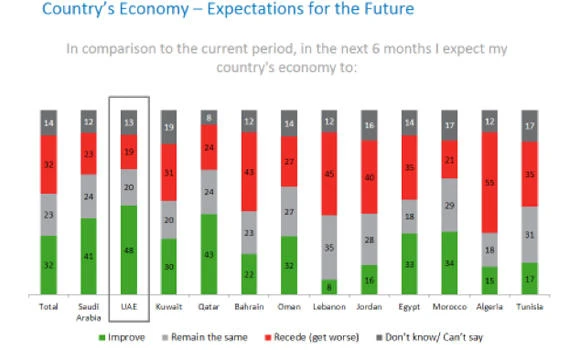
RIYADH: Forty-one of people who responded to a recent survey in Saudi Arabia have a positive outlook on the future of the economy in the country.
Thirty-six percent Saudi respondents believe that business conditions are either ‘good’ or ‘very good’, while 21 percent believe that business conditions are ‘bad’, according to the most recent Bayt.com Middle East and North Africa Consumer Confidence Index survey.
Bayt.com, the Middle East’s number one job site, and YouGov, a leading market research agency, conducted the poll.
“While the region as a whole has seen a relative dip in consumer confidence, future expectations among respondents remain positive and bright,” said Suhail Masri, VP of Employer Solutions, Bayt.com.
According to the survey, most half of the respondents (49 percent) are largely optimistic about the future, expecting business conditions to ‘get better’ in a year’s time.
Data for this survey was collected online from Jan. 27 to Feb. 10, 2016, with 3,905 respondents from the UAE, Saudi Arabia, Qatar, Oman, Kuwait, Bahrain, Syria, Jordan, Lebanon, Egypt, Morocco, Tunisia and Algeria.
Males and females aged 18 years old and above, of all nationalities, were included in the survey.
Nineteen percent of respondents in Saudi Arabia believe that the country’s economy has ‘improved’ in the last six months, while 43 percent believe that it has ‘receded’. However, 41 percent of the respondents expect the economy to ‘improve’ in the next six months.
Personal economic
situation
According to 37 percent of poll respondents in KSA, their financial situation is the ‘same as it was six months ago’ (21 percent say it is ‘better’ now, while 31 percent claim that it is ‘worse’). The outlook is positive though: almost half of respondents (48 percent) believe that their personal financial situation will ‘improve’ in the next six months. When it comes to the cost of living in the next six months, 70 percent of respondents expect it to increase, while 17 percent expect the cost of living to ‘remain the same’.
Half of the respondents (50 percent) in Saudi Arabia say that their savings have ‘decreased’ when compared to last year. Almost one in five respondents (19 percent) claim that their savings have ‘increased’, while a quarter (25 percent) reveal that they have ‘remained the same’.
Consumer spending
Forty-two percent of those surveyed in Saudi Arabia are planning to invest in a motor vehicle in the next 12 months.
Of those, 51 percent are planning to buy a new vehicle, while 27 percent are planning to buy a used one.
Forty-nine percent of Saudi respondents are not planning on purchasing a vehicle.
When it comes to investing in property, 28 percent of respondents are planning to invest in the next 12 months.
Of those who are planning to buy property, 41 percent will invest in an ‘apartment’, while 34 percent plan to buy a ‘villa/townhouse/bungalow’ and 25 percent will purchase ‘commercial property’.
The majority of respondents (57 percent) who are planning to invest in property in Saudi Arabia plan to buy new property in the next 12 months, while 18 percent will invest in pre-owned property.
Regarding consumer goods, 23 percent of Saudi respondents plan to purchase a ‘tablet or smartphone’ in the next six months, while 21 percent will invest in a ‘desktop or laptop’.
Thirty-one percent of respondents are planning to buy ‘furniture’ over the same period.
An ‘LCD or Plasma TV’ (17 percent), air conditioner (17 percent) and washing machine (16 percent) are also among the respondents’ list of priorities this year.
Current job Perspective
Presently, 42 percent of respondents surveyed believe that there are plenty of jobs available in Saudi Arabia, with 22 percent claiming availability across multiple industries and 20 percent claiming availability across a limited number of industries. 29 percent of KSA respondents expect the job availability to ‘increase’ in the next six months.
Thity-two percent of employed respondents feel that the number of employees in their companies over the past six months has ‘increased’, while 41 percent believe the opposite to be true. Over the course of the next six months, 33 percent of employed KSA respondents expect the number of employees in their organization to ‘increase’.
With regard to satisfaction levels, 47 percent of employed KSA respondents are ‘satisfied’ with their career growth opportunities, and 39 percent are satisfied with their current compensation.
On the other hand, 41 percent are dissatisfied with their current salary and allowances. When it comes to non-monetary benefits, 57 percent of employed KSA respondents are satisfied, while 29 percent feel the opposite. 44 percent of employed respondents in Saudi Arabia feel secure in their jobs.
Suhail Masri, VP of employer solutions, Bayt.com, added: “At Bayt.com there are currently more than 10,000 jobs posted on the website on any given day. This augments the tremendous amount of recruitment that takes place via the Bayt.com CV Search functionality for employers who prefer not to immediately advertise their pressing job vacancies, which recruiters can try for free on bayt.com/en/search-cv/. Jobseeker registration on our website is growing at over 12,000 new professionals a day and continues to reflect a healthy appetite for jobs across the industrial and career spectrum. In an extra-competitive job market though, we advise professionals to enhance their visibility to employers by creating online profiles on Bayt.com and increasing their visibility on popular search engines. At Bayt.com, we always endeavor to empower the region’s job seekers and employers by providing them with the latest technology and most relevant tools and market insights related to recruitment.”
Elissavet Vraka, research manager, YouGov, said: “Gauging consumer opinion is a powerful tool for revealing the current attitudes and sentiments about the business and economic conditions in a specific country. Despite the positive outlook on the future, the rising cost of living is negatively impacting residents’ ability to save.”
Consumer confidence in KSA: Expectations remain positive