FRANKFURT: Deutsche Bank, Germany’s biggest lender, said it would axe tens of thousands of jobs, sell off assets and pull out of 10 countries in a vast overhaul after record losses in the third quarter.
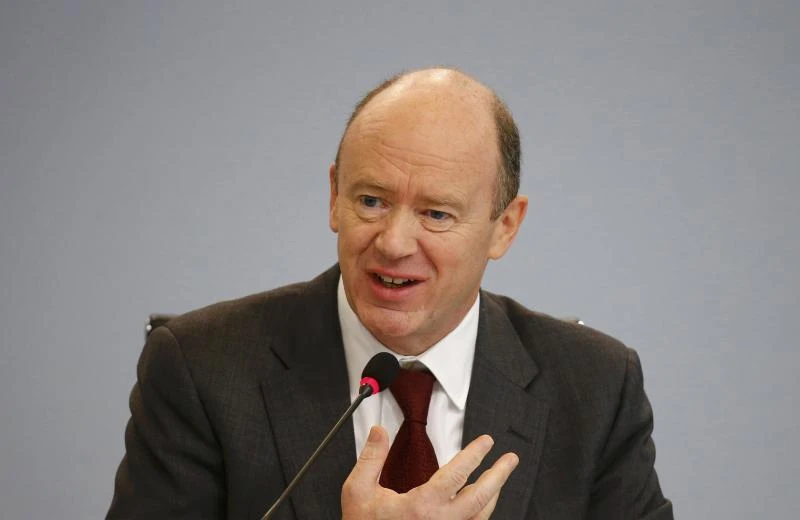
“It’s not all going to be sweetness and light,” the bank’s new co-CEO John Cryan, who took over from disgraced Anshu Jain in July, told a news conference.
He faced the press shortly after Deutsche Bank unveiled its biggest-ever quarterly loss of 6.01 billion euros ($6.6 billion) in the three months through September.
Cryan described the result as “highly disappointing” and said it would take nothing less than “a miracle” for the group not to report a loss for the full-year.
Deutsche Bank is currently mired in a tangle of litigation cases and was fined a record $2.5 billion in May for its involvement in rigging interest rates.
It has also faced probes by Swiss authorities for suspected price fixing on the precious metals market, and US investigators have looked at its Moscow branch on suspicion of possible involvement in money-laundering.
In the third quarter alone, Deutsche Bank set aside 1.2 billion euros in provisions to cover those costs.
In addition, it undertook massive writedowns on assets such as its stake in China’s Hua Xia Bank, thereby pushing it deep into the red.
On top of this, “our revenues were impacted by challenging market conditions with persistent low interest rates and uncertainty around the (US) Federal Reserve’s interest rate policy,” Cryan said at his first official appearance as co-CEO.
Third-quarter revenues declined by seven percent to 7.3 billion euros.
Nevertheless, Deutsche Bank’s key capital ratio — a measure of its financial strength — rose slightly to 11.5 percent.
“Revenues in core businesses held up, despite mixed business conditions during the quarter with market volatility in August and September,” Cryan said.
In a bid to “stabilize the bank and turn around its long-term performance,” Cryan announced a series of stinging cost-cutting measures.
The bank will shut down onshore operations in Argentina, Chile, Mexico, Peru, Uruguay, Denmark, Finland, Norway, Malta and New Zealand. And it plans to move trading activities in Brazil to global and regional hubs.
At the same time, it will reduce its workforce by approximately 9,000 net full-time equivalent positions. Around 6,000 external contractor positions in its global technology operations would also go.
And over 200 branches in Germany will be closed, reducing the number of products on offer and streamline head office and operations.
“Sadly ... this is never an easy task, and we will not do so lightly,” Cryan said.
The measures are estimated to lead to gross cost savings of about 3.8 billion euros, including restructuring and severance costs of approximately 3.0-3.5 billion euros.
In addition, the bank plans to dispose of assets with a total cost base of around four billion euros and 20,000 full-time equivalent positions “over the next 24 months.”
That means that the bank’s headcount, which stood at 100,000 in September, would be reduced by around 30,000 in all.
Employee bonuses, traditionally generous in the past, were also under threat, Cryan said, without providing any further details at this point.
But shareholders were set to feel the pinch, too.
Late Wednesday, Deutsche Bank said it would not pay dividends in 2015 and 2016, only hoping to resume them again in 2017.
The group has paid a dividend every year since Germany’s postwar reconstruction, including throughout the 2008-2009 financial crisis.
“It’s all about executing on our plans to build a better Deutsche Bank ... about making Deutsche Bank simpler and more efficient,” Cryan said.
Deutsche Bank is trapped between its international ambitions in the field of investment banking, where it insists it is among the top five in the world, and its traditional high-street banking in Germany.
It suffers from mediocre profitability, faces ferocious competition and increasing regulatory demands.
Investors did not appear to be pleased with the record loss or particularly convinced by the cost-cutting plans. Deutsche Bank shares were among the biggest loser on the Frankfurt stock exchange on Thursday, shedding as much as 6.9 percent to an intraday low of 25.59 euros.
Deutsche Bank set to cut tens of thousands of jobs