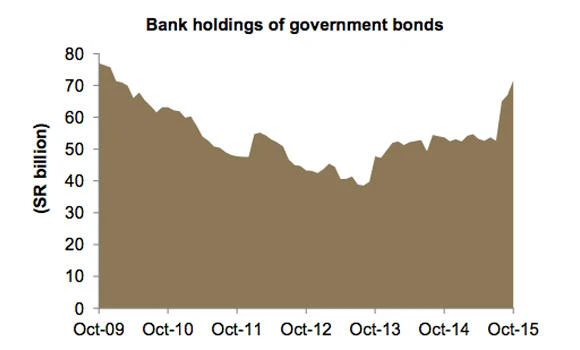
JEDDAH: Bank holdings of Saudi government bonds rose in October by SR4.5 billion, month-on-month, according to the latest edition of the monthly chartbook from Jadwa Investment.
In October, the net monthly change in government accounts with Saudi Arabian Monetary Agency (SAMA) came out positive for the first time in 11 months.
“We think this improvement reflects the lower spending by the government compared to earlier in the year,” said the Jadwa economists.
The net monthly change to government accounts rose by $4.6 billion. The increase was mainly due to a $5.6 billion net monthly addition to current deposits, the December chartbook added.
It said that October data showed a mixed picture for domestic economic activity.
Data on ATM withdrawals and point-of-sales transactions indicate healthy growth in consumer spending. PMI fell to its lowest point on record but continues to show an expanding nonoil sector. Cement production and sales were up both in year-on-year and monthly terms.
ATM withdrawals and point- of-sales transactions were up 5 percent, and 14.8 percent, year-on-year respectively, the monthly report added.
SAMA foreign reserves fell to $644 billion in October. However, the net monthly withdrawals continued to be at a slower rate than the first half of 2015, reflecting the effectiveness of the new financing strategy. Within foreign reserves, bank deposits now constitute 32.4 percent of total reserves in October, rising from 24.6 percent in January.
SAMA foreign reserves fell to $644 billion in October, compared to $651 billion in the previous month. However, the net monthly withdrawals continued to be at a slower rate than the first half of 2015, reflecting the effectiveness of the new financing strategy. Within foreign reserves, bank deposits now constitute 32.4 percent of total reserves in October, rising from 24.6 percent in January.
Growth in bank lending to the private sector slowed to 5.0 percent. The slower year-on-year rise of 5.0 percent was mainly due to a higher base in October 2014, when banks aggressively extended credit to finance subscriptions for National Commercial Bank’s IPO.
In month-on-month terms, bank lending rose by 0.8 percent, while deposits fell by SR51 billion. Negative monthly growth in deposits relative to a positive 0.8 monthly growth in credit pushed up the loan -to-deposit ratio to 83.7, a six-year high.
Total deposits fell by 3.1 percent (SR 51 billion), month-on-month, dragged down by withdrawals from independent government institutions to free up liquidity in order to purchase government bonds.
Inflation continued to edge upwards for the third consecutive month to reach 2.4 percent in October. Housing inflation was again the main force behind this rise as it accelerated to 4.4 percent, its fastest in 18 months. It was pushed up by a record rise in rentals for housing. The core index rose as well, reaching its highest point (2 percent) in 2015, while food inflation slowed to 1.2 percent.
“We think the rise in housing inflation reflects increasing preference in renting over owning properties, as anticipation of further progress in housing initiatives builds up,” said the economists.
In September, the report said that nonoil exports continued to trend downwards due to weaker global demand so far in 2015. Imports continued to post a year-on-year decline in both in value and volume terms as well.
The value of new letters of credit opened by the private sector point to a likely continuation of lower imports in coming months, according to the report.
Economists highlight success of SAMA financing strategy