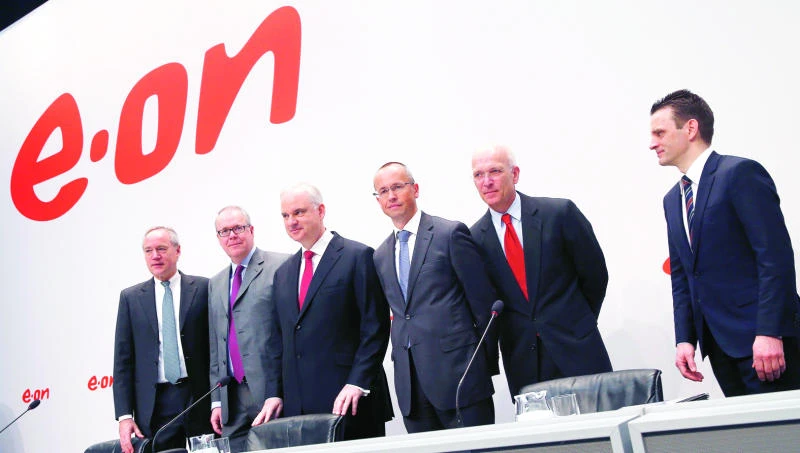
DUESSELDORF: Germany's E.ON suffered its biggest ever annual loss after booking billions of euros in charges on its ailing power plants, clearing the way for it to spin off these assets that are suffering from ultra-low wholesale prices.
"What we plan to do isn't just one of the biggest ever spinoffs in Germany. It's also one of the biggest ever in the energy industry worldwide," Chief Executive Johannes Teyssen said on Wednesday.
Europe's power companies are having to adapt to big changes in their industry caused by a steep decline in oil prices and a surge in renewable energy capacity which has driven many coal
and gas-fired plants out of the market.
In the most drastic corporate response yet to the crisis, E.ON, Germany's biggest utility, announced plans in November to split its business. It will spin off its conventional power generation business to focus on renewables, power grids and services.
Analysts, who have on average a "hold" rating on the stock according to Reuters data, have been divided over the group's move to split in two. Some analysts welcome the separation of the generation business, while others fail to see how this will create value for investors.
"Whether one plus one is more than two as a result of the pending split decision remains unclear until details are published," Equinet analyst Michael Schaefer said.
Shares in the company were up around 1 percent at 1205 GMT, underperforming a 1.6 percent rise in the German bluechip index.
E.ON swung to a net loss of 3.2 billion euros ($3.4 billion) in 2014, compared with a profit of 2.14 billion euros a year earlier, the company said on Wednesday. Analysts had, on average, expected a net loss of 3.3 billion euros.
The loss, the biggest since it was formed by the merger of German power groups VEBA and VIAG in 2000, was triggered by 5.4 billion euros in impairment charges on power plants, including assets in Britain, Sweden and Italy.
The company expects 2015 earnings before interest, tax, depreciation and amortisation (EBITDA) of 7-7.6 billion euros, down from 8.3 billion last year.
Teyssen also blamed currency effects — most notably in Russia, where E.ON makes six percent of its operating profits — and continued low interest rates in Europe for a decline in profits.
Smaller rival RWE on Tuesday also gave a bleak forecast for its business and said profits and investments would fall this year, echoing an outlook from French peer GDF Suez in late February.
E.ON clears path for spin-off after record loss