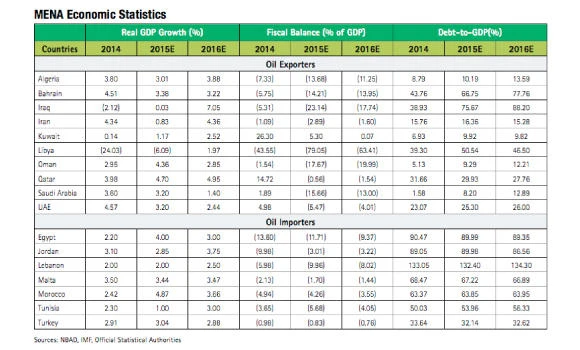
JEDDAH: The MENA region as a whole is expected to have achieved economic growth of 2.7 percent in 2015, with common sense alone suggesting that with much lower oil prices, growth will be lower in the current years, according to National Bank of Abu Dhabi’s Global Investment Outlook 2016.
The report said that Iran’s integration into the global economy and improved growth in oil importing countries is expected to at least partially off-set the impact of the fall in oil prices, however.
NBAD has published its ‘Global Investment Outlook 2016’, entitled ‘Investment Strategies in Today’s Volatile Markets’, that examines the global economic and investment environment, and provides insights that should help investors navigate financial markets profitably during the rest of 2016.
Last year’s report anticipated the difficult year ahead for 2015, describing the investment world as ‘fragile.’
This continues to be the case in 2016, according to this year’s report. Many structural problems remain, and investors are increasingly wary of ‘quick fixes’.
Claude-Henri Chavanon, NBAD’s head of global asset management, said: “The fall in the oil price has complicated investment decisions around the world, and has been described as the ‘New Normal’. It is a significant shift in the global investment landscape that investors have to deal with.”
Chavanon said: “The risks associated with a strong dollar are among those uppermost in our minds, especially insofar as this could exacerbate the reduction in US corporate earnings. However, there are always opportunities arising from a new idea, asset class or company, or due to an existing asset being oversold. Investors will need to exercise patience and then have the courage required to decisively deploy funds when opportunities arise.”
According to the report, oil prices are expected to trade in a range of $25-45 during the remainder of the year.
Investors are advised to continue to fully emphasize quality government and other investment grade bonds in their portfolios, said the report.
While headwinds will persist during 2016, NBAD believes attractive investment opportunities will arise, for instance in selected emerging and frontier markets, and also especially within commodities.
While a bear market in US equities is likely to unfold, this should lead to buying opportunities in other markets, some of which are already very depressed.
Within MENA, for instance, UAE equities could easily be described as being oversold, and cheap in terms of valuation.
The report also said that GCC oil exporters’ decisions to focus on fiscal policy strongly suggest that for the time being they will maintain their currency regimes, despite pressures resulting from them — The GCC currency pegs force governments to follow US monetary decisions, irrespective of whether this is appropriate; because the GCC economies, especially Saudi Arabia, are slowing down, they could be facing monetary tightening at the wrong time — During 2016, the GCC region is expected register an overall fiscal deficit of around 10% of GDP, indicating continued vulnerability unless oil prices rally and/or there are further spending cuts.
Saudi Arabia registered a fiscal deficit of 16 percent of GDP in 2015 (~ $100 billion), and is expected to register a budget deficit of 13 percent of GDP in 2016.
The Saudi riyal is thought to be theoretically overvalued by around 16 percent to 17 percent vs. their main trading partners’ currencies.
On a similar basis, the UAE dirham could be overvalued by more than 25 percent.
The GCC nations are estimated to have had about $3 trillion in net foreign assets at the end of 2014, and during 2015 are thought to have seen depletion of about $210 billion of that total amount.
“We expect that a further $180 billion or so of assets could be depleted in the current year,” said the report.
It added that 2015 turned out to be a challenging year for MENA equity markets.
On the back of persistent declines in oil prices, MENA markets corrected by 17 percent overall.
Oil of course continues to play an important role in the region, despite various steps taken by the GCC oil-producing countries to diversify their economies.
MENA equities looked at collectively are trading at the lower end of their five-year P/E range, and on a relative P/E basis are at close to a 30 percent discount to the MSCI World Index.
Given the heavy weighting of Saudi Arabia in the MENA equity mix, the recent Saudi budget for 2016 was a significant event. It focused on three key factors: improving efficiency of government spending, economic diversification and fiscal consolidation.
The government forecasts that the fiscal deficit will narrow in 2016 to SR326.2 billion ($87 billion), from SR367 billion ($98 billion) in 2015.
In 2016, the fiscal deficit should be financed by domestic and global debt issuance.
The Saudi market is expected to enter the MSCI EM Index in 2017, and this should be positive for regional equities generally.
Looking elsewhere, the well-diversified UAE economy and stock market sectors contained within the Dubai and Abu Dhabi markets offer interesting options to international investors, especially into current market weakness. Banking and real estate remain quite heavily-weighted in UAE equity markets, hence these sectors are important to international investors wishing to put money to work.
The long-awaited verdict regarding the Qatar/FIFA world cup is out and we expect the related infrastructure projects to gather momentum in 2016, supporting economic growth.
Looking ahead across the region, continued government spending on other strategic projects such as EXPO 2020 will drive growth not only up to and during, but also beyond the due date.
Fall in oil price complicates global investment decisions