WASHINGTON: The current head of the Group of 20 wealthy and emerging nations says governments need to do more to jolt the global economy out of the rut it fell into after the 2008 financial crisis.
Turkish Deputy Prime Minister Ali Babacan, who is responsible for his country’s economy, said the worst may be over but recent economic developments are not yet satisfactory.
Speaking in Washington, he said there are bright spots in some countries but growth is weak, imbalanced and uneven.
He said G-20 countries must do more to carry out commitments made last year in Australia to jumpstart growth including investing in infrastructure and boosting trade.
Babacan also said the G-20 needs to involve low income developing countries more in its deliberations.
The Group of 20 leading economies struck a hopeful tone on the outlook for global growth even as officials fretted that Athen’s inability to strike a deal with its lenders could upset Europe’s tentative recovery.
In a draft of a communique, G20 finance ministers and central bankers welcomed brighter economic signs in rich economies, but lamented over weakness in some emerging nations.
“Risks to the global economy are more balanced since we last met,” the draft said.
“Prospects in advanced economies, notably the euro area and Japan, have improved and this could support a stronger global recovery.”
Still, the group of developed and emerging market nations, which represent around 80 percent of global economic output, warned of risks. “There are challenges, including volatility in exchange rates and prolonged low inflation along with negative interest rates, sustained imbalances and geopolitical tensions,” it said.
While Greece was not mentioned by name in the communique, it was clearly on the minds of top officials in Washington for the G20 gathering, and the spring meetings of the International Monetary Fund and World Bank.
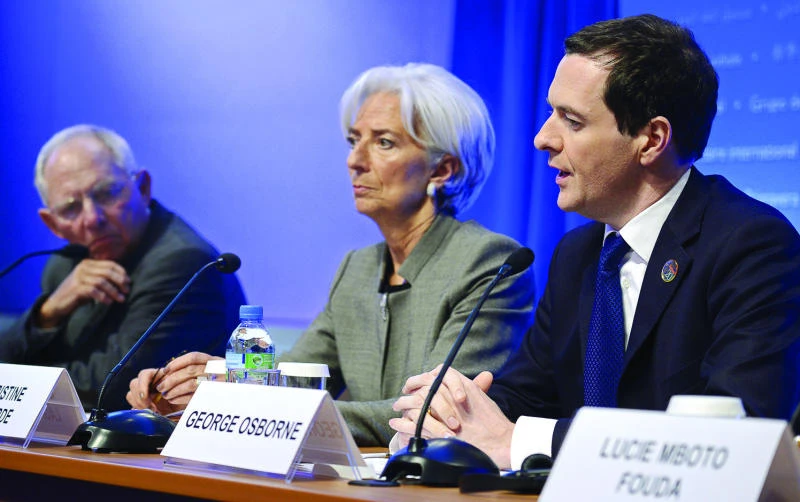
“The mood is notably more gloomy than at the last international gathering,” British finance minister George Osborne told reporters, adding that discussions on Greece “pervaded” every meeting.
“It’s clear now to me that a misstep or a miscalculation on either side could easily return European economies to the kind of perilous situation we saw three to four years ago.”
Athens has been trying to strike a deal with its IMF and EU creditors to ease the bailout terms the lenders imposed. Until a deal is struck, bailout cash is on hold.
Progress in the talks, however, has been painfully slow and Greece could run out of money ahead of debt repayments next month.
“It’s important that we in the coming days make significant progress, that the process gains momentum,” IMF European Department Director Poul Thomsen told reporters.
“There needs to be a comprehensive package and that will clearly take several weeks or more of discussions,” he said.
Concerns about Greece contributed to stock price declines in Europe and on Wall Street.
The G-20, however, sounded guardedly optimistic the global economy was poised for at least a modest recovery.
But it pointed to a heightened risk of financial volatility as the monetary policies of major central banks begin to go their separate ways.
“In an environment of diverging monetary policy settings and rising financial market volatility, policy settings should be carefully calibrated and clearly communicated to minimize negative spillovers,” the draft communique said.
“We will continue to monitor financial market volatility and take necessary actions.”
The language was evidence of concern over potential disruptions as the US Federal Reserve moves toward a rate hike, even as the European Central Bank and Bank of Japan keep the monetary spigots wide open.
The main worry centers on emerging markets, which have been beset by capital outflows as investors placed bets on higher interest rates in the US.
“Those who managed themselves well will probably not suffer very much and those who went totally into short term may well suffer for some while while they adjust,” Fed Vice Chairman Stanley Fischer said.
“We all know the famous Warren Buffet line, that when the water goes out you discover who’s been swimming naked.”
G-20 chief urges more action to drive trade