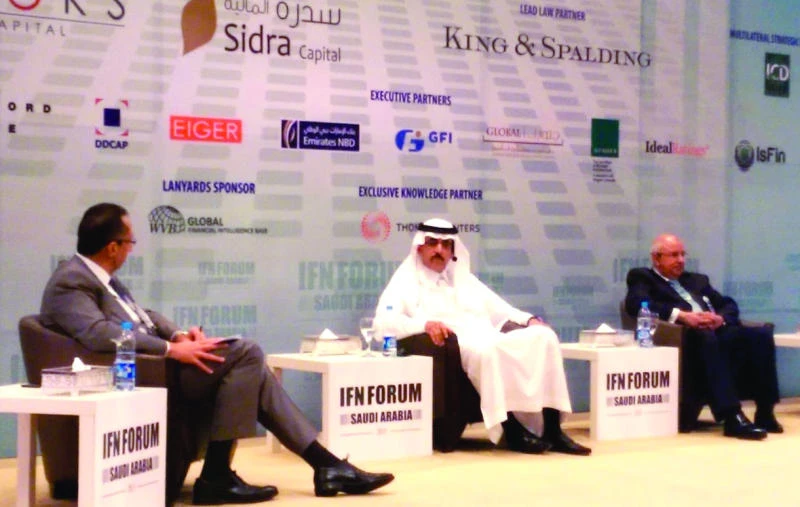
JEDDAH: Islamic Corporation for the Development of the Private Sector (ICD), the private sector arm of the Islamic Development Bank (IDB) Group, attended the Islamic Finance News’ forum in Jeddah recently.
Khaled Al-Aboodi, CEO and general manager of ICD, delivered the keynote address at the IFN forum.
“Today’s forum is a clear example of our collective efforts in the Muslim world to promote Islamic finance and to utilize it as an integrated element of our economic growth and development framework,” said the CEO.
Although MENA in general, and Saudi Arabia in particular, have very good lessons to share, but we are still in need of acquiring more knowledge and experience, which hope it shall materialize after your deliberations in this forum.
Al-Aboodi briefly reviewed the latest global economic situation in the world that have a number of bearings for our region and my country.
Nowadays, the global economic growth remains moderate and uneven. It has been projected by IMF that the global economic growth will stand at 3.1 percent this year, and will slightly accelerate to 3.6 percent in 2016.
Moreover, these growth prospects vary across the main countries and regions of the world.
Although the advanced economies are witnessing some dynamism, the post crisis legacies are still preventing them from acceleration and high growth.
However, there is some evidence of strengthening a modest recovery in the euro area and a return to positive growth in Japan.
While the post crisis recovery of the US economy is entrenched too, the pick-up of economies in advanced countries such as Canada and Norway is hampered by a decline in global commodity prices.
The growth trajectories in emerging and developing markets vary significantly across countries, and in general, the outlook shows more weakening due to low prices of oil and other commodities, as well as the slowdown in China.
Highly volatile financial markets and a sharp appreciation of US dollar further raise the downside risks in these countries.
As far as the Middle East and North Africa (MENA) region is concerned, the economic growth prospects is further hampered by geopolitical tensions and security challenges in some countries.
Moreover, low oil prices are taking a toll on economic activity, including through fiscal adjustments or its expectations, particularly in the oil-exporting countries of the region.
For more than four decades now, Islamic finance has emerged as a nascent industry gaining traction around the world.
It has gained a footprint in mostly Muslim-dominated countries of Asia and Middle East; riped for growth in traditionally non-Muslim countries mainly South America and Europe; and its future markets are in North America, Central Asia and Australia.
Today, the size of Shariah compatible assets stands above $2 trillion, practically a 10-fold increase from a decade ago, and highly outperforming the growth of conventional finance. Going forward, the assets of Islamic finance are projected to reach $3.5 trillion in 2020.
Together with Malaysia, the countries such as Saudi Arabia, UAE, Kuwait and Qatar are leading jurisdictions in global Islamic finance sector.
In the last five years (2008-2013), IDB Group has approved over $4.5 billion worth of project financing to the private sector.
The Islamic Corporation for the Development of the Private Sector (ICD), the private sector arm of IDB Group, accounted for more than half (51 percent) of this amount.
In general, since inception, ICD has substantially expanded its operation across the Islamic world.
With 52 member countries representing more than 1.5 billion population, ICD’s accumulated gross approvals exceeding $3.5 billion allocated to almost 350 projects in various sectors.
The sectoral composition of ICD investments underscores diversity and has been spread over 11 sectors, with the financial sector accounted for the largest share.
ICD recently introduced the concept of development through Islamic finance channels.
The development mandate of ICD calls for activities that benefit the poor and needy people, or in other words, the bottom of pyramid.
Global economic growth remains ‘moderate and uneven’