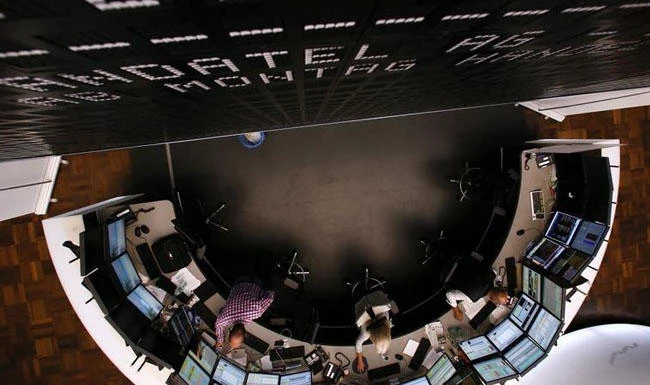
LONDON: World stock markets nosedived for a fourth day running on Tuesday, having seen $4 trillion wiped off from what just eight days ago had been record high values.
Europe’s main bourses were down around 2 percent, leaving investors with little option but to seek traditional refuges such as gold and one of the initial triggers for the sell-off — benchmark government bonds.
Wall Street futures offered a chink of light as they turned higher in Europe but commodities remained gloomy, with oil and industrial metals all tumbling backwards as the year’s upbeat start for markets soured rapidly.
“Playtime is officially over, kids,” analysts at Rabobank said. “Rising volatility painfully reminds some investors that one-way bets don’t exist.”
The stock selloff had been viewed by some as a healthy correction after a rapid rise over the last year but, as it snowballed through Asia and Europe, nerves were starting to fray.
Wall Street’s Dow Jones and S&P 500 benchmarks had slumped 4.6 percent and 4.1 percent on Monday, their biggest drops since August 2011. It was also the Dow’s biggest fall on a pure points basis of all-time and put it in the red for 2018.
Europe’s drop sent the region’s STOXX 600 to its lowest level in six months. There was intense trading activity, with almost 90 percent of the average daily volume traded on Germany’s DAX and Europe’s STOXX 50 by 1030 GMT, just 2-1/2 hours into the session.
The euro STOXX volatility index, Europe’s main market ‘fear-gauge’, saw its biggest spike since the September 11 attacks on the US in 2001.
“Price action is clearly driven by technical factors, tied to a brutal awakening of stock volatility,” said Alessandro Balsotti, head of asset management at JCI Capital. “We are undoubtedly in uncharted waters.”
“Since last autumn, investors had been betting on the ‘Goldilocks’ economy — solid economic expansion, improving corporate earnings and stable inflation. But the tide seems to have changed,” said Norihiro Fujito, senior investment strategist at Mitsubishi UFJ Morgan Stanley Securities.
MSCI’s broadest index of Asia-Pacific shares outside Japan slid 3.4 percent. Taiwan’s main index lost 5.0 percent, its biggest slump since 2011, and Hong Kong’s Hang Seng Index dropped 4.2 percent.
Japan’s Nikkei dived 4.7 percent, its worst fall since November 2016, to four-month lows.
The original trigger for the sell-off was a sharp rise in US bond yields late last week after data showed US wages increasing at the fastest pace since 2009. That raised the alarm about higher inflation and, with it, potentially higher interest rates.
That could be painful for markets that have been propped up by central banks’ stimulus for many years.
The 10-year US Treasuries yield rose to as high as 2.885 percent on Monday, its highest in four years.
But a massive fall in share prices prompted an about-turn, which sent it as far back as 2.662 percent. German Bunds, Europe’s equivalent benchmark, then fell 6 basis points in morning trading, their biggest drop in over two months.
“Ten-year treasuries at four-year highs — does this herald the start of a bond bear market? Or are we simply returning to a more ‘normal’ cycle of higher yields and higher interest rates?” said Graham Bishop, Investment Director at Heartwood Investment Management.
Europe’s main bourses were down around 2 percent, leaving investors with little option but to seek traditional refuges such as gold and one of the initial triggers for the sell-off — benchmark government bonds.
Wall Street futures offered a chink of light as they turned higher in Europe but commodities remained gloomy, with oil and industrial metals all tumbling backwards as the year’s upbeat start for markets soured rapidly.
“Playtime is officially over, kids,” analysts at Rabobank said. “Rising volatility painfully reminds some investors that one-way bets don’t exist.”
The stock selloff had been viewed by some as a healthy correction after a rapid rise over the last year but, as it snowballed through Asia and Europe, nerves were starting to fray.
Wall Street’s Dow Jones and S&P 500 benchmarks had slumped 4.6 percent and 4.1 percent on Monday, their biggest drops since August 2011. It was also the Dow’s biggest fall on a pure points basis of all-time and put it in the red for 2018.
Europe’s drop sent the region’s STOXX 600 to its lowest level in six months. There was intense trading activity, with almost 90 percent of the average daily volume traded on Germany’s DAX and Europe’s STOXX 50 by 1030 GMT, just 2-1/2 hours into the session.
The euro STOXX volatility index, Europe’s main market ‘fear-gauge’, saw its biggest spike since the September 11 attacks on the US in 2001.
“Price action is clearly driven by technical factors, tied to a brutal awakening of stock volatility,” said Alessandro Balsotti, head of asset management at JCI Capital. “We are undoubtedly in uncharted waters.”
“Since last autumn, investors had been betting on the ‘Goldilocks’ economy — solid economic expansion, improving corporate earnings and stable inflation. But the tide seems to have changed,” said Norihiro Fujito, senior investment strategist at Mitsubishi UFJ Morgan Stanley Securities.
MSCI’s broadest index of Asia-Pacific shares outside Japan slid 3.4 percent. Taiwan’s main index lost 5.0 percent, its biggest slump since 2011, and Hong Kong’s Hang Seng Index dropped 4.2 percent.
Japan’s Nikkei dived 4.7 percent, its worst fall since November 2016, to four-month lows.
The original trigger for the sell-off was a sharp rise in US bond yields late last week after data showed US wages increasing at the fastest pace since 2009. That raised the alarm about higher inflation and, with it, potentially higher interest rates.
That could be painful for markets that have been propped up by central banks’ stimulus for many years.
The 10-year US Treasuries yield rose to as high as 2.885 percent on Monday, its highest in four years.
But a massive fall in share prices prompted an about-turn, which sent it as far back as 2.662 percent. German Bunds, Europe’s equivalent benchmark, then fell 6 basis points in morning trading, their biggest drop in over two months.
“Ten-year treasuries at four-year highs — does this herald the start of a bond bear market? Or are we simply returning to a more ‘normal’ cycle of higher yields and higher interest rates?” said Graham Bishop, Investment Director at Heartwood Investment Management.